
Hiring Filipino Staff Directly: The Legal Risks, Explained Honestly
Is engaging someone in the Philippines a legal risk for an Australian business? A plain-English look at contractor vs employee rules in both countries, which risks are real, and what a managed contractor model does and doesn't change.
If you spend any time in Australian small business forums, Facebook groups or on Reddit, one question comes up again and again: "If I hire someone in the Philippines directly, am I breaking any rules?"
It's usually asked by a business owner who has done the maths. A great bookkeeper, developer, designer or customer support lead in Manila or Cebu costs a fraction of a local hire, and the talent is genuinely good. Then the doubts creep in. What happens with tax? Do I owe super? Is this "sham contracting"? If it goes wrong, who can take me where?
Most answers online are either a breezy "it's fine, everyone does it" or a wall of legal jargon. Neither helps you decide anything. So here's our attempt at the useful middle ground: how Australian and Philippine rules look at these arrangements, which risks are real and which are mostly noise, a self-check you can run on your own setup, and an honest look at what working through a provider like us changes and what it doesn't.
Quick answer: Engaging someone in the Philippines is legal and very common. Most offshore team members work as independent contractors. The real risks for an Australian business usually aren't a court case in Manila. They're owning the work your contractor produces, protecting your customers' data, keeping things running when someone leaves, and making sure the arrangement genuinely looks like contracting if anyone ever asks. A good managed provider reduces those risks with proper contracts, vetting and support. It doesn't make them disappear.
Why this question keeps coming up
Offshore hiring used to belong to big call centres and global corporates with in-house lawyers. Today a five-person accounting practice in Parramatta or a SaaS startup in Brisbane can find a candidate on a job board, interview them on Zoom on Tuesday and have them working on Monday. Starting is easy. Setting it up properly takes a bit more thought, and that gap is where most of the anxiety lives.
A few things have made owners more nervous lately:
- Australia's 2024 change to the definition of employee. From 26 August 2024, the Fair Work Act looks at the real substance and practical reality of a working relationship, not only the written contract. The Fair Work Ombudsman explains it on its independent contractors and employees page. That test applies for Fair Work Act purposes. For tax and super, the courts still give the written contract a lot of weight, following the High Court's 2022 decisions in Personnel Contracting and Jamsek.
- Underpayment stories in the news. Owners see local back-payment cases and wonder whether the same thing could happen with someone overseas.
- Privacy reform. Since 1 July 2026, accountants, lawyers, conveyancers and real estate businesses caught by the AML/CTF "Tranche 2" reforms have Privacy Act obligations for information they handle for AML purposes, even under $3 million turnover. The government released draft legislation in August 2026 that revisits the small business exemption more broadly. If your offshore team touches client data, that's now a live question.
Employee or contractor? The question behind everything
Almost every legal question in this topic comes back to one thing: is the person really an independent contractor, or is the relationship employment in practice?
How Australia looks at it
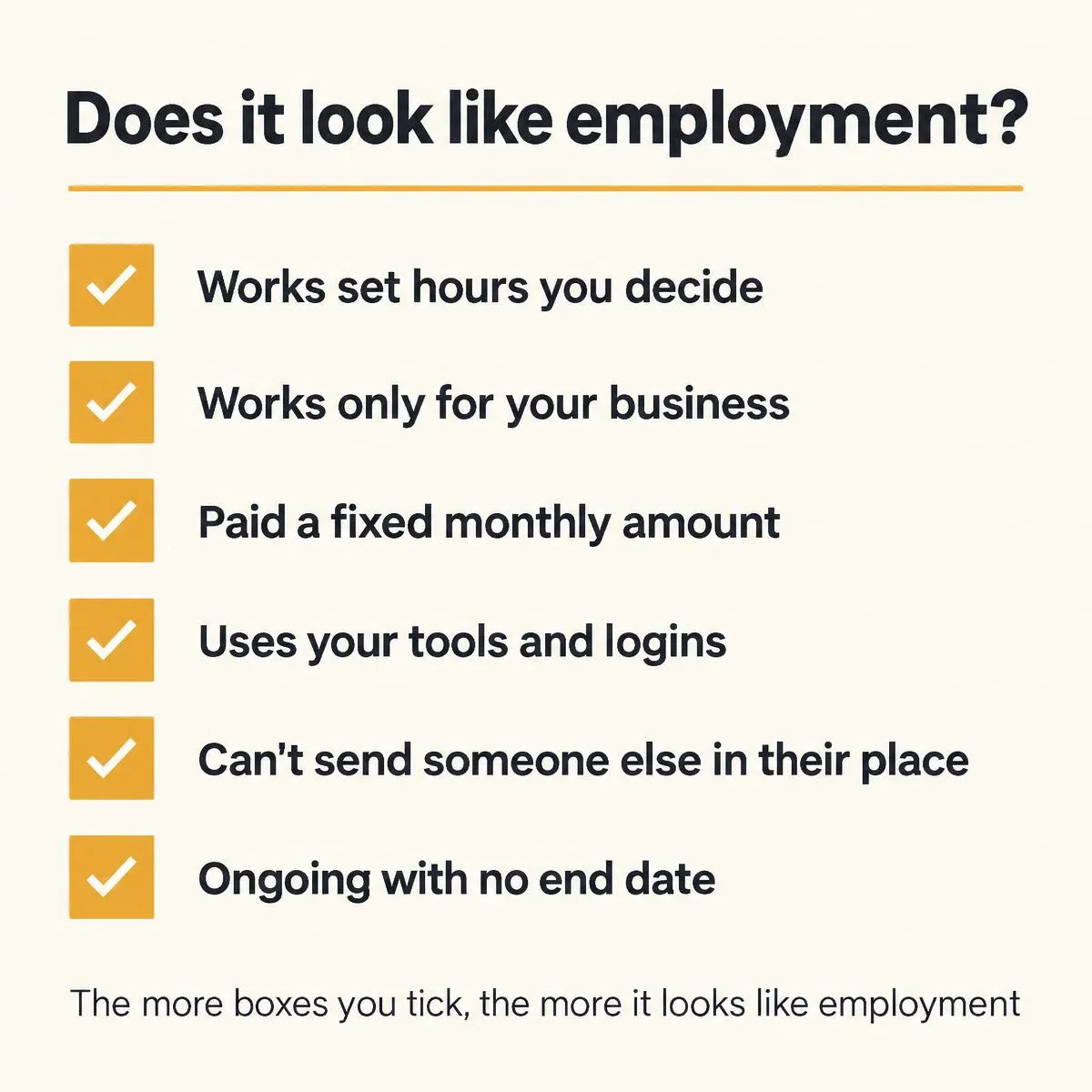
For Fair Work purposes, regulators and courts weigh up the whole relationship. The Australian Taxation Office has a practical guide, Employee or contractor, plus a decision tool. Things that tend to point towards employment include:
- You control how, when and where the work is done
- The person works only, or mainly, for you
- They're paid for their time with no real commercial risk
- They can't send someone else to do the work
- You supply all the tools and equipment
- The arrangement is open-ended
The Fair Work Ombudsman also has a clear page on sham contracting.
Here's the part most forum threads skip, though. The Fair Work Act generally doesn't reach someone who lives and works entirely in the Philippines and was never an Australian-based employee. For most offshore arrangements, Australian employment law isn't where the exposure sits.
How the Philippines looks at it
Philippine labour authorities and courts commonly apply the "four-fold test": who selected and engaged the worker, who pays them, who can dismiss them and, above all, who has the power to control how the work is done. They also look at economic dependence: does the person rely on this one engagement for their living?
A contract that says "contractor" helps, but it doesn't decide the question on its own. And choosing Australian or Singapore law in the contract doesn't switch off Philippine labour protections for someone working in the Philippines.
The uncomfortable truth
Plenty of offshore arrangements tick several of those boxes, whether they're set up directly or through a provider. A full-time person working with one company, paid monthly, using that company's systems, with no end date, will always carry some reclassification risk. Anyone who tells you a particular structure makes that risk vanish is overselling.
What you can control is how the arrangement is set up and run: a properly drafted contractor agreement, real flexibility in how the work is done, the freedom to take on other work, no direct disciplinary-style control, and clear ownership of everything they produce.
What realistically goes wrong with a direct arrangement
Let's be practical about where the pain actually comes from, roughly in order of how often we see it.
1. You don't own what you think you own
Under many legal systems, an employee's work belongs to the employer by default, but a contractor's work often stays with the contractor unless the contract clearly assigns it. If you engaged someone on a downloaded template, or on nothing at all, you may not own the code, designs, content or processes they built. That tends to surface at the worst moment, like due diligence when you're raising money or selling.
2. Data and privacy
If your offshore team member handles customer information and your business is covered by the Privacy Act, the Australian Privacy Principles apply, including APP 8 on disclosing personal information overseas. Many smaller businesses sit under the $3 million small business exemption for now, but accounting and other Tranche 2 practices may already be covered for some activities. Your own client contracts may also restrict offshore access. None of this stops you working offshore. It means access, devices and policies need some thought.
3. Continuity
The day-to-day risks often hurt most:
- Your only developer stops replying and there's nobody to call
- A laptop with client data is lost or stolen
- Payment transfers fail, fees creep up, or exchange rates bite
- Someone resigns with a day's notice and takes the knowledge with them
4. Reclassification
If a Philippine tribunal decided your contractor was really your employee, entitlements like 13th month pay, social security contributions, service incentive leave and security of tenure could come into play. The National Labor Relations Commission handles these disputes.
Two honest points here. First, enforcing a Philippine claim against an Australian business with no Philippine presence or assets is genuinely uncertain, so for most small businesses this is a lower-probability risk than people fear. Second, an Australian company with no Philippine entity can't realistically run Philippine payroll anyway: registering as an SSS employer, withholding through the BIR and remitting PhilHealth and Pag-IBIG all need local infrastructure. That's one reason most offshore engagements are structured as contracting in the first place.
A myth worth clearing up while we're here: night shift differential in the Philippines applies between 10pm and 6am. Australian business hours fall in the Philippine daytime (Perth hours line up exactly with Manila), which is one reason the Philippines suits Australian businesses so well.
5. Super and tax
Superannuation guarantee generally doesn't apply to payments to a non-resident for work done entirely outside Australia, so for a Filipino contractor working from home in the Philippines the usual answer is no. On the Philippine side, a contractor is responsible for registering and paying their own tax with the Bureau of Internal Revenue. Edge cases exist, like someone who is an Australian resident or spends time working here, so check your own facts with your accountant.
What a managed contractor model changes
When you work with Sprint Labs, here's how it's structured, plainly:
- Your contract is with a business. You sign a Master Services Agreement and a Work Order with Sprint Labs Pte. Ltd., a Singapore company. You don't contract with an individual overseas, and you pay one monthly invoice.
- We engage your team member as an independent contractor. They sign a contractor agreement with us, invoice us monthly through our portal, and are responsible for their own tax and registrations. We don't employ them, and we don't pay 13th month pay, social security or statutory leave.
- We set up the contracting side properly. The agreement covers committed availability instead of fixed hours, the contractor's right to take on other work and propose a substitute, confidentiality, data security, and a clear non-availability allowance.
- The work belongs to you. Our contractors assign their work to us as it's created, and our MSA assigns everything created specifically for you to you, from creation, regardless of invoice status.
- You direct the work. We handle the engagement. You set tasks, priorities and outcomes. Fees, time off, performance concerns, replacement and ending an engagement all run through us.
- Continuity. We recruit and vet, you interview and choose, and if someone leaves we find a replacement.

Direct engagement vs a managed contractor model
| Question | Direct engagement | Managed contractor model with Sprint Labs |
|---|---|---|
| Who do you contract with? | An individual overseas | Sprint Labs Pte. Ltd., under an MSA and Work Order |
| How is the team member engaged? | However you set it up, often on a template | As an independent contractor under a purpose-built agreement |
| Who owns the work product? | Depends entirely on your contract drafting | Assigned to you from creation under the MSA |
| Who handles payments and FX? | You | Sprint Labs. You pay one monthly invoice |
| Time off and engagement issues | You manage them directly | Handled by Sprint Labs, with you kept informed |
| Who vets candidates? | You | We recruit, screen and shortlist; you choose |
| If the person leaves? | You start from scratch | We find a replacement |
| Reclassification risk | Sits with you | Reduced by structure and practice, not removed |
What this model doesn't do
We'd rather be straight with you than oversell:
- It isn't a legal shield. A full-time, long-term offshore arrangement can carry some reclassification risk under Philippine law however it's structured. Good contracts and good practice reduce it.
- How you work together matters. The structure holds up best when it's respected in practice. Don't pay team members on the side, offer them direct contracts, or discipline them directly. Route those things through us.
- Your own obligations still apply. Privacy, data security and any offshore restrictions in your own client contracts are yours to check. We can help with practical controls.
- It isn't legal advice. If you're in a regulated industry, run the arrangement past your own adviser. We're happy to share our documents.
Run your own five-minute check
If you already engage someone overseas directly, ask yourself:
- Do you have a written contract that clearly assigns IP to your business?
- Does it cover confidentiality and how your customers' data is handled?
- Do they decide how to do the work, or do you control every step?
- Are they free to take on other work, and could they send a qualified substitute?
- Do you know what happens if they leave tomorrow, or if you end the arrangement?
- If you're covered by the Privacy Act, have you thought about APP 8 and your client contracts?
If you answered "no" to the first two, fix those first. They're the cheapest problems to solve and the most expensive to discover late.
If you've already engaged someone directly
Don't panic. Thousands of Australian businesses run direct arrangements, and most never have a problem. A few sensible steps:
- Fix the paperwork. At a minimum, get IP assignment, confidentiality and governing law properly covered.
- Get advice on your specific setup if the person is core to your business.
- Move them into a managed arrangement. We can often bring someone you already work with onto our contractor agreement, so the working relationship stays the same and the contracting, invoicing and support move to us. Anything owed under your previous arrangement stays between you and them, so it's worth tidying that up as part of the move.
Frequently asked questions
Is it illegal for an Australian business to engage someone in the Philippines?
No. It's legal and very common. The questions are about how the arrangement is structured and run.
Do I have to pay super for a contractor in the Philippines?
Generally no, where they're a non-resident working entirely outside Australia. Check with your accountant if the person is an Australian resident or works here at any point.
Does Sprint Labs employ the people it places?
No. Our team members are independent contractors engaged by Sprint Labs. They invoice us monthly and look after their own tax and registrations. You contract with Sprint Labs, not with the individual.
Do they work our hours?
Each placement has a committed availability window that overlaps your business day, set out in your Work Order. Australian business hours fall in the Philippine daytime, so overlap is easy.
What about time off?
Contractors have a non-availability allowance built into their fee. They notify us in advance and we let you know. Your monthly charge doesn't change for time off within the allowance.
What happens if it doesn't work out?
Tell us. We'll work on it with the contractor, and if it's still not right we'll propose a replacement. You can end a placement on the notice period in your Work Order.
The bottom line
The worry you see on Reddit is fair, but it's usually aimed at the wrong risk. For most Australian businesses, the things that actually bite are IP you don't own, client data handled loosely, and no plan for when someone leaves. Reclassification risk is real but often overstated, and no structure removes it entirely.
A managed contractor model puts a proper business contract between you and your team, gets the paperwork right, and gives you someone to call. If you'd like to see how it would work for your business, see how it works, browse the roles you can hire, or book a call. We'll give you a straight answer about your situation.
This article is general information only and isn't legal, tax or financial advice. Laws change and every situation is different. Speak to a qualified Australian and, where relevant, Philippine adviser about your own circumstances. External links are provided for reference; Sprint Labs isn't responsible for third-party content.
Hiring in Asia? We'll do it for you.
Sprint Labs is a managed staffing firm. We recruit, vet, place and manage senior professionals across the Philippines, Vietnam, Malaysia, Indonesia and India. You direct the work, we handle the engagement.
Create a request →