
Hire an Offshore Accounting Team: A 2026 Buyer’s Guide
Plan to hire offshore accounting team support in 2026? Learn how to evaluate models, establish data controls, and scale recurring finance tasks effectively.
An offshore accounting hire can clear a backlog, but a poorly defined setup can create a new problem: unclear ownership of work and sensitive financial data. If you’re looking to hire offshore accounting team support, start with the work that needs doing and the controls it requires, not the location alone.
It makes sense to add capacity without adding another layer of management. The key is knowing what you’re hiring for. Dedicated accounting staff can handle defined, recurring tasks under your direction. A managed delivery model may assign responsibility differently. Neither should be treated as CFO-level strategy unless that scope is explicitly agreed.
This 2026 buyer’s guide will help you match tasks to suitable roles and compare engagement models by accountability, oversight, and workload. It also covers practical questions about financial-data access, review procedures, and communication to resolve before you commit. You’ll come away with a clearer picture of what a provider should handle, what stays under your control, and how to build an offshore accounting setup around your actual needs.
Key Takeaways
- Map recurring tasks, deadlines, and capacity gaps before choosing roles, so the hire addresses a defined workload.
- If you plan to hire offshore accounting team members, compare who directs daily work, manages delivery, and handles engagement administration.
- Set access permissions, approval boundaries, review steps, and escalation routes before sharing financial data.
- Write a role brief that specifies relevant systems experience, communication overlap, reporting lines, and review expectations.
- Sprint Labs’ finance and accounting officers can support defined recurring work under your direction. They aren’t a substitute for virtual CFO services or independent finance strategy.
Table of Contents
- Before you hire an offshore accounting team, define the work and outcome
- Choose the offshore accounting team model that matches your workload
- Evaluate security, accuracy, and oversight before you hire offshore accountants
- Use a structured hiring and onboarding process for an offshore accounting team
- Decide whether Sprint Labs’ managed accounting staffing fits your next step
Before you hire an offshore accounting team, define the work and outcome
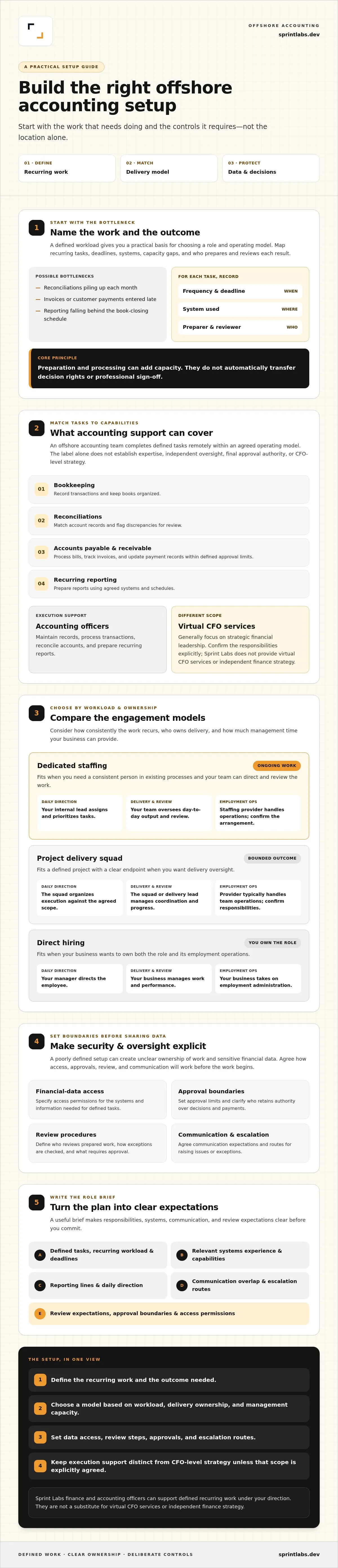
Start with the bottleneck, not the job title. Are reconciliations piling up each month? Are invoices or customer payments being entered late? Is reporting falling behind because your current team lacks time to close the books on schedule? Naming the recurring work and the outcome you need gives you a practical basis for choosing a role and operating model.
An offshore accounting team is made up of finance professionals who work remotely within an agreed operating model to complete defined accounting tasks. The term describes where and how work is performed. It doesn’t establish a particular level of expertise, independent oversight, final approval authority, or CFO-level strategy. For context, offshoring refers broadly to moving business activities to another country.
Which accounting tasks can an offshore team support?
Build the scope around your actual workflow. For each task, note how often it occurs, which system it uses, who prepares it, and who reviews the result. For example, a team member might prepare reconciliations or process invoices while an internal manager reviews exceptions and approves payments. Preparation and processing can add capacity, but they don’t automatically transfer decision rights or professional sign-off.
- Bookkeeping: Record transactions and keep books organized.
- Reconciliations: Match account records and flag discrepancies for review.
- Accounts payable and receivable: Process bills, track invoices, and update payment records within defined approval limits.
- Reporting: Prepare recurring reports using agreed systems and schedules.
Before you hire offshore accounting team members, confirm the tasks, software experience, and capabilities required for the specific role. Don’t assume a provider’s general accounting offering covers every workflow your business uses.
Do you need accounting capacity or a virtual CFO?
These address different needs. Accounting officers typically support execution: maintaining records, processing transactions, reconciling accounts, and preparing recurring reports. Virtual CFO services generally focus on strategic financial leadership, but the scope varies by provider. Confirm responsibilities rather than relying on the label.
If the gap is unfinished operational work, define the tasks, deadlines, review process, and approvals a staff member will support. If you need someone to lead financial planning or make strategic decisions, establish that requirement separately and confirm the provider explicitly offers it. Sprint Labs provides finance and accounting officers for client-directed work, not virtual CFO services or independent finance strategy. Clear boundaries help you hire for the work you need without expecting execution support to become executive leadership.
Choose the offshore accounting team model that matches your workload
The right model depends on more than location. Consider how consistently the work recurs, who owns delivery, and how much management time your business can provide. A monthly close usually calls for a different setup than a defined project with a clear endpoint.
| Model | Who directs daily work? | Who manages delivery? | Who handles engagement administration? |
|---|---|---|---|
| Dedicated staffing | Your internal lead assigns and prioritizes tasks. | Your team oversees day-to-day output and review. | The staffing provider handles contractor engagement; confirm the arrangement. |
| Project delivery squad | The squad organizes execution against the agreed scope. | The squad or its delivery lead manages coordination and progress. | The provider typically handles the team’s engagement administration; confirm responsibilities. |
| Direct hiring | Your manager directs the team member. | Your business manages the work and performance. | Your business takes on employment administration. |
Decision rule: Choose dedicated staffing when work is ongoing, you need a consistent person in existing processes, and your team can direct and review the work. Choose a delivery squad for a bounded outcome when you want delivery oversight. Hire directly when you want to own both the role and its employment operations.
When does dedicated accounting staffing fit best?
Dedicated staffing suits recurring work that depends on familiarity with your systems and handoffs. Your team sets priorities, assigns tasks, and reviews output. Sprint Labs recruits, vets, places, and manages independent finance and accounting professionals under a managed contractor model, and handles contractor agreements, fees and payments, time off, performance concerns, replacement, offboarding, and managed devices where a client needs one. Your team still needs a clear task owner, an onboarding plan, and a review process. The model adds capacity, not automatic management of accounting decisions.
When should you consider a project delivery squad instead?
A squad may suit a defined function or outcome that needs coordinated delivery oversight, rather than one person embedded in recurring tasks. Agree on scope, ownership, communication, and how you’ll assess completion before work starts. A squad isn’t a default replacement for every ongoing accounting role. For more on how managed staffing operates, see the managed offshore staffing operating model.
Whichever model you choose, outsourcing doesn’t remove the need to define oversight and responsibility. The professional liability risks of outsourcing are a useful reminder to assess provider competence and safeguards as part of your decision. If dedicated, client-directed staffing may suit your workload, review Sprint Labs’ finance and accounting staffing and clarify the proposed role’s scope and operating responsibilities.
Evaluate security, accuracy, and oversight before you hire offshore accountants
Financial access should reflect the work, not just the job title. Before onboarding, map the records and systems the role needs, the actions the person can take, and who reviews the results. Apply least-privilege access and role-based permissions where your systems and policies allow. For example, someone preparing reconciliations may not need authority to approve payments or change supplier banking details.
Agree on access controls and review ownership before onboarding, not after the first close.
Use due diligence to understand both the provider’s operating practices and the controls your team will retain. Ask how contractor engagement, confidentiality, devices, and account management are handled. Get specific answers, then check that they align with your internal policies. Don’t rely on general assurances or assume a particular security certification, regulatory status, or guarantee.
How should you protect financial data?
Ask direct questions and document the agreed process before granting access:
- Access provisioning: Who requests, approves, and creates each account? Can access be limited by role and task?
- Authentication and devices: Is multifactor authentication available for the systems involved? What device policies apply, and who manages equipment?
- Information handling: How are sensitive records shared, stored, and retained? Which channels are approved for files and routine communication?
- Access removal: Who disables accounts when a role changes or ends, and how is removal confirmed?
- Incident escalation: Who should be contacted if data goes to the wrong recipient, an account appears compromised, or an unusual transaction is spotted?
Check the answers against your systems and policies. If a control depends on a tool or process your business doesn’t use, agree on a workable alternative before work begins.
How do you maintain accounting quality and control?
Assign a named internal reviewer for reconciliations, journal entries, and reporting outputs. Document how work is prepared, what evidence is retained, which transactions require approval, and how exceptions are escalated. Set approval thresholds and a close calendar so the accounting officer knows when to submit work and the reviewer knows when to respond.
Set service expectations that fit the work, such as submission dates, required supporting documents, and how unresolved discrepancies should be reported. Agree on a review cadence, such as checking outputs during each close cycle and revisiting the process when the scope or systems change. This creates a feedback loop without confusing preparation with final approval.
As you prepare to hire offshore accounting team support, include the control plan in the role brief and onboarding checklist. Clear access boundaries, review ownership, communication routes, and escalation steps give both sides a practical standard to follow.
Use a structured hiring and onboarding process for an offshore accounting team
A defined process makes it easier to compare candidates and identify gaps before they affect a close or reporting deadline. Use these steps to turn workload needs into a role you can manage and review:
- 1. Map the workload. List recurring tasks, volumes, deadlines, systems, and current handoffs. Note where work stalls and what a completed task should include.
- 2. Write the role brief. Specify accounting tasks, required systems experience, communication overlap, reporting lines, and who can approve transactions or entries. Separate preparation from review and sign-off.
- 3. Vet for the actual work. Assess relevant accounting experience, tool familiarity, written communication, and attention to detail. Ask who conducts vetting and what role-specific evidence the provider can share.
- 4. Plan onboarding and access. Document procedures, recurring deadlines, reviewers, escalation contacts, and the access needed for each task before work starts.
- 5. Review and adjust. Track accuracy, turnaround, completion, and rework. Use regular check-ins to address friction and update the scope as the role becomes established.
Hiring timelines depend on the role and scope. Ask the provider for its current estimate for your requirements, and confirm the expected steps and timing before planning around a start date. For questions to assess provider fit, use this offshore staffing partner selection guide.
What should you verify during interviews and vetting?
Use practical work samples based on anonymized workflows, not sensitive live company records. For example, ask a candidate to identify discrepancies in a fictional reconciliation or explain how they would organize supporting documents. Assess the reasoning and written explanation, not just the final result. Confirm the accounting tasks and systems experience available for the specific role, and ask the provider how its vetting process evaluates those capabilities.
What belongs in the first month of onboarding?
Start with controlled tasks and limited permissions. Give the new team member documented procedures, a close calendar, named reviewers, reporting lines, and clear escalation contacts. Review early outputs before expanding access or approval authority. Schedule regular check-ins and track accuracy, turnaround, completion, and rework against expectations agreed in advance. Use review notes to clarify instructions and improve handoffs instead of letting informal workarounds become the process.
Ready to scope a client-directed finance and accounting role? Discuss your accounting staffing requirements with Sprint Labs, including the tasks, systems, and oversight your setup needs.
Decide whether Sprint Labs’ managed accounting staffing fits your next step
Sprint Labs’ managed staffing may suit your business if you have recurring accounting work, a named internal reviewer, and a manager who can direct daily tasks. The model adds dedicated finance and accounting capacity while your team retains responsibility for priorities, approvals, and review.
Sprint Labs recruits, vets, places, and manages independent finance and accounting professionals under a managed contractor model. Its staffing operations include contractor agreements, fees and payments, time off, performance concerns, replacement, offboarding, and managed devices where a client needs one. Before you hire offshore accounting team members, confirm the proposed role’s tasks, systems experience, reporting line, and division of responsibilities. Compare the full scope and provider responsibilities before weighing any claims about speed or savings.
Is managed offshore accounting staffing right for your business?
Consider this model for ongoing execution work, such as recurring bookkeeping, reconciliations, or reporting, when internal ownership and review are clearly assigned. Reconsider if you need local on-site staff or standalone strategic CFO leadership. Sprint Labs provides staffing support, not virtual CFO services or independent finance strategy. The fit depends on the work and your capacity to manage it, not simply on the offshore label.
Be explicit about what stays with your business. Your manager sets priorities and directs the professional’s day-to-day work; your internal reviewer checks output and handles approvals according to your process. Confirm how the provider’s contractor engagement and operating responsibilities fit those arrangements. Clear boundaries help prevent you from expecting a staffing provider to own decisions or outcomes that remain with your team.
What should you prepare before speaking with a provider?
Bring a practical role brief, not just a job title. List recurring tasks, current bottlenecks, accounting systems, required access, and reporting deadlines. Define success measures, manager availability, communication expectations, and who reviews or approves each type of work. This lets you discuss the actual operating model and check whether the proposed role’s capabilities can be confirmed.
Use this checklist to make the conversation specific:
- Workload: Which tasks repeat, and when are they due?
- Systems and access: Which tools must the role use, and what permissions are necessary?
- Ownership: Who assigns work, reviews results, approves transactions, and handles exceptions?
- Communication: What overlap and check-in rhythm will help work move without delays?
- Provider scope: Which recruitment, vetting, contractor agreements, fees and payments, management support, managed devices where needed, and replacement support are included?
If recurring work, internal review, and day-to-day direction are in place, discuss managed finance and accounting staffing with Sprint Labs and clarify the proposed role’s scope before deciding whether it fits.
Turn your accounting backlog into a defined operating plan
The right offshore setup starts with the work, not the label. Match recurring tasks to a dedicated role, or choose a delivery model suited to a bounded outcome. Before onboarding, establish who directs the work, who reviews it, and what access the role needs.
If you’re ready to hire offshore accounting team capacity, define the responsibilities and controls first. Sprint Labs recruits, vets, places, and manages dedicated independent finance and accounting professionals under a managed contractor model, while handling contractor agreements, fees and payments, time off, performance concerns, replacement, offboarding, and managed devices where a client needs one. Clients direct contractors’ day-to-day work, so internal ownership and review remain essential.
Before committing, confirm the role’s task and systems fit, clarify provider responsibilities, and verify any hiring timeline or savings claim against your specific requirements. A clear scope makes the next step easier to assess and helps prevent execution support from being mistaken for CFO-level strategy.
Discuss your finance and accounting staffing needs with Sprint Labs and explore whether the model fits your workload. With the right role, boundaries, and review process in place, you can add capacity with greater confidence.
Frequently Asked Questions
What does an offshore accounting team do?
An offshore accounting team can support defined finance operations, depending on the people hired and the agreed scope. Tasks may include bookkeeping, reconciliations, accounts payable, accounts receivable, and reporting. Before work starts, decide who owns each task, which systems the team can access, who reviews completed work, and who approves transactions. “Offshore” describes where the team works; it doesn’t automatically establish its qualifications, decision-making authority, or responsibility for final sign-off.
How do I hire an offshore accounting team?
Start by listing recurring tasks, required systems experience, deadlines, and review responsibilities. Then decide whether you need dedicated staff for ongoing work or a delivery model for a defined outcome. If you plan to hire offshore accounting team members, assess role-specific skills and ask about the provider’s contractor engagement and security processes. Before onboarding, document access permissions, procedures, communication expectations, reporting lines, and how you’ll review performance.
Is an offshore accountant the same as a virtual CFO?
No. An offshore accountant typically supports defined accounting operations, while virtual CFO services generally focus on strategic financial leadership and planning. Scope varies, so confirm responsibilities and relevant qualifications directly with a provider. Sprint Labs offers finance and accounting officers for client-directed work. Don’t assume staffing support includes virtual CFO advisory, independent financial strategy, or executive decision-making. Match the role to the work you need done.
How do I assess data security when hiring offshore accountants?
Ask how access is granted, limited, reviewed, and removed, and how devices and financial records are handled. Confirm whether multifactor authentication, confidentiality terms, and approval workflows fit your policies. Ask who receives incident reports and how concerns are escalated. Request evidence for any claimed certification or compliance status, and assess it against your own requirements. A general assurance isn’t a substitute for specific answers about the provider’s processes and your systems.
Should I hire a dedicated accounting professional or outsource a project?
Dedicated staffing can suit continuous work that needs a consistent person embedded in your processes, with your team directing daily tasks. A project delivery model may suit a defined outcome with delivery oversight. Compare how continuous the work is, who owns delivery, and whether your managers have capacity to direct and review tasks. Ask the provider to explain who manages the work, who handles contractor engagement, and which responsibilities stay with your business.
How quickly can I hire an offshore accounting professional?
Hiring time depends on the role, candidate availability, vetting, and onboarding requirements. Sprint Labs states a general estimate of two to four weeks, but confirm whether it applies to the specific accounting role and scope you need. Allow time for your own approvals, system access, documentation, and training. A start date doesn’t mean the person will immediately be operating at full capacity; plan for a structured handover and review period.
How can I measure whether an offshore accounting team is working well?
Agree on measures before work begins, then review them with the person responsible for approvals. Track completion against deadlines, accuracy, rework, backlog, and adherence to review procedures. For example, monitor whether reconciliations arrive on schedule and whether exceptions include the information reviewers need. Look for patterns, not just activity counts. If results slip, check for unclear procedures, access gaps, workload issues, or communication delays, then adjust the process or scope.
Frequently asked questions
Which accounting tasks can an offshore team support?
Build the scope around your actual workflow. For each task, note how often it occurs, which system it uses, who prepares it, and who reviews the result. For example, a team member might prepare reconciliations or process invoices while an internal manager reviews exceptions and approves payments. Preparation and processing can add capacity, but they don’t automatically transfer decision rights or professional sign-off. Before you hire offshore accounting team members, confirm the tasks, software experience, and capabilities required for the specific role. Don’t assume a provider’s general accounting offering covers every workflow your business uses.
Do you need accounting capacity or a virtual CFO?
These address different needs. Accounting officers typically support execution: maintaining records, processing transactions, reconciling accounts, and preparing recurring reports. Virtual CFO services generally focus on strategic financial leadership, but the scope varies by provider. Confirm responsibilities rather than relying on the label. If the gap is unfinished operational work, define the tasks, deadlines, review process, and approvals a staff member will support. If you need someone to lead financial planning or make strategic decisions, establish that requirement separately and confirm the provider explicitly offers it. Sprint Labs provides finance and accounting officers for client-directed work, not virtual CFO services or independent finance strategy. Clear boundaries help you hire for the work you need without expecting execution support to become executive leadership. The right model depends on more than location. Consider how consistently the work recurs, who owns delivery, and how much management time your business can provide. A monthly close usually calls for a different setup than a defined project with a clear endpoint. Decision rule: Choose dedicated staffing when work is ongoing, you need a consistent person in existing processes, and your team can direct and review the work. Choose a delivery squad for a bounded outcome when you want delivery oversight. Hire directly when you want to own both the role and its employment operations.
When does dedicated accounting staffing fit best?
Dedicated staffing suits recurring work that depends on familiarity with your systems and handoffs. Your team sets priorities, assigns tasks, and reviews output. Sprint Labs recruits, vets, places, and manages independent finance and accounting professionals under a managed contractor model, and handles contractor agreements, fees and payments, time off, performance concerns, replacement, offboarding, and managed devices where a client needs one. Your team still needs a clear task owner, an onboarding plan, and a review process. The model adds capacity, not automatic management of accounting decisions.
When should you consider a project delivery squad instead?
A squad may suit a defined function or outcome that needs coordinated delivery oversight, rather than one person embedded in recurring tasks. Agree on scope, ownership, communication, and how you’ll assess completion before work starts. A squad isn’t a default replacement for every ongoing accounting role. For more on how managed staffing operates, see the managed offshore staffing operating model. Whichever model you choose, outsourcing doesn’t remove the need to define oversight and responsibility. The professional liability risks of outsourcing are a useful reminder to assess provider competence and safeguards as part of your decision. If dedicated, client-directed staffing may suit your workload, review Sprint Labs’ finance and accounting staffing and clarify the proposed role’s scope and operating responsibilities. Financial access should reflect the work, not just the job title. Before onboarding, map the records and systems the role needs, the actions the person can take, and who reviews the results. Apply least-privilege access and role-based permissions where your systems and policies allow. For example, someone preparing reconciliations may not need authority to approve payments or change supplier banking details. Agree on access controls and review ownership before onboarding, not after the first close. Use due diligence to understand both the provider’s operating practices and the controls your team will retain. Ask how contractor engagement, confidentiality, devices, and account management are handled. Get specific answers, then check that they align with your internal policies. Don’t rely on general assurances or assume a particular security certification, regulatory status, or guarantee.
How should you protect financial data?
Ask direct questions and document the agreed process before granting access: Check the answers against your systems and policies. If a control depends on a tool or process your business doesn’t use, agree on a workable alternative before work begins.
How do you maintain accounting quality and control?
Assign a named internal reviewer for reconciliations, journal entries, and reporting outputs. Document how work is prepared, what evidence is retained, which transactions require approval, and how exceptions are escalated. Set approval thresholds and a close calendar so the accounting officer knows when to submit work and the reviewer knows when to respond. Set service expectations that fit the work, such as submission dates, required supporting documents, and how unresolved discrepancies should be reported. Agree on a review cadence, such as checking outputs during each close cycle and revisiting the process when the scope or systems change. This creates a feedback loop without confusing preparation with final approval. As you prepare to hire offshore accounting team support, include the control plan in the role brief and onboarding checklist. Clear access boundaries, review ownership, communication routes, and escalation steps give both sides a practical standard to follow. A defined process makes it easier to compare candidates and identify gaps before they affect a close or reporting deadline. Use these steps to turn workload needs into a role you can manage and review: Hiring timelines depend on the role and scope. Ask the provider for its current estimate for your requirements, and confirm the expected steps and timing before planning around a start date. For questions to assess provider fit, use this offshore staffing partner selection guide.
What should you verify during interviews and vetting?
Use practical work samples based on anonymized workflows, not sensitive live company records. For example, ask a candidate to identify discrepancies in a fictional reconciliation or explain how they would organize supporting documents. Assess the reasoning and written explanation, not just the final result. Confirm the accounting tasks and systems experience available for the specific role, and ask the provider how its vetting process evaluates those capabilities.
What belongs in the first month of onboarding?
Start with controlled tasks and limited permissions. Give the new team member documented procedures, a close calendar, named reviewers, reporting lines, and clear escalation contacts. Review early outputs before expanding access or approval authority. Schedule regular check-ins and track accuracy, turnaround, completion, and rework against expectations agreed in advance. Use review notes to clarify instructions and improve handoffs instead of letting informal workarounds become the process. Ready to scope a client-directed finance and accounting role? Discuss your accounting staffing requirements with Sprint Labs, including the tasks, systems, and oversight your setup needs. Sprint Labs’ managed staffing may suit your business if you have recurring accounting work, a named internal reviewer, and a manager who can direct daily tasks. The model adds dedicated finance and accounting capacity while your team retains responsibility for priorities, approvals, and review. Sprint Labs recruits, vets, places, and manages independent finance and accounting professionals under a managed contractor model. Its staffing operations include contractor agreements, fees and payments, time off, performance concerns, replacement, offboarding, and managed devices where a client needs one. Before you hire offshore accounting team members, confirm the proposed role’s tasks, systems experience, reporting line, and division of responsibilities. Compare the full scope and provider responsibilities before weighing any claims about speed or savings.
Is managed offshore accounting staffing right for your business?
Consider this model for ongoing execution work, such as recurring bookkeeping, reconciliations, or reporting, when internal ownership and review are clearly assigned. Reconsider if you need local on-site staff or standalone strategic CFO leadership. Sprint Labs provides staffing support, not virtual CFO services or independent finance strategy. The fit depends on the work and your capacity to manage it, not simply on the offshore label. Be explicit about what stays with your business. Your manager sets priorities and directs the professional’s day-to-day work; your internal reviewer checks output and handles approvals according to your process. Confirm how the provider’s contractor engagement and operating responsibilities fit those arrangements. Clear boundaries help prevent you from expecting a staffing provider to own decisions or outcomes that remain with your team.
What should you prepare before speaking with a provider?
Bring a practical role brief, not just a job title. List recurring tasks, current bottlenecks, accounting systems, required access, and reporting deadlines. Define success measures, manager availability, communication expectations, and who reviews or approves each type of work. This lets you discuss the actual operating model and check whether the proposed role’s capabilities can be confirmed. Use this checklist to make the conversation specific: If recurring work, internal review, and day-to-day direction are in place, discuss managed finance and accounting staffing with Sprint Labs and clarify the proposed role’s scope before deciding whether it fits. The right offshore setup starts with the work, not the label. Match recurring tasks to a dedicated role, or choose a delivery model suited to a bounded outcome. Before onboarding, establish who directs the work, who reviews it, and what access the role needs. If you’re ready to hire offshore accounting team capacity, define the responsibilities and controls first. Sprint Labs recruits, vets, places, and manages dedicated independent finance and accounting professionals under a managed contractor model, while handling contractor agreements, fees and payments, time off, performance concerns, replacement, offboarding, and managed devices where a client needs one. Clients direct contractors’ day-to-day work, so internal ownership and review remain essential. Before committing, confirm the role’s task and systems fit, clarify provider responsibilities, and verify any hiring timeline or savings claim against your specific requirements. A clear scope makes the next step easier to assess and helps prevent execution support from being mistaken for CFO-level strategy. Discuss your finance and accounting staffing needs with Sprint Labs and explore whether the model fits your workload. With the right role, boundaries, and review process in place, you can add capacity with greater confidence.
What does an offshore accounting team do?
An offshore accounting team can support defined finance operations, depending on the people hired and the agreed scope. Tasks may include bookkeeping, reconciliations, accounts payable, accounts receivable, and reporting. Before work starts, decide who owns each task, which systems the team can access, who reviews completed work, and who approves transactions. “Offshore” describes where the team works; it doesn’t automatically establish its qualifications, decision-making authority, or responsibility for final sign-off.
How do I hire an offshore accounting team?
Start by listing recurring tasks, required systems experience, deadlines, and review responsibilities. Then decide whether you need dedicated staff for ongoing work or a delivery model for a defined outcome. If you plan to hire offshore accounting team members, assess role-specific skills and ask about the provider’s contractor engagement and security processes. Before onboarding, document access permissions, procedures, communication expectations, reporting lines, and how you’ll review performance.
Is an offshore accountant the same as a virtual CFO?
No. An offshore accountant typically supports defined accounting operations, while virtual CFO services generally focus on strategic financial leadership and planning. Scope varies, so confirm responsibilities and relevant qualifications directly with a provider. Sprint Labs offers finance and accounting officers for client-directed work. Don’t assume staffing support includes virtual CFO advisory, independent financial strategy, or executive decision-making. Match the role to the work you need done.
How do I assess data security when hiring offshore accountants?
Ask how access is granted, limited, reviewed, and removed, and how devices and financial records are handled. Confirm whether multifactor authentication, confidentiality terms, and approval workflows fit your policies. Ask who receives incident reports and how concerns are escalated. Request evidence for any claimed certification or compliance status, and assess it against your own requirements. A general assurance isn’t a substitute for specific answers about the provider’s processes and your systems.
Should I hire a dedicated accounting professional or outsource a project?
Dedicated staffing can suit continuous work that needs a consistent person embedded in your processes, with your team directing daily tasks. A project delivery model may suit a defined outcome with delivery oversight. Compare how continuous the work is, who owns delivery, and whether your managers have capacity to direct and review tasks. Ask the provider to explain who manages the work, who handles contractor engagement, and which responsibilities stay with your business.
How quickly can I hire an offshore accounting professional?
Hiring time depends on the role, candidate availability, vetting, and onboarding requirements. Sprint Labs states a general estimate of two to four weeks, but confirm whether it applies to the specific accounting role and scope you need. Allow time for your own approvals, system access, documentation, and training. A start date doesn’t mean the person will immediately be operating at full capacity; plan for a structured handover and review period.
How can I measure whether an offshore accounting team is working well?
Agree on measures before work begins, then review them with the person responsible for approvals. Track completion against deadlines, accuracy, rework, backlog, and adherence to review procedures. For example, monitor whether reconciliations arrive on schedule and whether exceptions include the information reviewers need. Look for patterns, not just activity counts. If results slip, check for unclear procedures, access gaps, workload issues, or communication delays, then adjust the process or scope.
Hiring in Asia? We'll do it for you.
Sprint Labs is a managed staffing firm. We recruit, vet, place and manage senior professionals across the Philippines, Vietnam, Malaysia, Indonesia and India. You direct the work, we handle the engagement.
Create a request →