
Bookkeeper Cost: Philippines vs. U.S. Hiring Compared in 2026
Compare the true cost of hiring a bookkeeper Philippines vs US in 2026. Evaluate salaries, hidden overhead, and staffing models to make the right hire today.
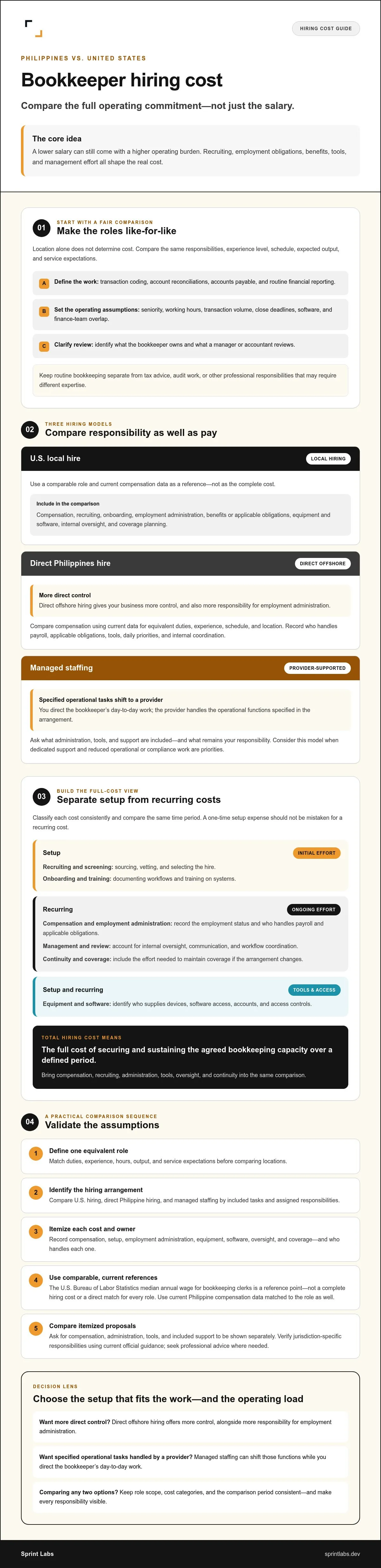
A lower salary can still come with a higher operating burden. That’s the trap when comparing the cost of hiring a bookkeeper philippines vs US by pay alone: recruiting, employment obligations, benefits, and the work of managing the hire all affect the real cost.
To find out whether hiring in the Philippines will cost less overall, compare both options using the same assumptions. A headline salary is not equivalent to the full cost of a U.S. employee. The hiring model matters, too. Direct offshore hiring gives you more control, but also more responsibility for employment administration. Managed staffing shifts specified operational tasks to a provider while you direct the bookkeeper’s day-to-day work.
This guide compares local U.S. hiring, direct Philippine hiring, and managed staffing by the costs and responsibilities involved. You’ll learn what to include in a total-cost comparison, how to weigh the trade-offs, and how to choose a setup that supports reliable bookkeeping without adding unnecessary operational or compliance work.
Key Takeaways
- Compare the cost of hiring a bookkeeper philippines vs US using the same responsibilities, experience level, schedule, and expected output.
- Account for recruiting, onboarding, employment administration, equipment, software access, and internal oversight to see the fuller cost.
- Evaluate U.S. hiring, direct Philippine hiring, and managed staffing based on who handles administrative tasks and how much management effort each model requires.
- Ask for itemized proposals so you can compare compensation, administration, tools, and included support on equal terms.
- Consider managed offshore staffing if you want dedicated support while a provider handles specified contractor engagement and operational functions.
Table of Contents
- Bookkeeper Cost in the Philippines vs. the U.S.: What Are You Comparing?
- Which Cost Components Change Between Philippine and U.S. Bookkeepers?
- U.S. Hire, Direct Philippines Hire, or Managed Staffing?
- How to Calculate and Validate Your Bookkeeper Hiring Cost
- When Managed Offshore Bookkeeping Support Makes Sense
Bookkeeper Cost in the Philippines vs. the U.S.: What Are You Comparing?
Location is only one factor in a bookkeeping hire. The cost of hiring a bookkeeper philippines vs US also depends on whether you hire an employee directly, engage a contractor, or use managed staffing, and on what each arrangement includes. Offshoring means moving a business process to another country. Offshoring can change where the work is performed, but it doesn’t define the role’s scope, quality expectations, or management needs.
Begin with a like-for-like role. Compare equivalent duties, seniority, working hours, expected output, and service expectations. A part-time transaction-coding role is not comparable to a full-time bookkeeper handling reconciliations, payables, and month-end reporting. Define the scope first, then assess what each hiring model requires from your business.
What does a bookkeeper do, and what level do you need?
Bookkeeping may include transaction coding, account reconciliations, accounts payable, and routine financial reporting. Define which tasks the bookkeeper owns and what a manager or accountant will review. Specify the accounting software, transaction volume, close deadlines, and required overlap with your finance team. Keep routine bookkeeping separate from tax advice, audit work, or other professional responsibilities that may require different expertise.
Why salary alone cannot answer the cost question
Salary is one input, not the full commitment. Employment status affects which costs and administrative responsibilities sit with your business, while a staffing arrangement may include some operational support. Compensation benchmarks are useful only when they reflect current data for a comparable role, seniority, location, and schedule.
Total hiring cost is the full cost of securing and sustaining the agreed bookkeeping capacity over a defined period. Include:
- Compensation and recruiting or screening
- Onboarding and employment administration
- Required equipment and software access
- Internal oversight, communication, and workflow coordination
- Continuity planning, including the effort needed to maintain coverage if the arrangement changes
For example, compare two roles with the same responsibilities and expected hours. Then record who supplies equipment, handles employment administration, and manages daily priorities. If those assumptions differ, the headline figures aren’t comparable. This baseline helps you assess not just where the bookkeeper works, but what your business pays for and remains responsible for.
Which Cost Components Change Between Philippine and U.S. Bookkeepers?
A fair comparison starts with equivalent work. Match responsibilities, experience, scheduled hours, and expected output before comparing compensation. For a U.S. benchmark, the Bureau of Labor Statistics publishes the median annual wage for bookkeeping clerks. Treat it as a reference point, not a complete hiring cost or a direct match for every role and seniority level.
Apply the same discipline to the Philippines. Use current compensation data that matches the duties, experience, schedule, and location you’re assessing, then add the costs salary figures leave out. An employee, contractor, and managed-staffing arrangement can assign payroll, benefits, statutory obligations, and employment administration differently. Verify responsibilities for each arrangement using current official guidance for the relevant jurisdictions, and seek professional advice where needed.
Separate setup costs from recurring costs
Recruiting, screening, and onboarding generally belong in the setup view. Compensation, payroll administration, software access, equipment, supervision, and ongoing review are recurring considerations. Classify each item consistently and compare the same time period. This prevents a one-time setup expense from being mistaken for a recurring monthly cost.
| Cost area | Classification | Assumption to record |
|---|---|---|
| Recruiting and screening | Setup | Who sources, vets, and selects the hire? |
| Onboarding and training | Setup, with ongoing refreshers if needed | Who documents workflows and trains on systems? |
| Compensation and employment administration | Recurring | What status is used, and who handles payroll and applicable obligations? |
| Equipment, software, and secure access | Setup and recurring | Who supplies devices, accounts, and access controls? |
| Management, review, and coverage | Recurring | How much internal time goes to oversight, exceptions, handoffs, and absence coverage? |
Include the operating effort
Internal time has a cost, even when it doesn’t appear on an invoice. Estimate the manager hours needed for recruiting, training, checking reconciliations, resolving exceptions, and maintaining process documentation. Include oversight in your total-cost comparison because directing and reviewing the work uses resources your business must commit to the role.
Check whether the arrangement includes operational support. Sprint Labs’ managed contractor model covers recruitment, vetting, contractor agreements, fees and payments, management support, replacement, and a managed device where needed, while the client directs day-to-day work. If you’re considering dedicated offshore capacity, you can explore managed finance staffing and discuss the duties, seniority, and workflow requirements your business needs.
U.S. Hire, Direct Philippines Hire, or Managed Staffing?
The right model depends on more than compensation. Compare who recruits, engages, equips, and supports the bookkeeper, then assess how much internal coordination each option requires. A lower compensation benchmark for an offshore role doesn’t automatically mean a lower all-in cost if your business takes on substantial recruiting, administration, training, and oversight.
Hiring a bookkeeper in the United States
A U.S.-based hire may suit a business that values local business context, close working-hour overlap, or direct coordination with an existing finance team. But proximity doesn’t remove the operating work. Include recruiting and screening, onboarding, payroll and benefits administration, equipment, software access, and manager time in your comparison. This model can fit companies with established HR and hiring processes, especially when frequent real-time collaboration is central to the role.
Direct Philippines hire versus managed staffing
With a direct offshore hire, your business takes on more recruiting and employment administration. That may work if your team has the capacity to manage those responsibilities and verify the requirements that apply to its arrangement. The compensation figure alone won’t show the full commitment.
Managed staffing divides the work differently. Sprint Labs recruits, vets, places, and manages dedicated independent professionals across Asia, including finance and accounting specialists. Its managed contractor model covers contractor agreements, fees and payments, management support, replacement, and a managed device where needed, while the client directs day-to-day priorities. Confirm that the provider can recruit for your specific bookkeeping duties and seniority level, and clarify what support and continuity processes are included before comparing proposals. For more context on this operating model, see managed offshore staffing in Asia.
Use these questions to identify the model that best fits your operations:
- Responsibility: Who handles recruiting, administration, and equipment?
- Control: Who sets priorities, reviews work, and resolves exceptions?
- Onboarding: Who documents workflows and trains the bookkeeper on your systems?
- Continuity: What happens to handoffs and coverage if the arrangement changes or the person is absent?
- Internal effort: How much time will your team spend managing the role?
Businesses with established hiring and HR operations may prefer direct employment and tighter control. If internal capacity is limited, managed staffing can shift specified operational responsibilities to a provider while you continue to direct the work. Neither approach is automatically cheaper or better. For a fair cost of hiring a bookkeeper philippines vs US decision, compare the responsibilities and support attached to each option, not just the location or pay figure.
How to Calculate and Validate Your Bookkeeper Hiring Cost
Use one comparison brief for every option. Keep the duties, evaluation period, expected output, and service assumptions consistent. Request itemized proposals that separate compensation from recruiting, administration, equipment, software access, and included support. If costs are bundled, ask what the package covers. A clear breakdown exposes gaps before you compare totals.
Build an apples-to-apples comparison
Write down the role before requesting estimates. Include required experience, transaction volume, accounting software, working hours, close deadlines, access controls, and expectations for communication and review. Separate one-time setup from recurring commitments, and count internal management time consistently across hiring models. This turns the cost of hiring a bookkeeper philippines vs US into a comparison of equivalent capacity, not mismatched salary figures.
- Scope: List the bookkeeping duties and the work that remains with your finance team.
- Setup: Record recruiting, screening, onboarding, equipment, account setup, and documentation needs.
- Recurring effort: Include compensation, administration, tools, supervision, quality checks, and coordination.
- Proposal clarity: Ask which services are included, which are billed separately, and who owns each responsibility.
Compare estimates over the same period. Don’t compare a monthly employment figure with a proposal that includes broader operational support without accounting for the difference.
Check quality, continuity, and risk before deciding
Test the model against real work. Ask how the bookkeeper would handle month-end close, a sudden increase in transactions, and an absence during a critical handoff. Find out how procedures are documented, who reviews the work, how errors are corrected, and how responsibilities transfer if staffing changes. These questions show whether the arrangement can support your workflow beyond a typical week.
Clarify permissions for financial systems, confidentiality practices, and data retention expectations. Have qualified professionals review applicable employment, tax, and data-security requirements for your specific arrangement. Don’t treat a general estimate as confirmation of compliance.
Where appropriate, use staged onboarding or a role-specific trial plan with defined tasks, review points, and access limits. This gives both sides a practical way to test fit before expanding responsibilities. If you’re assessing dedicated offshore finance support, discuss your bookkeeping role requirements and clarify which contractor engagement and operational responsibilities you want handled.
When Managed Offshore Bookkeeping Support Makes Sense
Managed offshore staffing can suit a business that needs dedicated capacity but doesn’t want to build every recruiting and contractor engagement process internally. It separates day-to-day direction from contractor engagement administration: your team sets priorities and reviews the work, while the provider handles agreed operational responsibilities. You still need to define the role, establish controls, and manage bookkeeping workflows.
Sprint Labs recruits, vets, places, and manages dedicated independent professionals across Asia, including finance and accounting specialists. Its managed contractor model covers contractor agreements, fees and payments, management support, replacement, and a managed device where needed. Before discussing a bookkeeping role, confirm that the specific duties, software experience, and seniority you need are within scope. A general finance profile isn’t automatically a match for every bookkeeping requirement.
Signs your team may benefit from a managed model
Consider managed support if recruiting and HR tasks compete with core work, or if recurring transactions, reconciliations, and close tasks need consistent ownership. A dedicated professional may suit a sustained workload better than repeatedly assigning disconnected tasks. By contrast, short-term task bidding or freelance marketplace work is designed around individual assignments, not necessarily an ongoing role integrated into your team’s processes.
Managed staffing isn’t automatically the right or lower-cost choice. The cost of hiring a bookkeeper philippines vs US still depends on role scope, management effort, included support, and fit with your operating needs. If your team already has recruiting and employment administration in place, direct hiring may be practical. If contractor engagement support is a bottleneck, shifting specified responsibilities to a staffing provider may reduce operational friction.
Questions to ask a potential staffing partner
Get clear answers before comparing proposals. Ask how the provider sources and vets candidates, how onboarding works, and what support continues after placement. Confirm exactly which responsibilities are included, such as contractor fees and payments, management support, equipment where needed, and other operational overhead. Establish who directs daily work, documents procedures, reviews output, and manages handoffs or coverage if circumstances change.
- Can you recruit for the specific bookkeeping duties, software, and seniority level we require?
- What does your vetting process assess, and how will role fit be confirmed?
- Which contractor engagement and operational functions do you handle, and which remain with us?
- How are onboarding, work documentation, and ongoing support structured?
Start with a clear role brief that lists responsibilities, expected output, tools, working hours, and review processes. Then discuss whether the staffing model and role requirements align. Discuss your finance and accounting staffing needs with Sprint Labs to explore the requirements and responsibilities involved.
Choose the Bookkeeping Model Your Business Can Support
The real cost of hiring a bookkeeper philippines vs US comes down to more than location or salary. Compare equivalent responsibilities and working hours, then account for recruiting, employment administration, tools, oversight, and continuity. That gives you a clearer picture of the total commitment.
Next, choose a hiring model that fits your operating capacity. A U.S. hire may suit teams that value close collaboration and already have hiring processes in place. Direct offshore hiring can work when you’re equipped to manage recruitment and employment responsibilities. Managed staffing offers another option: Sprint Labs handles recruitment, vetting, contractor agreements, fees and payments, management support, replacement, and a managed device where needed, while you direct the work of dedicated offshore professionals. Confirm the role requirements and responsibilities before moving forward.
If you’re weighing dedicated finance and accounting support, discuss your finance and accounting staffing needs with Sprint Labs. Start with a clear role brief and a consistent cost comparison. With the right assumptions, you can make an informed decision and build a bookkeeping setup that works for your business.
Frequently Asked Questions
How much does it cost to hire a bookkeeper in the Philippines compared with the U.S.?
To compare the cost of hiring a bookkeeper philippines vs US, match compensation to the role before adding employment and operating expenses. 2026 benchmarks for full-time remote bookkeepers in the Philippines range from $800-$950 monthly at entry level, $900-$1,400 at mid-level, and $1,200-$2,000 or more at senior level. In the U.S., the reported average annual salary is $50,573. These are compensation benchmarks, not all-in hiring totals.
Is a Philippines-based bookkeeper cheaper after employment and management costs?
Possibly, but a lower compensation benchmark doesn’t guarantee a lower total cost. Add recruiting, employment administration, equipment, software access, onboarding, supervision, and time spent reviewing work. The result depends on the hiring arrangement and how much operational responsibility your team takes on. Compare the same duties, experience, schedule, and evaluation period, then request itemized proposals showing what’s included and what remains your responsibility.
What costs should I include when comparing bookkeepers in the Philippines and the United States?
Include compensation, recruitment and screening, onboarding, payroll and employment administration, benefits or other applicable obligations, equipment, software access, secure account setup, and internal management time. Also account for review, training, handoffs, and continuity planning. Separate one-time setup costs from recurring expenses. Keep the scope and comparison period consistent, and verify employment and tax obligations for your specific arrangement with qualified professionals.
Can a Philippines-based bookkeeper work with U.S. accounting software and processes?
They may be able to, but verify experience rather than assume it. Specify the software your business uses, such as QuickBooks or Xero, and assess familiarity with your transaction workflows, reconciliations, reporting format, and close deadlines. If your processes follow U.S. accounting standards, include relevant knowledge in the role requirements. Confirm access controls and review procedures, too. Bookkeeping support shouldn’t be treated as a substitute for tax advice or audit work.
What is the difference between directly hiring an offshore bookkeeper and using managed staffing?
With direct hiring, your business handles more of the recruiting and employment administration itself. Managed staffing provides dedicated talent while a provider takes on specified operational responsibilities. Sprint Labs’ managed contractor model covers recruitment, vetting, contractor agreements, fees and payments, management support, replacement, and a managed device where needed, while clients direct day-to-day work. Compare each proposal’s responsibilities, included support, and management expectations. Confirm that the provider can recruit for the bookkeeping duties and seniority level you require.
Do I need to hire a bookkeeper as an employee or a contractor?
That depends on the role, working relationship, and requirements that apply to your business and the worker’s location. Don’t choose a contractor arrangement only because you expect simpler administration. Classification rules and obligations can depend on the facts and applicable law. Before deciding, describe the expected duties, schedule, supervision, and duration, then consult qualified employment or tax professionals about the appropriate arrangement.
How can I compare the quality of a U.S. bookkeeper with a Philippines-based bookkeeper?
Use the same role-specific assessment for every candidate. Test practical skills tied to the work, such as coding transactions, reconciling accounts, identifying discrepancies, and preparing a sample report. Assess software familiarity, communication, documentation habits, and ability to meet your close schedule. Check relevant references and use consistent scoring criteria. Geography alone doesn’t establish quality; fit depends on demonstrated skills, clear processes, and reliable review.
Frequently asked questions
What does a bookkeeper do, and what level do you need?
Bookkeeping may include transaction coding, account reconciliations, accounts payable, and routine financial reporting. Define which tasks the bookkeeper owns and what a manager or accountant will review. Specify the accounting software, transaction volume, close deadlines, and required overlap with your finance team. Keep routine bookkeeping separate from tax advice, audit work, or other professional responsibilities that may require different expertise.
How much does it cost to hire a bookkeeper in the Philippines compared with the U.S.?
To compare the cost of hiring a bookkeeper philippines vs US, match compensation to the role before adding employment and operating expenses. 2026 benchmarks for full-time remote bookkeepers in the Philippines range from $800–$950 monthly at entry level, $900–$1,400 at mid-level, and $1,200–$2,000 or more at senior level. In the U.S., the reported average annual salary is $50,573. These are compensation benchmarks, not all-in hiring totals.
Is a Philippines-based bookkeeper cheaper after employment and management costs?
Possibly, but a lower compensation benchmark doesn’t guarantee a lower total cost. Add recruiting, employment administration, equipment, software access, onboarding, supervision, and time spent reviewing work. The result depends on the hiring arrangement and how much operational responsibility your team takes on. Compare the same duties, experience, schedule, and evaluation period, then request itemized proposals showing what’s included and what remains your responsibility.
What costs should I include when comparing bookkeepers in the Philippines and the United States?
Include compensation, recruitment and screening, onboarding, payroll and employment administration, benefits or other applicable obligations, equipment, software access, secure account setup, and internal management time. Also account for review, training, handoffs, and continuity planning. Separate one-time setup costs from recurring expenses. Keep the scope and comparison period consistent, and verify employment and tax obligations for your specific arrangement with qualified professionals.
Can a Philippines-based bookkeeper work with U.S. accounting software and processes?
They may be able to, but verify experience rather than assume it. Specify the software your business uses, such as QuickBooks or Xero, and assess familiarity with your transaction workflows, reconciliations, reporting format, and close deadlines. If your processes follow U.S. accounting standards, include relevant knowledge in the role requirements. Confirm access controls and review procedures, too. Bookkeeping support shouldn’t be treated as a substitute for tax advice or audit work.
What is the difference between directly hiring an offshore bookkeeper and using managed staffing?
With direct hiring, your business handles more of the recruiting and employment administration itself. Managed staffing provides dedicated talent while a provider takes on specified operational responsibilities. Sprint Labs’ managed contractor model covers recruitment, vetting, contractor agreements, fees and payments, management support, replacement, and a managed device where needed, while clients direct day-to-day work. Compare each proposal’s responsibilities, included support, and management expectations. Confirm that the provider can recruit for the bookkeeping duties and seniority level you require.
Do I need to hire a bookkeeper as an employee or a contractor?
That depends on the role, working relationship, and requirements that apply to your business and the worker’s location. Don’t choose a contractor arrangement only because you expect simpler administration. Classification rules and obligations can depend on the facts and applicable law. Before deciding, describe the expected duties, schedule, supervision, and duration, then consult qualified employment or tax professionals about the appropriate arrangement.
How can I compare the quality of a U.S. bookkeeper with a Philippines-based bookkeeper?
Use the same role-specific assessment for every candidate. Test practical skills tied to the work, such as coding transactions, reconciling accounts, identifying discrepancies, and preparing a sample report. Assess software familiarity, communication, documentation habits, and ability to meet your close schedule. Check relevant references and use consistent scoring criteria. Geography alone doesn’t establish quality; fit depends on demonstrated skills, clear processes, and reliable review.
Hiring in Asia? We'll do it for you.
Sprint Labs is a managed staffing firm. We recruit, vet, place and manage senior professionals across the Philippines, Vietnam, Malaysia, Indonesia and India. You direct the work, we handle the engagement.
Create a request →