
Offshore Marketing Manager: Role, Responsibilities, and Team Fit
Hire the right offshore marketing manager. Discover key roles, responsibilities, team integration tips, and KPIs to bridge marketing strategy and execution.
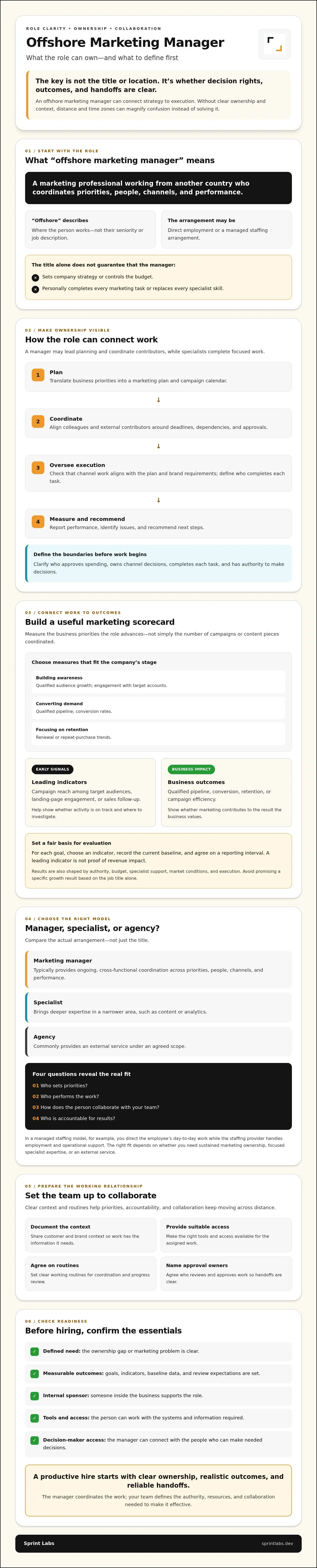
An offshore marketing manager won’t fix a marketing team that hasn’t decided who owns the work. The role can connect strategy to execution, but only when decision rights, outcomes, and handoffs are clear. Without that context, distance and time zones can magnify confusion instead of solving it.
If you’re weighing this hire, the concern is valid: who sets direction, who manages campaigns, and who completes the work? An offshore marketing manager may lead planning and coordinate specialists, or focus on execution management, depending on your team. The title alone doesn’t define the boundary.
This guide explains what the role can own, which marketing problems may justify the hire, and how it fits alongside your existing team. You’ll learn what to define before hiring, how to set expectations, and when one manager may be enough versus when you need a broader team. The goal is a productive working relationship where priorities, accountability, and collaboration keep moving across distance.
Key Takeaways
- An offshore marketing manager can coordinate priorities, people, channels, and performance. Define the role’s ownership clearly; “offshore” describes work location, not seniority.
- Set responsibilities and KPIs around business outcomes, your marketing stage, and the baseline data you have.
- Choose between a manager, a specialist, or an agency by weighing the ownership gap, expertise required, management capacity, and need for continuity.
- Prepare for effective collaboration with documented customer and brand context, suitable access, clear routines, and agreed approval owners.
- Before hiring, check that you have a defined need, measurable outcomes, an internal sponsor, the right tools, and access to decision-makers.
Table of Contents
- What Is an Offshore Marketing Manager, and What Does the Role Own?
- What Should an Offshore Marketing Manager Deliver Across the Team?
- Offshore Marketing Manager, Specialist, or Agency: Which Model Fits?
- How to Set Up an Offshore Marketing Manager for Effective Work
- How to Decide Whether an Offshore Marketing Manager Is Your Next Hire
What Is an Offshore Marketing Manager, and What Does the Role Own?
An offshore marketing manager is a marketing professional who works from another country and coordinates marketing priorities, people, channels, and performance. The person’s work location, engagement arrangement, and responsibilities are separate questions. “Offshore” describes where the person works. They might be employed directly, engaged as an independent contractor, or supported through a managed staffing arrangement. Their marketing scope depends on what your business assigns them to own.
The offshoring concept describes relocating a business process to another country. It doesn’t define a person’s seniority or job description. An offshore manager may lead planning and coordinate contributors, but the title alone doesn’t mean they set company strategy, control the budget, or personally deliver every campaign.
Which marketing responsibilities can the manager own?
Set ownership around the outcomes you need, your existing capabilities, the manager’s budget authority, and your team size. The manager might:
- Translate business priorities into a marketing plan and campaign calendar.
- Coordinate internal colleagues and external contributors around deadlines, dependencies, and approvals.
- Oversee channel execution, checking that work aligns with the plan and brand requirements.
- Report performance, identify issues, and recommend next steps.
These responsibilities can involve decision-making without requiring the manager to execute every task. For example, they may prioritize campaigns and review results while a specialist handles paid search or design. Define who approves spending, owns channel decisions, and completes each task. One hire can close a coordination gap, but shouldn’t be treated as a replacement for every marketing skill.
How does the role differ from a specialist or agency?
A manager typically provides ongoing, cross-functional coordination. A specialist brings deeper expertise in a narrower area, such as content or analytics. An agency commonly provides an external service under an agreed scope; a dedicated professional joins your team and works on priorities you direct. These are useful distinctions, not universal job definitions.
Compare the actual arrangement, not just the title. Ask who sets priorities, who performs the work, how the person collaborates with your team, and who is accountable for results. In a managed contractor model, for example, you direct the contractor’s day-to-day work while the staffing provider handles engagement and operational support. The right fit depends on whether you need sustained marketing ownership, focused specialist expertise, or an external service.
What Should an Offshore Marketing Manager Deliver Across the Team?
Measure the role by the business priorities it advances, not by the number of campaigns or content pieces it coordinates. An offshore marketing manager connects business priorities to coordinated execution and clear performance measurement.
Start by choosing outcomes that match the company’s stage and funnel. A team building awareness may track qualified audience growth and engagement with target accounts. A team focused on converting demand may watch qualified pipeline and conversion rates. A retention-focused business might measure renewal or repeat-purchase trends. These are examples, not universal targets. The right measures depend on your channels, available resources, market, and ability to influence results.
Agree on what the manager can decide, what resources are available, and how progress will be reviewed. Performance depends on more than the person in the role. Authority, budget, specialist support, market conditions, and execution all shape what marketing can achieve. Set expectations accordingly; don’t promise a specific growth result based on the job title alone.
How should goals and marketing KPIs be defined?
For each goal, select an indicator that shows progress toward it. Record the current baseline and set a reporting interval before judging performance. A useful scorecard pairs early signals with business results:
- Leading indicators: campaign reach among target audiences, landing-page engagement, or sales follow-up. These help reveal whether activity is on track and where to investigate.
- Business outcomes: qualified pipeline, conversion, retention, or campaign efficiency. These show whether marketing activity is contributing to the result the business values.
Don’t treat a leading indicator as proof of revenue impact. Review both types of measures, then adjust the plan when the evidence points to a bottleneck. For example, if a campaign attracts attention but isn’t producing qualified conversations, investigate the audience, offer, landing page, and sales handoff before simply increasing activity.
How does the manager work with specialists and leaders?
Map handoffs with sales, product, leadership, and existing marketing specialists. For each decision, name one accountable owner and the people who contribute or approve. For example, leadership may approve positioning and budget, product may verify feature details, sales may share customer objections, and the manager may coordinate campaign priorities and reporting.
A simple responsibility matrix makes those boundaries visible. Include the decision, owner, approver, contributors, and escalation path. Define who can approve customer-facing claims before publication. This prevents stalled work and conflicting instructions, especially when contributors work across time zones. If you’re evaluating a dedicated staffing model for this kind of ongoing coordination, explore sales and marketing staffing as one option.
Offshore Marketing Manager, Specialist, or Agency: Which Model Fits?
Choose the model that closes your actual gap. An offshore marketing manager can suit a business with priorities and contributors in place but no consistent owner to coordinate the work. A specialist fits a defined expertise gap. An agency may fit when you need an external service rather than an embedded team member.
| Decision criterion | Dedicated manager | Specialist | Agency |
|---|---|---|---|
| Ownership breadth | Coordinates priorities across marketing work | Owns a narrower channel or skill area | Delivers an agreed external service scope |
| Required expertise | Marketing judgment and cross-team coordination | Depth in a specific discipline | Capabilities defined by the agency’s scope |
| Management capacity | Needs an internal stakeholder for direction and decisions | Needs clear briefs and access to relevant collaborators | Needs a client contact for approvals and coordination |
| Continuity | Ongoing work within the client’s team | Focused contribution to a specific need | Continues according to the agreed service arrangement |
These are common patterns, not fixed definitions. Compare the actual responsibilities, working arrangements, and accountability on offer. Location alone doesn’t determine effectiveness. Access to context, appropriate authority, timely decisions, and dependable operating routines matter more than geography.
When is a dedicated offshore manager a sensible fit?
Consider this model when the plan is broadly understood but campaign priorities drift, contributors lack coordination, or no one consistently tracks delivery and performance. The role needs an internal stakeholder who can explain business context, resolve competing priorities, and make or secure decisions on time.
Without that support, the manager can inherit responsibility without the ability to act. Unclear strategy, missing system access, or unavailable decision-makers can stall work regardless of where the person is based.
When might another model fit better?
Choose a specialist when the need is narrow, such as expertise in one channel or a technical marketing skill. An agency may be a better fit when you want an external provider to deliver a defined service, rather than a dedicated professional integrated into your team.
If the workload spans more functions than one person can realistically own, consider adding roles around the specific capacity or expertise gap. There’s no universal team structure. For more about the contracting and support arrangements behind one offshore staffing approach, see this guide to managed offshore staffing.
How to Set Up an Offshore Marketing Manager for Effective Work
A strong setup makes the work clear before the first campaign starts. Use this sequence to turn an offshore marketing manager’s remit into a working plan:
- Define outcomes: State the business priorities, expected deliverables, and measures of progress.
- Document context: Share customer segments, positioning, active campaigns, brand rules, and approval owners in a central workspace.
- Grant appropriate access: Provide role-based access to the CRM, analytics, campaign tools, and reporting systems needed for the work.
- Agree routines: Set communication channels, response expectations, planned overlap, meeting cadence, and escalation routes.
- Review results: Schedule an initial review period with clear deliverables, named stakeholders, and time to address blockers.
Write down decisions as well as background. A current campaign brief should show its audience, objective, status, next action, and approver. That gives the manager useful operating context without relying on scattered messages or repeated explanations.
What should the role brief and onboarding cover?
Specify responsibilities and decision rights, not just a list of tasks. Clarify which priorities the manager can set, which decisions need approval, and which specialists handle execution. Include the experience required and an honest picture of the current marketing operation, including active work and known constraints.
Before onboarding, confirm system access and identify a named stakeholder for each key area. Agree on a realistic initial review period and what you’ll assess during it, such as campaign coordination, reporting quality, or delivery against agreed milestones. This creates a fair basis for feedback without treating early activity as proof of long-term impact.
How can distributed collaboration stay clear and accountable?
Distance doesn’t have to mean delay. Use asynchronous updates for status, blockers, and decisions that don’t require a live discussion. Plan a regular overlap window for time-sensitive collaboration, and record decisions where the wider team can find them. Set response expectations by channel, so urgent questions don’t disappear into a general inbox.
Make handoffs explicit. For marketing and sales, agree how campaign leads are qualified, routed, and followed up, then document where ownership passes between teams. For more detail on that sales-side role, see this guide to offshore SDR hiring.
Review completed work and agreed outcomes together. Online availability isn’t a performance measure; clear ownership, useful communication, and accountable delivery are. If you’re ready to explore dedicated marketing support, review Sprint Labs’ sales and marketing staffing.
How to Decide Whether an Offshore Marketing Manager Is Your Next Hire
Make the hiring decision from the gap you need to close, not from the appeal of a job title. If marketing needs a consistent owner to align priorities, coordinate contributors, and track progress, a manager may fit. If the plan is already owned and one defined task is falling behind, a specialist may be the more direct hire.
What questions should you answer before hiring?
Use this readiness checklist to test whether the role can succeed in your current setup:
- Defined need: What business outcome or persistent operating problem should this role address?
- Measurable outcomes: How will you assess progress, and what baseline information is available?
- Internal sponsor: Who will set priorities, provide context, give feedback, and resolve competing requests?
- Tools and access: Can the hire use the systems, data, and materials needed to do the work?
- Decision access: Who approves budgets, positioning, campaign priorities, and customer-facing claims?
Then check the workload. If the need is broad coordination and sustained marketing ownership, a manager may be appropriate. If it centers on one channel or technical skill, define that execution gap and consider specialist support. If the responsibilities span more work than one person can reasonably handle, plan for additional capacity rather than expecting one hire to cover every function.
Be candid about what’s not ready. If strategy is unsettled, no one can approve decisions, or key tools and context aren’t available, hiring alone won’t remove those blockers. Resolve what you can first, then describe the role in terms of its remit, authority, working relationships, and expected outcomes.
How does managed offshore staffing support the arrangement?
Once the role is clear, managed offshore staffing is one way to structure the contractor engagement. Sprint Labs recruits, vets, places, and manages offshore marketing professionals as independent contractors. The client directs the dedicated contractor’s day-to-day work, while Sprint Labs handles the engagement: contracts, fees and payments, time off, performance concerns, replacement, and offboarding. That separates marketing direction from contractor engagement and operational support.
It’s an option to assess, not a default answer for every business. Confirm the responsibilities, management capacity, and support arrangement that fit your needs before choosing a model. If your requirements are defined and you’re considering this approach, explore Sprint Labs’ staffing approach.
Make the Role Accountable Before You Hire
The right offshore marketing manager is more than a remote hire. The role needs clear ownership, measurable outcomes, and access to the people and decisions required to move work forward. If you need broad coordination and ongoing marketing ownership, a manager may fit. If the gap is one specific channel or skill, a specialist may be the sharper choice.
Set the working relationship before the start date. Document priorities, approval rights, reporting expectations, and how the manager will coordinate with your existing team. Distance is manageable when context is shared and decisions don’t depend on constant live meetings.
Sprint Labs provides dedicated sales and marketing staffing. In its managed contractor model, the client directs the contractor’s day-to-day work, while Sprint Labs handles the engagement: recruitment, vetting, contracts, fees and payments, time off, performance concerns, replacement, and offboarding. If that arrangement matches your needs, explore Sprint Labs’ managed staffing approach.
Define the role first, then choose the structure that gives it a fair chance to succeed. With clear ownership and practical support in place, you can build a more accountable marketing operation.
Frequently Asked Questions
What does an offshore marketing manager do?
An offshore marketing manager coordinates marketing priorities, contributors, channels, and performance while working from another country. Depending on your needs, the role may include planning campaigns, coordinating specialists, overseeing channel execution, and reporting results. The manager’s scope should connect to your business goals and spell out decision rights. “Offshore” describes work location, not a fixed level of seniority or a standard set of responsibilities.
Is an offshore marketing manager an employee or an agency?
It depends on the arrangement. A dedicated professional works within your team, while an agency generally provides an external service under an agreed scope. In Sprint Labs’ managed contractor model, Sprint Labs recruits, vets, places, and manages the professional as an independent contractor, and your business directs the contractor’s work. Sprint Labs handles recruitment, vetting, contracts, fees and payments, time off, performance concerns, replacement, and offboarding. Clarify who directs the work and who is responsible for engagement support before choosing.
How is an offshore marketing manager different from a marketing specialist?
A marketing manager typically coordinates work across priorities, people, and channels. A specialist focuses on deeper expertise in a narrower area, such as a particular channel or technical skill. If your campaigns need a consistent owner and cross-team coordination, a manager may fit. If the strategy and ownership are already clear but a specific capability is missing, a specialist may address that gap more directly.
Can an offshore marketing manager work effectively with an in-house team?
Yes, if the role has the context, access, and decision support needed to contribute. Document team responsibilities, campaign status, brand guidance, and approval owners. Agree on communication channels, response expectations, meeting cadence, and escalation routes. Shared updates and written decisions help collaboration continue between live meetings. Assign an internal sponsor who can answer questions, provide feedback, and resolve priorities when the team needs a decision.
What should an offshore marketing manager be responsible for?
Responsibilities should reflect the business’s goals, existing capabilities, budget authority, and team size. The manager might shape marketing plans, coordinate campaigns and contributors, oversee channel execution, and report performance. Define which decisions the manager can make and which need approval. Separate coordination and accountability from specialist execution, so the role doesn’t become an expectation that one person will perform every marketing function.
How do you measure an offshore marketing manager’s performance?
Agree on outcomes, indicators, a baseline, and a reporting interval before reviewing performance. Choose measures that fit the business goal, such as qualified pipeline, conversion, retention, or campaign efficiency. Track leading indicators, like campaign engagement or sales follow-up, alongside business outcomes. Leading indicators can reveal where execution needs attention; business outcomes show whether activity is contributing to the intended result. Consider the manager’s authority and available resources when interpreting results.
What should you prepare before hiring an offshore marketing manager?
Define the business need, measurable outcomes, responsibilities, and decision rights. Name an internal sponsor who will set priorities and provide timely feedback. Prepare customer and brand context, details of active campaigns, approval processes, and access to the CRM, analytics, campaign tools, and reporting systems the role requires. Finally, assess whether the workload suits one manager or also needs specialist support. A clear brief helps candidates understand the role and your expectations.
Frequently asked questions
Which marketing responsibilities can the manager own?
Set ownership around the outcomes you need, your existing capabilities, the manager’s budget authority, and your team size. The manager might: These responsibilities can involve decision-making without requiring the manager to execute every task. For example, they may prioritize campaigns and review results while a specialist handles paid search or design. Define who approves spending, owns channel decisions, and completes each task. One hire can close a coordination gap, but shouldn’t be treated as a replacement for every marketing skill.
How does the role differ from a specialist or agency?
A manager typically provides ongoing, cross-functional coordination. A specialist brings deeper expertise in a narrower area, such as content or analytics. An agency commonly provides an external service under an agreed scope; a dedicated professional joins your team and works on priorities you direct. These are useful distinctions, not universal job definitions. Compare the actual arrangement, not just the title. Ask who sets priorities, who performs the work, how the person collaborates with your team, and who is accountable for results. In a managed contractor model, for example, you direct the contractor’s day-to-day work while the staffing provider handles engagement and operational support. The right fit depends on whether you need sustained marketing ownership, focused specialist expertise, or an external service. Measure the role by the business priorities it advances, not by the number of campaigns or content pieces it coordinates. An offshore marketing manager connects business priorities to coordinated execution and clear performance measurement. Start by choosing outcomes that match the company’s stage and funnel. A team building awareness may track qualified audience growth and engagement with target accounts. A team focused on converting demand may watch qualified pipeline and conversion rates. A retention-focused business might measure renewal or repeat-purchase trends. These are examples, not universal targets. The right measures depend on your channels, available resources, market, and ability to influence results. Agree on what the manager can decide, what resources are available, and how progress will be reviewed. Performance depends on more than the person in the role. Authority, budget, specialist support, market conditions, and execution all shape what marketing can achieve. Set expectations accordingly; don’t promise a specific growth result based on the job title alone.
How should goals and marketing KPIs be defined?
For each goal, select an indicator that shows progress toward it. Record the current baseline and set a reporting interval before judging performance. A useful scorecard pairs early signals with business results: Don’t treat a leading indicator as proof of revenue impact. Review both types of measures, then adjust the plan when the evidence points to a bottleneck. For example, if a campaign attracts attention but isn’t producing qualified conversations, investigate the audience, offer, landing page, and sales handoff before simply increasing activity.
How does the manager work with specialists and leaders?
Map handoffs with sales, product, leadership, and existing marketing specialists. For each decision, name one accountable owner and the people who contribute or approve. For example, leadership may approve positioning and budget, product may verify feature details, sales may share customer objections, and the manager may coordinate campaign priorities and reporting. A simple responsibility matrix makes those boundaries visible. Include the decision, owner, approver, contributors, and escalation path. Define who can approve customer-facing claims before publication. This prevents stalled work and conflicting instructions, especially when contributors work across time zones. If you’re evaluating a dedicated staffing model for this kind of ongoing coordination, explore sales and marketing staffing as one option. Choose the model that closes your actual gap. An offshore marketing manager can suit a business with priorities and contributors in place but no consistent owner to coordinate the work. A specialist fits a defined expertise gap. An agency may fit when you need an external service rather than an embedded team member. These are common patterns, not fixed definitions. Compare the actual responsibilities, working arrangements, and accountability on offer. Location alone doesn’t determine effectiveness. Access to context, appropriate authority, timely decisions, and dependable operating routines matter more than geography.
When is a dedicated offshore manager a sensible fit?
Consider this model when the plan is broadly understood but campaign priorities drift, contributors lack coordination, or no one consistently tracks delivery and performance. The role needs an internal stakeholder who can explain business context, resolve competing priorities, and make or secure decisions on time. Without that support, the manager can inherit responsibility without the ability to act. Unclear strategy, missing system access, or unavailable decision-makers can stall work regardless of where the person is based.
When might another model fit better?
Choose a specialist when the need is narrow, such as expertise in one channel or a technical marketing skill. An agency may be a better fit when you want an external provider to deliver a defined service, rather than a dedicated professional integrated into your team. If the workload spans more functions than one person can realistically own, consider adding roles around the specific capacity or expertise gap. There’s no universal team structure. For more about the contracting and support arrangements behind one offshore staffing approach, see this guide to managed offshore staffing. A strong setup makes the work clear before the first campaign starts. Use this sequence to turn an offshore marketing manager’s remit into a working plan: Write down decisions as well as background. A current campaign brief should show its audience, objective, status, next action, and approver. That gives the manager useful operating context without relying on scattered messages or repeated explanations.
What should the role brief and onboarding cover?
Specify responsibilities and decision rights, not just a list of tasks. Clarify which priorities the manager can set, which decisions need approval, and which specialists handle execution. Include the experience required and an honest picture of the current marketing operation, including active work and known constraints. Before onboarding, confirm system access and identify a named stakeholder for each key area. Agree on a realistic initial review period and what you’ll assess during it, such as campaign coordination, reporting quality, or delivery against agreed milestones. This creates a fair basis for feedback without treating early activity as proof of long-term impact.
How can distributed collaboration stay clear and accountable?
Distance doesn’t have to mean delay. Use asynchronous updates for status, blockers, and decisions that don’t require a live discussion. Plan a regular overlap window for time-sensitive collaboration, and record decisions where the wider team can find them. Set response expectations by channel, so urgent questions don’t disappear into a general inbox. Make handoffs explicit. For marketing and sales, agree how campaign leads are qualified, routed, and followed up, then document where ownership passes between teams. For more detail on that sales-side role, see this guide to offshore SDR hiring. Review completed work and agreed outcomes together. Online availability isn’t a performance measure; clear ownership, useful communication, and accountable delivery are. If you’re ready to explore dedicated marketing support, review Sprint Labs’ sales and marketing staffing. Make the hiring decision from the gap you need to close, not from the appeal of a job title. If marketing needs a consistent owner to align priorities, coordinate contributors, and track progress, a manager may fit. If the plan is already owned and one defined task is falling behind, a specialist may be the more direct hire.
What questions should you answer before hiring?
Use this readiness checklist to test whether the role can succeed in your current setup: Then check the workload. If the need is broad coordination and sustained marketing ownership, a manager may be appropriate. If it centers on one channel or technical skill, define that execution gap and consider specialist support. If the responsibilities span more work than one person can reasonably handle, plan for additional capacity rather than expecting one hire to cover every function. Be candid about what’s not ready. If strategy is unsettled, no one can approve decisions, or key tools and context aren’t available, hiring alone won’t remove those blockers. Resolve what you can first, then describe the role in terms of its remit, authority, working relationships, and expected outcomes.
How does managed offshore staffing support the arrangement?
Once the role is clear, managed offshore staffing is one way to structure the contractor engagement. Sprint Labs recruits, vets, places, and manages offshore marketing professionals as independent contractors. The client directs the dedicated contractor’s day-to-day work, while Sprint Labs handles the engagement: contracts, fees and payments, time off, performance concerns, replacement, and offboarding. That separates marketing direction from contractor engagement and operational support. It’s an option to assess, not a default answer for every business. Confirm the responsibilities, management capacity, and support arrangement that fit your needs before choosing a model. If your requirements are defined and you’re considering this approach, explore Sprint Labs’ staffing approach. The right offshore marketing manager is more than a remote hire. The role needs clear ownership, measurable outcomes, and access to the people and decisions required to move work forward. If you need broad coordination and ongoing marketing ownership, a manager may fit. If the gap is one specific channel or skill, a specialist may be the sharper choice. Set the working relationship before the start date. Document priorities, approval rights, reporting expectations, and how the manager will coordinate with your existing team. Distance is manageable when context is shared and decisions don’t depend on constant live meetings. Sprint Labs provides dedicated sales and marketing staffing. In its managed staffing model, the client directs the contractor’s day-to-day work, while Sprint Labs handles the engagement: contracts, fees and payments, time off, performance concerns, replacement, and offboarding. If that arrangement matches your needs, explore Sprint Labs’ managed staffing approach. Define the role first, then choose the structure that gives it a fair chance to succeed. With clear ownership and practical support in place, you can build a more accountable marketing operation.
What does an offshore marketing manager do?
An offshore marketing manager coordinates marketing priorities, contributors, channels, and performance while working from another country. Depending on your needs, the role may include planning campaigns, coordinating specialists, overseeing channel execution, and reporting results. The manager’s scope should connect to your business goals and spell out decision rights. “Offshore” describes work location, not a fixed level of seniority or a standard set of responsibilities.
Is an offshore marketing manager an employee or an agency?
It depends on the arrangement. A dedicated professional works within your team, while an agency generally provides an external service under an agreed scope. In Sprint Labs’ managed contractor model, Sprint Labs recruits, vets, places, and manages the professional as an independent contractor, and your business directs the contractor’s work. Sprint Labs handles recruitment, vetting, contracts, fees and payments, time off, performance concerns, replacement, and offboarding. Clarify who directs the work and who is responsible for engagement support before choosing.
How is an offshore marketing manager different from a marketing specialist?
A marketing manager typically coordinates work across priorities, people, and channels. A specialist focuses on deeper expertise in a narrower area, such as a particular channel or technical skill. If your campaigns need a consistent owner and cross-team coordination, a manager may fit. If the strategy and ownership are already clear but a specific capability is missing, a specialist may address that gap more directly.
Can an offshore marketing manager work effectively with an in-house team?
Yes, if the role has the context, access, and decision support needed to contribute. Document team responsibilities, campaign status, brand guidance, and approval owners. Agree on communication channels, response expectations, meeting cadence, and escalation routes. Shared updates and written decisions help collaboration continue between live meetings. Assign an internal sponsor who can answer questions, provide feedback, and resolve priorities when the team needs a decision.
What should an offshore marketing manager be responsible for?
Responsibilities should reflect the business’s goals, existing capabilities, budget authority, and team size. The manager might shape marketing plans, coordinate campaigns and contributors, oversee channel execution, and report performance. Define which decisions the manager can make and which need approval. Separate coordination and accountability from specialist execution, so the role doesn’t become an expectation that one person will perform every marketing function.
How do you measure an offshore marketing manager’s performance?
Agree on outcomes, indicators, a baseline, and a reporting interval before reviewing performance. Choose measures that fit the business goal, such as qualified pipeline, conversion, retention, or campaign efficiency. Track leading indicators, like campaign engagement or sales follow-up, alongside business outcomes. Leading indicators can reveal where execution needs attention; business outcomes show whether activity is contributing to the intended result. Consider the manager’s authority and available resources when interpreting results.
What should you prepare before hiring an offshore marketing manager?
Define the business need, measurable outcomes, responsibilities, and decision rights. Name an internal sponsor who will set priorities and provide timely feedback. Prepare customer and brand context, details of active campaigns, approval processes, and access to the CRM, analytics, campaign tools, and reporting systems the role requires. Finally, assess whether the workload suits one manager or also needs specialist support. A clear brief helps candidates understand the role and your expectations.
Hiring in Asia? We'll do it for you.
Sprint Labs is a managed staffing firm. We recruit, vet, place and manage senior professionals across the Philippines, Vietnam, Malaysia, Indonesia and India. You direct the work, we handle the engagement.
Create a request →