Offshore Team Hardware Options: The Complete Operational Checklist for 2026
Scale securely in 2026. With managed offshore hardware available where needed, reduce customs delays, prevent BYOD security risks, and support seamless day-one IT deployment.
Shipping corporate laptops across international borders isn't a routine IT chore. It's an active operational vulnerability. When building distributed technical teams, choosing a partner model that can provide managed offshore hardware where needed isn't an administrative perk; it's a critical security boundary.
You hired global talent to accelerate execution, not to spend weeks tracking freight through customs holds or worrying about unvetted personal devices accessing production environments. Juggling cross-border shipments, absorbing unrecovered asset losses, and lacking certified remote-wipe capabilities drains internal engineering bandwidth and stalls momentum.
You shouldn't have to run an international freight department just to scale your workforce. You will learn how to evaluate, provision, and secure properly equipped offshore team members where managed devices are required, without customs bottlenecks, compliance audit risks, or BYOD security exposures. Here is your definitive operational checklist for vetting managed staffing partners and supporting seamless day-one productivity in 2026.
Key Takeaways
- Relying on contractor-owned devices introduces severe compliance liabilities, making dedicated provisioning essential for intellectual property protection.
- Partnering with a provider that can offer managed offshore hardware where needed reduces international customs friction while supporting standardized, high-performance machines on day one.
- Mandatory Mobile Device Management (MDM) enrollment integrates endpoints into your zero-trust architecture, ensuring continuous posture checks and instant remote-wipe capabilities.
- Closed-loop reverse logistics protocols protect sensitive codebases and eliminate asset loss when offboarding international talent.
- Managed staffing partnerships bundle IT procurement into recurring fees, enabling fully equipped technical talent to deploy within 2 to 4 weeks.
Table of Contents
- The Operational Reality of Hardware in Offshore Staffing: BYOD vs. Managed Provisioning
- Evaluation Checklist: What Enterprise Hardware Included Should Actually Mean
- Security, MDM, and Compliance Checklist for Offshore Devices
- Reverse Logistics and Offboarding: Protecting Your Assets and IP
- The Managed Staffing Advantage: How Sprint Labs Delivers Managed Teams and Hardware Support Where Needed
The Operational Reality of Hardware in Offshore Staffing: BYOD vs. Managed Provisioning
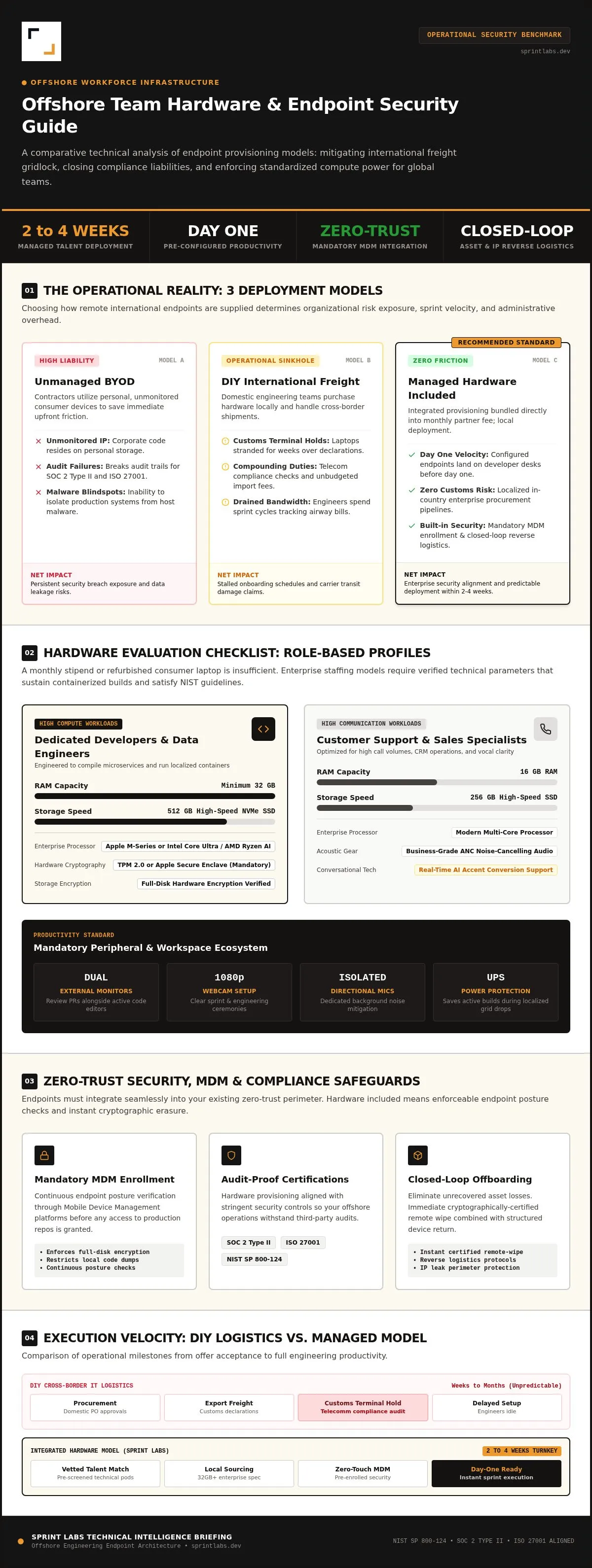
Offshore staffing typically defaults to three operational approaches: unmanaged Bring-Your-Own-Device (BYOD), self-managed international freight, or managed staffing with hardware delivery where required. Most organizations pick BYOD to save upfront time. They regret it almost immediately. Relying on contractor-owned machines turns corporate intellectual property into an unmonitored liability. Conversely, attempting to purchase and ship laptops internationally forces engineering leaders to act as customs brokers. True operational velocity requires an operational model that can provide managed devices where needed, helping ensure pre-configured machines land on developer desks before day one.
The Hidden Risks of the BYOD Trap
Personal laptops introduce dangerous architectural blind spots. Without uniform corporate control through Mobile Device Management (MDM) platforms, security teams cannot verify disk encryption, restrict local repository storage, or isolate internal systems from personal malware. This operational gap immediately compromises audit trails for SOC 2 Type II and modern ISO 27001 certifications. When remote developers run production workloads on unmonitored consumer devices, fragmented operating systems and accidental data leakage become persistent threats.
The True Friction of DIY Hardware Shipping
Procuring hardware domestically and shipping it overseas creates an administrative sinkhole. Cross-border IT logistics trigger complex customs classifications, strict telecommunications compliance checks, and heavy local import duties that quickly compound overhead. A single missing declaration form can leave a high-performance developer laptop stranded in an international customs terminal for weeks.
While packages sit in freight holding facilities, your hiring schedule stalls. Engineering leaders lose valuable sprint cycles tracking airway bills, managing carrier insurance claims for transit damage, and fielding onboarding delays. Standardizing on a managed provider that can provide offshore team hardware where needed reduces this friction, provisioning secure, enterprise-grade endpoints locally so new team members can begin executing without delay.
Evaluation Checklist: What Enterprise Hardware Included Should Actually Mean
Staffing firms often use vague terms to describe device support. When evaluating an offshore partner offering managed offshore hardware where needed, you need enforceable technical parameters. A monthly stipend or a refurbished consumer laptop won't protect enterprise data or sustain engineering throughput. You need standardized compute power, certified peripherals, and binding service levels that align directly with established NIST guidelines for enterprise mobile device security.
Core Machine Specifications for Developers and Back-Office
Modern engineering workflows require serious local resources to compile services and run containerized environments. Standardize device profiles by functional discipline:
- Dedicated Developers and Data Engineers: Minimum 32 GB RAM, 512 GB high-speed NVMe SSD storage, and current-generation enterprise processors (Apple M-Series or Intel Core Ultra / AMD Ryzen AI). Discrete hardware security chips (TPM 2.0 or Apple Secure Enclave) are mandatory for full-disk encryption.
- Customer Support and Sales Specialists: Modern multi-core processors, 16 GB RAM, 256 GB SSDs, and business-grade active noise-cancelling audio gear. For customer success units handling high call volumes, combining certified headsets with real-time AI accent conversion support removes conversational friction and elevates caller satisfaction.
Peripheral Ecosystem and Workspace Standards
Compute power alone doesn't complete the workstation. Productive distributed execution depends heavily on peripheral infrastructure. Engineering pods require dual external monitors to review PRs alongside active code editors, accompanied by ergonomic mechanical inputs. Remote setups should include 1080p webcams, dedicated directional microphones for clear sprint ceremonies, and uninterrupted power supplies (UPS) to protect active builds during localized grid fluctuations.
Hardware Replacement SLAs and In-Country Support
Hardware failures will happen. The operational difference lies in resolution speed. When you evaluate providers offering managed offshore hardware where needed, verify their localized support infrastructure. If a motherboard fails, an overseas ticket desk means an engineer sits idle for weeks.
Demand contracts that mandate a 24- to 48-hour swap-out Service Level Agreement (SLA). Vendors must maintain in-country floating equipment buffers and direct relationships with certified repair partners. This operational foundation keeps sprint velocity intact when physical faults occur. If managing this level of international technical logistics sounds like unnecessary overhead, consider partnering with Sprint Labs to deploy pre-configured developer pods without the procurement drag.
Security, MDM, and Compliance Checklist for Offshore Devices
Distributed endpoints represent your primary network perimeter. In a zero-trust architecture, you don't grant trust based on identity credentials alone; you evaluate device posture before authorizing access. Choosing a partner model with managed offshore hardware where needed helps ensure each provided machine connects directly to your identity and access management fabric under strict, non-negotiable security baselines.
Zero-Touch Provisioning and MDM Enrollment
Modern endpoint management eliminates manual staging entirely. Through automated zero-touch enrollment (utilizing platforms like Microsoft Intune, Jamf, or Kandji), corporate policies and security baselines push down the moment the machine completes its first network handshake. IT teams save hours of manual setup. More importantly, it guarantees the laptop cannot access production environments until enterprise configurations, identity profiles, and cryptographic certificates are fully installed. Remote wiping capability must be validated before granting repository access.
Endpoint Security and Access Controls
Hardening physical hardware prevents local compromises from becoming network intrusions. Every provisioned laptop must enforce rigid access controls by default:
- Hardware-Level Encryption: Enforce BitLocker (Windows) or FileVault (macOS) through mandatory TPM 2.0 or Secure Enclave chips, with recovery keys automatically escrowed into your enterprise directory.
- Restricted Privileges: Revoke local administrator rights. Blocking unsanctioned binary execution and unapproved browser extensions stops drive-by attacks and unauthorized software installations.
- EDR Integration: Deploy continuous endpoint detection and response tooling to monitor device health, flag anomalous behavior, and enforce real-time patch compliance.
Compliance Sign-Off and Asset Tracking
Enterprise audits demand absolute chain of custody. You can't satisfy SOC 2 Type II or ISO/IEC 27001:2022 standards using manual spreadsheets and informal asset logs. Every provisioned machine must link to an immutable digital registry that logs hardware serial numbers, hardware specifications, user assignments, and real-time encryption status.
Standardizing these device-level governance protocols with established managed offshore staffing in Asia frameworks ensures distributed pods satisfy enterprise vendor risk assessments without slowing sprint delivery.
Reverse Logistics and Offboarding: Protecting Your Assets and IP
Offboarding remote workers exposes companies to severe data vulnerabilities. When contracts conclude, reclaiming physical machines across borders without local ground operations turns into an operational nightmare. Packages go missing, couriers miss pickups, and corporate IP sits unsecured in residential environments. Where a managed device was provided, selecting a provider with hardware support shifts this retrieval burden to the staffing partner, closing offboarding windows with strict operational protocols.
Instant Remote Lockout Protocols
Physical distance cannot delay account revocation. The moment offboarding triggers, centralized device management isolates the machine. IT administrators instantly revoke Single Sign-On (SSO) credentials, disconnect active VPN tunnels, and push a cryptographic device lock command. Disabling mass-storage capabilities across local USB ports prevents departing workers from extracting proprietary source code or confidential datasets before returning the hardware. If physical recovery hits resistance, security teams execute a remote zero-state wipe immediately.
Physical Asset Reclamation and Custody Chains
Self-managed courier return labels rarely work. Independent recovery attempts fail frequently, leaving expensive machines unreturned and creating massive administrative follow-up drag. A managed hardware partner executes reverse logistics through structured local workflows:
- Direct Residential Collection: Insured, scheduled local couriers collect equipment directly from the departing worker's doorstep using specialized protective packaging.
- Chain of Custody Verification: Agents inspect physical components, record serial numbers, verify peripheral returns, and capture formal handover signatures.
- Secure Depot Intake: Assets transfer directly to local operations facilities for diagnostic logging, removing the client from regional transport headaches entirely.
Cryptographic Erasure and Device Re-Imaging
Hardware recovery requires auditable data destruction. Once a device reaches depot intake, certified technicians sanitize all local storage partitions under strict NIST SP 800-88 Rev. 1 media sanitization standards. This process erases cryptographic keys, operating system states, and residual cached files beyond recovery.
Technicians generate auditable wipe certificates to satisfy your internal security and compliance governance. Once certified clean, the machine re-enters inventory staging, ready for zero-touch configuration for the next technical placement. Choosing a managed offshore staffing partnership with hardware support where needed reduces asset write-offs and protects proprietary IP. If you want to eliminate cross-border retrieval headaches permanently, build your managed offshore team with Sprint Labs.
The Managed Staffing Advantage: How Sprint Labs Delivers Managed Teams and Hardware Support Where Needed
Traditional offshore staffing models fracture operational ownership. One vendor sources talent, another ships laptops, and internal IT scrambles to tie endpoints to access controls. Sprint Labs eliminates this friction. By consolidating talent vetting, contractor agreements, fees and payments, management support, and device management where required into a single operational partner, hiring teams scale without logistics headaches. Choosing this managed offshore staffing framework moves much of the operational burden off your engineering leadership.
All-Inclusive Operational Infrastructure
Capital expenditure spikes and unexpected logistics line items slow down hiring plans. Where a client needs a managed device, Sprint Labs can wrap hardware procurement, continuous maintenance, and replacement overhead into predictable, recurring monthly fees. You avoid surprise customs duties, import tariffs, and emergency courier invoices.
Whether you need dedicated developers, full project delivery squads, customer support teams, or finance officers, the physical environment arrives solved. Following proven guidelines to hire dedicated developers in Asia ensures that every individual contributor or delivery pod integrates directly into your existing Jira boards, Slack channels, and Git workflows from day one.
Velocity Without Compromise
Speed matters. Traditional cross-border procurement stretches hiring cycles across several months. Sprint Labs cuts through that timeline cleanly:
- Accelerated Onboarding: Move from candidate selection to active deployment in just 2 to 4 weeks.
- Pre-Configured Environments: Engineers boot up machines pre-enrolled in your required MDM profile, with approved IDEs, repos, and security baselines ready immediately.
- Direct Technical Control: You manage daily product backlogs, architecture decisions, and code reviews while Sprint Labs handles contractor agreements, engagement support, and physical operations where required.
- Elastic Scaling: Add dedicated contributors or complete delivery squads as roadmaps expand, backed by flexible 60-day operational terms.
Engineering leaders shouldn't have to double as international logistics managers. Partnering with a managed offshore staffing provider that can support hardware where needed lets your internal teams stay focused on building core product architecture while global contributors deploy smoothly, securely, and on schedule.
Standardize Your Distributed Infrastructure for 2026
Scaling a global workforce shouldn't force technical leaders to manage international freight routes or accept the severe liabilities of personal devices. Pre-configured machines, zero-touch MDM enrollment, and structured reverse logistics turn hardware from an administrative headache into an ironclad operational perimeter. Choosing a model with managed hardware support where needed protects your proprietary source code while equipping top global talent to contribute quickly.
Sprint Labs reduces logistics friction. We manage the contractor engagement lifecycle, handling talent vetting, contractor agreements, fees and payments, management support, and enterprise hardware deployment where required within predictable monthly fees. Where a managed device is needed, your technical professionals can start with pre-configured, secure equipment within 2 to 4 weeks, leaving your engineering leadership free to focus strictly on product architecture and sprint velocity. Stop tracking international courier delays and build your technical pipeline with confidence. Build a managed offshore team with Sprint Labs today.
Frequently Asked Questions
What can managed offshore hardware support actually cover in a managed staffing contract?
Where a client needs a managed device, managed offshore hardware support can cover enterprise-grade laptops, essential peripherals, local device procurement, and maintenance coordinated as part of the engagement. This can include high-spec developer machines, dual displays, ergonomic accessories, and IT asset coordination. You don't have to manage equipment capital expenditures, customs clearance documentation, or international transport logistics internally.
How do we install our corporate security tools and MDM profiles on vendor-provided laptops?
Devices enroll into your Mobile Device Management platform via zero-touch provisioning before the contractor logs in for the first time. The provider coordinates hardware serials with your IT team to link Apple Business Manager or Windows Autopilot. This connection pushes your specific disk encryption, endpoint protection, and VPN profiles down automatically on the first network boot.
What happens if an offshore engineer laptop breaks down during a sprint?
The staffing provider coordinates rapid in-country replacement through active service level agreements. Instead of shipping a machine internationally, the provider deploys a pre-configured replacement from an in-country buffer within 24 to 48 hours. Certified repair technicians handle hardware diagnostics locally. Your developer transitions to the backup device quickly, preserving sprint velocity and preventing unbilled engineering downtime.
Why is a managed hardware model safer than allowing offshore developers to use BYOD?
Personal devices lack centralized security visibility and expose your codebase to malware or accidental leakage. Where a managed device is needed, choosing a partner model with managed offshore hardware support enables strict endpoint isolation, enforced disk encryption, restricted local administrative privileges, and continuous compliance telemetry. You maintain complete auditability for SOC 2 and ISO standards while retaining the technical authority to trigger immediate remote wipes if risk surfaces.
How does hardware recovery work when an offshore team member rolls off the engagement?
Where a managed device was provided, the staffing partner manages complete reverse logistics on the ground. When offboarding triggers, IT revokes digital access credentials and initiates remote device locks through MDM. Insured couriers schedule doorstep collection from the contractor's residence with tamper-evident packaging. The hardware returns to a regional facility for physical inspection, followed by verifiable NIST SP 800-88 cryptographic sanitization.
Can our company specify exact hardware configurations like MacBook Pros or high-RAM Linux machines?
Yes. Managed staffing partners align procurement with your specific technical stack. Whether your software engineers require high-tier Apple silicon machines, 32 GB RAM configurations for containerized workflows, or specialized Linux environments, the provider provisions matching hardware profiles. You define the exact compute baseline and operating system images required for your developers during the initial scoping stage.
Are there hidden customs fees or shipping costs when hardware is included?
No. Reputable managed staffing partners absorb all procurement, local import taxes, freight insurance, and courier logistics into their standard recurring monthly fees. Because devices are sourced and deployed through established in-country distribution channels rather than mailed cross-border, you don't face unexpected tariff invoices, customs storage penalties, or surprise administrative surcharges on your monthly statements.
Frequently asked questions
What can managed offshore hardware support actually cover in a managed staffing contract?
Where a client needs a managed device, managed offshore hardware support can cover enterprise-grade laptops, essential peripherals, local device procurement, and maintenance coordinated as part of the engagement. This can include high-spec developer machines, dual displays, ergonomic accessories, and IT asset coordination. You don't have to manage equipment capital expenditures, customs clearance documentation, or international transport logistics internally.
How do we install our corporate security tools and MDM profiles on vendor-provided laptops?
Devices enroll into your Mobile Device Management platform via zero-touch provisioning before the contractor logs in for the first time. The provider coordinates hardware serials with your IT team to link Apple Business Manager or Windows Autopilot. This connection pushes your specific disk encryption, endpoint protection, and VPN profiles down automatically on the first network boot.
What happens if an offshore engineer laptop breaks down during a sprint?
The staffing provider coordinates rapid in-country replacement through active service level agreements. Instead of shipping a machine internationally, the provider deploys a pre-configured replacement from an in-country buffer within 24 to 48 hours. Certified repair technicians handle hardware diagnostics locally. Your developer transitions to the backup device quickly, preserving sprint velocity and preventing unbilled engineering downtime.
Why is a managed hardware model safer than allowing offshore developers to use BYOD?
Personal devices lack centralized security visibility and expose your codebase to malware or accidental leakage. Where a managed device is needed, choosing a partner model with managed offshore hardware support enables strict endpoint isolation, enforced disk encryption, restricted local administrative privileges, and continuous compliance telemetry. You maintain complete auditability for SOC 2 and ISO standards while retaining the technical authority to trigger immediate remote wipes if risk surfaces.
How does hardware recovery work when an offshore team member rolls off the engagement?
Where a managed device was provided, the staffing partner manages complete reverse logistics on the ground. When offboarding triggers, IT revokes digital access credentials and initiates remote device locks through MDM. Insured couriers schedule doorstep collection from the contractor's residence with tamper-evident packaging. The hardware returns to a regional facility for physical inspection, followed by verifiable NIST SP 800-88 cryptographic sanitization.
Can our company specify exact hardware configurations like MacBook Pros or high-RAM Linux machines?
Yes. Managed staffing partners align procurement with your specific technical stack. Whether your software engineers require high-tier Apple silicon machines, 32 GB RAM configurations for containerized workflows, or specialized Linux environments, the provider provisions matching hardware profiles. You define the exact compute baseline and operating system images required for your developers during the initial scoping stage.
Are there hidden customs fees or shipping costs when hardware is included?
No. Reputable managed staffing partners absorb all procurement, local import taxes, freight insurance, and courier logistics into their standard recurring monthly fees. Because devices are sourced and deployed through established in-country distribution channels rather than mailed cross-border, you don't face unexpected tariff invoices, customs storage penalties, or surprise administrative surcharges on your monthly statements.
Hiring in Asia? We'll do it for you.
Sprint Labs is a managed staffing firm. We recruit, vet, place and manage senior professionals across the Philippines, Vietnam, Malaysia, Indonesia and India. You direct the work, we handle the engagement.
Create a request →