
Hire Dedicated Developers in Asia: The 2026 High-Velocity Operational Playbook
Ready to hire dedicated developers in Asia? Our 2026 playbook shows you how to cut costs by 70% & hire top talent in 4 weeks, minus the operational friction.
Most engineering leaders treat offshore hiring as a high-risk gamble when it should be a calculated exercise in operational leverage. You've likely felt the friction of local recruitment where talent is overpriced and the hiring process moves at a glacial pace. When you decide to hire dedicated developers in asia, you shouldn't have to choose between technical excellence and legal compliance. The traditional BPO model is broken. It leaves CTOs to drown in management overhead and inconsistent code quality.
We understand the frustration of managing remote teams that feel like outsiders rather than an integrated extension of your office. You need a system that removes the "engine room" noise of HR, hardware, and payroll. This 2026 operational playbook shows you how to reduce your burn rate by 60-70% without sacrificing speed or standards. We'll explore a managed staffing model that delivers top-tier talent in under four weeks, ensuring your global team is fully compliant and ready to ship. From navigating India's new labor codes to leveraging Vietnam's high-tech incentives, this is your guide to friction-less scaling.
Key Takeaways
- Scale your engineering team with 60-70% cost savings compared to local markets. Reduce your total time-to-hire to a predictable 2-4 week window.
- Learn how to hire dedicated developers in asia using a managed model that eliminates the legal and operational friction of setting up a foreign entity.
- Adopt a multi-stage vetting blueprint to identify the top 1% of technical talent. This process replaces the inconsistency of freelance marketplaces with vetted engineering quality.
- Map regional technical strengths across Asia to find the best fit for backend, mobile, or specialized AI development.
- Focus on shipping code while an operational partner handles the "engine room" of hardware, payroll, and local compliance.
Table of Contents
- Scaling Engineering Velocity: Why Asia is the Strategic Choice for 2026
- Managed Staffing vs. Traditional Outsourcing: Defining the New Standard
- Navigating the Asian Talent Market: Regional Strengths and Technical Verticals
- The Vetting Blueprint: Identifying and Integrating Top 1% Technical Talent
- Building Your Offshore Engine with Sprint Labs: Speed, Compliance, and Scale
Scaling Engineering Velocity: Why Asia is the Strategic Choice for 2026
The 2026 talent paradox is clear. Demand for senior engineers has hit record highs, yet local salary inflation has made domestic hiring unsustainable for most high-growth companies. You can't scale a product on overpriced, scarce talent. Traditional "offshoring" is dead. It's been replaced by global team integration. Modern startups don't just outsource tasks. They embed high-seniority talent into their core workflows to maintain a competitive edge.
Asia has emerged as the primary hub for this shift. It's no longer about basic maintenance. It's about core product development. High-velocity companies now use Asian teams to maintain 24/7 development cycles. While your local team sleeps, your offshore engine is shipping. This isn't just a cost play. It's a velocity play. Understanding the history of offshore development helps clarify why this region now dominates the technical landscape. When you hire dedicated developers in asia, you're accessing a talent density that local markets simply can't match.
The Local Hiring Bottleneck
Local recruitment is a momentum killer. A standard 3-6 month hiring cycle is too slow for 2026. By the time you onboard a senior dev, your roadmap has already shifted. Then come the hidden costs. Office space. Benefits. Payroll taxes. These overheads bloat your burn rate without adding a single line of code. The cost-to-velocity ratio measures the capital efficiency of your engineering output relative to the speed of feature deployment, serving as a critical metric for the modern CTO. If your hiring speed isn't matching your deployment goals, you're losing market share.
Asia's Technical Maturity in 2026
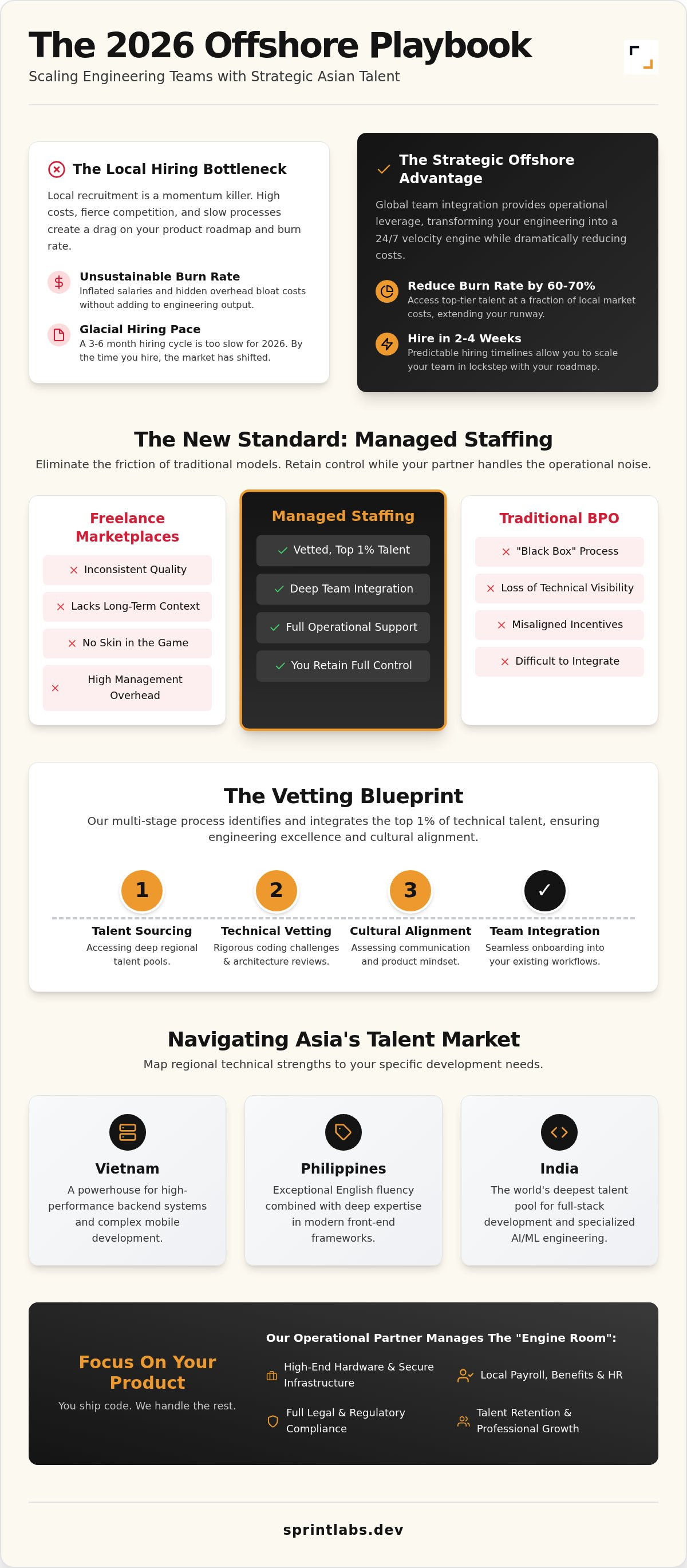
The talent pool has matured significantly. In regions like Vietnam, the Philippines, and India, the focus has shifted to sophisticated backend and mobile architecture. English proficiency is now the standard, not the exception. Cultural alignment is seamless. You aren't just getting workers. You're getting engineers who understand product-led growth. The depth of the talent pool is staggering:
- Vietnam: A powerhouse for high-performance backend systems and mobile development.
- Philippines: Exceptional English fluency combined with strong front-end expertise.
- India: The world's deepest pool of full-stack and specialized AI specialists.
To hire dedicated developers in asia is to leverage this technical maturity. You get 60-70% cost savings compared to local hires. More importantly, you get a hiring timeline of 2-4 weeks. That's how you maintain velocity in a crowded market. You don't wait for talent; you integrate it.
Managed Staffing vs. Traditional Outsourcing: Defining the New Standard
The traditional Business Process Outsourcing (BPO) model is a black box. You hand over a project and lose visibility. You're left hoping the final product matches your specs. Managed staffing solves this by embedding dedicated employees directly into your engineering team. When you hire dedicated developers in asia through a managed model, you retain full control over the technical direction while your partner handles the operational noise. It combines the transparency of an in-house team with the agility of a service provider. You drive the car; we maintain the engine.
Freelance marketplaces are often the first mistake scaling startups make. These platforms are built for short-term tasks, not core engineering. Core product development requires long-term commitment and deep technical context. A Southeast Asian software market analysis highlights the region's rapid shift toward high-value software services. This trend makes the region a prime location for long-term technical partnerships rather than gig-based bidding. Freelancers lack skin in the game. They don't care about your technical debt or long-term scalability. Managed developers do.
The Three Pillars of Managed Staffing
Managed staffing rests on three operational foundations. First, operational support ensures every developer has high-end hardware and stable, high-speed infrastructure. Second, HR and retention teams manage benefits, culture, and local compliance. Third, technical oversight keeps engineers engaged with your product roadmap. This structure prevents the management tax that usually kills offshore efficiency. It ensures your team feels like a natural extension of your local office, not a distant vendor.
Managed Staffing vs. Employer of Record (EOR)
Many CTOs confuse managed staffing with Employer of Record (EOR) services like Remote.com. These platforms are passive. They handle payroll and taxes, but they don't help you find or vet talent. You're still responsible for the heavy lifting of recruitment and vetting. The managed difference is active. We don't just process a paycheck; we build the team. We source, vet, and onboard talent in a 2-4 week timeline.
This approach bridges the gap between a simple recruiter and a compliance-only EOR. It allows you to hire dedicated developers in asia with zero operational friction. If you want to scale without the administrative burden, you can partner with Sprint Labs to handle the entire lifecycle. This managed model delivers 60-70% cost savings compared to local hiring while maintaining the technical standards your product requires. You get the talent without the headache.
Navigating the Asian Talent Market: Regional Strengths and Technical Verticals
Asia isn't a monolith. Success depends on matching your specific technical stack to the right geography. Generic BPOs fail because they ignore regional specializations, treating every developer as a fungible resource. When you hire dedicated developers in asia, you're buying into regional ecosystems that have spent decades maturing in specific verticals. This strategic alignment is backed by the U.S. government's view on Asian tech, which recognizes the region's critical role in global digital infrastructure and cybersecurity.
Vietnam is the rising powerhouse for high-performance backend systems and mobile development. Following Decree No. 260/2026/ND-CP, the country has doubled down on R&D incentives, attracting senior talent focused on complex architecture. The Philippines remains the gold standard for QA, frontend engineering, and customer-facing technical roles due to exceptional English fluency. India continues to provide unparalleled scale for enterprise-grade architecture. In 2026, Indian specialists in AI and Machine Learning are commanding 15-20% raises, reflecting their dominance in high-value, specialized engineering.
Matching Stack to Geography
Different regions excel in specific frameworks. Cultural nuances also dictate communication styles. Vietnam's engineering culture is direct and solution-oriented. The Philippines offers a collaborative approach that mirrors Western startup environments. India provides the depth needed for massive, multi-year enterprise migrations. Use the following table to align your needs with regional strengths.
| Region | Primary Tech Strength | English Proficiency | Best For |
|---|---|---|---|
| Vietnam | Backend, Mobile, Go, Rust | Professional | High-velocity product builds |
| Philippines | Frontend, QA, React, Swift | Native-level | Integrated product squads |
| India | Enterprise, AI/ML, Full-stack | Fluent | Scale and complex architecture |
Beyond Engineering: Scaling the Back Office
The managed model extends beyond the IDE. High-velocity companies use the same infrastructure to scale Sales Development Representatives (SDRs) and Marketing Operations. These roles require the same operational rigor as engineering. Managed teams in the Philippines, for example, now drive $42 billion in export revenue, proving their capability in high-value business process management. Hiring Finance and Accounting officers in these regions allows you to maintain 24/7 back-office operations. Unlike generic call centers, these managed pods are embedded in your culture. They use your tools, follow your SOPs, and report directly to your leadership. You get a global headquarters feel without the global headquarters cost.
The Vetting Blueprint: Identifying and Integrating Top 1% Technical Talent
Vetting is the operational barrier against mediocrity. Most offshore hiring failures stem from a lack of rigorous filtering. 99% of applications in the global market are noise. Generic agencies pass this noise directly to your inbox, forcing your engineering leads to waste hours on sub-par interviews. When you hire dedicated developers in asia through a managed model, the goal is to eliminate this friction. You need a multi-stage funnel that prioritizes technical execution over polished resumes.
The blueprint for top-tier talent moves beyond static portfolio reviews. Portfolios can be curated; live code cannot. A sophisticated assessment includes automated coding challenges followed by deep-dive architecture reviews. We look for engineers who don't just write syntax but understand system design. This process ensures that when a developer joins your team, they are ready to contribute to core product features in week one. It's about finding proactive problem solvers who fit the high-velocity culture of a modern startup.
Rigorous Technical Screening
Live coding sessions are mandatory. We test for real-world scenarios, not academic puzzles. This includes vetting for DevOps and Cloud proficiency across AWS, Azure, and GCP. If your stack relies on specialized infrastructure, the vetting process must reflect that complexity. Sprint Labs executes this entire funnel before you ever see a candidate. This meticulous approach is how we maintain a 2-4 week delivery timeline while ensuring 60-70% cost savings compared to local hires. We handle the technical "engine room" so your CTO can focus on the product roadmap.
If you are ready to stop filtering resumes and start shipping code, you can hire dedicated developers in asia who have already cleared our 1% threshold.
Seamless Team Integration
Integration is where many remote teams fail. It requires more than just a Slack invite. You need established asynchronous communication protocols to bridge time zone gaps. Tools like Jira and Slack must be used with discipline to maintain visibility. The "One Team" culture is the standard. We avoid the "Us vs. Them" mentality by embedding developers directly into your daily standups and sprint cycles. Success in week one depends on clear expectations and immediate access to documentation.
Managing time zone overlaps is a strategic exercise. We structure teams to ensure at least 3-4 hours of synchronous collaboration time. This allows for rapid feedback loops while leveraging the remaining hours for deep, focused work. By the time your local team logs on, the offshore engine has already moved the needle. This cycle creates a continuous development loop that doubles your operational velocity without increasing your management burden.
Building Your Offshore Engine with Sprint Labs: Speed, Compliance, and Scale
Sprint Labs serves as the operational architect for firms that have outgrown the limitations of freelance marketplaces and passive EORs. We solved the "No Entity" problem by providing a bridge of Singapore-based legal trust with high-velocity execution across the Asian continent. You don't need to navigate foreign tax codes or risk legal violations in complex jurisdictions like India. We handle the entire legal and operational stack. When you hire dedicated developers in asia through our managed model, you secure 60-70% cost savings without the management tax.
Our "Pod" model takes this a step further. Instead of just individual contributors, we build project delivery squads that take end-to-end ownership of your product features. This moves the needle from simple staffing to true engineering partnership. We provide the high-spec hardware and secure environments your IP requires. Our 60-day notice flexibility ensures you can scale up or down without the long-term risk associated with traditional employment contracts. This is how you maintain a high-velocity burn rate while keeping your capital focused on growth.
Managed Operations & Compliance
We handle the "engine room" noise. This includes payroll, local taxes, and strict adherence to labor laws like India's 2025 Labor Codes. You direct the work; we maintain the machine. Our infrastructure team ensures every developer has the specific hardware and high-speed connectivity needed for seamless remote work. Security isn't an afterthought. We implement secure environments to protect your codebase and data integrity at every level. This managed approach eliminates the "hidden" overhead that usually erodes the value of offshore teams.
Getting Started: The 4-Week Roadmap
Velocity is our core metric. We reduce the hiring cycle from months to weeks. Our process is designed for decision-makers who value time as much as technical proficiency. It is the most efficient path to hire dedicated developers in asia without the friction of traditional recruitment.
- Step 1: Requirement Discovery: We profile your roles and technical stack to align with regional strengths identified in previous sections.
- Step 2: Rapid Sourcing: We leverage our pre-vetted database to find the top 1% of talent in as little as 14 days.
- Step 3: Client Interviews: You conduct final technical reviews to ensure cultural and architectural fit.
- Step 4: Onboarding: We handle the hardware logistics and HR setup for a seamless week-one start.
This roadmap takes you from a resource bottleneck to a fully operational global team in under a month. Ready to scale? Book a consultation with Sprint Labs today.
Future-Proofing Your Technical Roadmap
Local hiring is a momentum killer. To hire dedicated developers in asia is to choose operational leverage over administrative noise. You've seen how regional specializations and a rigorous vetting blueprint can transform your cost-to-velocity ratio. By choosing a managed model over a passive EOR or a fragmented marketplace, you retain the control of an in-house team with the agility of a global service.
Sprint Labs provides the structural superiority needed to scale without friction. We deliver 60-70% cost savings and a hiring cycle of just 2-4 weeks. With our Singapore-based headquarters providing global trust and local execution, your leadership stays focused on the product roadmap while we maintain the engine room. It's time to replace record-high local salary inflation with a calculated, high-velocity engineering strategy.
Scale your engineering team with managed developers in Asia and build for the future today.
Frequently Asked Questions
How much can I actually save by hiring dedicated developers in Asia?
You will typically realize 60-70% cost savings compared to hiring local engineers in markets like the US, UK, or Australia. This reduction includes more than just base salary. It covers benefits, payroll taxes, and office overhead. When you hire dedicated developers in asia, you convert high local fixed costs into a predictable monthly managed fee. This allows you to scale your engineering team without the unsustainable burn rate of domestic markets.
Do I need to set up a local entity to hire developers in Vietnam or the Philippines?
No local entity is required. Sprint Labs operates as the Employer of Record and managed partner, handling all legal compliance, payroll, and HR in jurisdictions like Vietnam, India, and the Philippines. You avoid the legal complexity and compliance risks of direct offshore hiring. We provide a Singapore-based legal framework that ensures global trust while we execute the "engine room" operations locally in Asian markets on your behalf.
How does Sprint Labs ensure the technical quality of the developers?
We utilize a multi-stage technical funnel to identify the top 1% of talent. This process moves beyond static resumes to include automated coding tests and live architecture reviews. Our internal engineering leads vet candidates for specific stack proficiency, including DevOps and Cloud expertise. You only interview candidates who have already passed our rigorous technical and communication assessments. This ensures your high-velocity team maintains the same standards as your local office.
What happens if a developer doesn't work out or leaves the team?
We manage the entire employee lifecycle to maximize retention. If a developer leaves or isn't a fit, we leverage our 60-day notice flexibility and deep talent database to source a replacement rapidly. Because we maintain an active pipeline, we can often fill gaps within our standard 2-4 week hiring window. Our local HR teams focus on culture and engagement to minimize turnover and keep your project momentum high.
How do you handle time zone differences between Asia and the US or UK?
We structure teams to ensure at least 3-4 hours of synchronous overlap with your local headquarters. This allows for daily standups and real-time collaboration. The remaining hours are utilized for deep, focused work while your local team is offline. We implement strict asynchronous communication protocols using tools like Slack and Jira. This creates a continuous 24/7 development cycle that effectively doubles your operational output without increasing your management burden.
What is the typical timeline from signing a contract to a developer starting?
The typical timeline from requirement discovery to a developer starting is 2-4 weeks. This is significantly faster than the 3-6 month cycles common in local recruitment. Our high-velocity sourcing engine allows us to identify, vet, and present candidates in as little as 14 days. Once you make a selection, we handle the hardware logistics and onboarding immediately. This speed allows you to hire dedicated developers in asia and respond to market shifts without stalling your roadmap.
Does Sprint Labs provide equipment like laptops and office space?
Yes, we provide full operational handling, including high-spec hardware and secure office environments. Every developer receives the specific equipment your security protocols require. We also manage high-speed internet connectivity and redundant power systems to ensure zero downtime. You don't have to worry about the logistics of shipping laptops or managing local facilities. We handle the physical "engine room" so you can focus entirely on directing the technical work.
How do managed staffing fees work compared to a traditional recruitment fee?
Managed staffing uses a recurring monthly fee rather than a one-time recruitment percentage. Traditional recruiters charge a fee and disappear. Our model is different. The monthly fee covers recruitment, vetting, payroll, HR, hardware, and infrastructure for as long as the developer is on your team. This aligns our incentives with your long-term success. You get a dedicated resource embedded in your team without the administrative burden of being a foreign employer.
Frequently asked questions
How much can I actually save by hiring dedicated developers in Asia?
You will typically realize 60-70% cost savings compared to hiring local engineers in markets like the US, UK, or Australia. This reduction includes more than just base salary. It covers benefits, payroll taxes, and office overhead. When you hire dedicated developers in asia, you convert high local fixed costs into a predictable monthly managed fee. This allows you to scale your engineering team without the unsustainable burn rate of domestic markets.
Do I need to set up a local entity to hire developers in Vietnam or the Philippines?
No local entity is required. Sprint Labs operates as the Employer of Record and managed partner, handling all legal compliance, payroll, and HR in jurisdictions like Vietnam, India, and the Philippines. You avoid the legal complexity and compliance risks of direct offshore hiring. We provide a Singapore-based legal framework that ensures global trust while we execute the "engine room" operations locally in Asian markets on your behalf.
How does Sprint Labs ensure the technical quality of the developers?
We utilize a multi-stage technical funnel to identify the top 1% of talent. This process moves beyond static resumes to include automated coding tests and live architecture reviews. Our internal engineering leads vet candidates for specific stack proficiency, including DevOps and Cloud expertise. You only interview candidates who have already passed our rigorous technical and communication assessments. This ensures your high-velocity team maintains the same standards as your local office.
What happens if a developer doesn't work out or leaves the team?
We manage the entire employee lifecycle to maximize retention. If a developer leaves or isn't a fit, we leverage our 60-day notice flexibility and deep talent database to source a replacement rapidly. Because we maintain an active pipeline, we can often fill gaps within our standard 2-4 week hiring window. Our local HR teams focus on culture and engagement to minimize turnover and keep your project momentum high.
How do you handle time zone differences between Asia and the US or UK?
We structure teams to ensure at least 3-4 hours of synchronous overlap with your local headquarters. This allows for daily standups and real-time collaboration. The remaining hours are utilized for deep, focused work while your local team is offline. We implement strict asynchronous communication protocols using tools like Slack and Jira. This creates a continuous 24/7 development cycle that effectively doubles your operational output without increasing your management burden.
What is the typical timeline from signing a contract to a developer starting?
The typical timeline from requirement discovery to a developer starting is 2-4 weeks. This is significantly faster than the 3-6 month cycles common in local recruitment. Our high-velocity sourcing engine allows us to identify, vet, and present candidates in as little as 14 days. Once you make a selection, we handle the hardware logistics and onboarding immediately. This speed allows you to hire dedicated developers in asia and respond to market shifts without stalling your roadmap.
Does Sprint Labs provide equipment like laptops and office space?
Yes, we provide full operational handling, including high-spec hardware and secure office environments. Every developer receives the specific equipment your security protocols require. We also manage high-speed internet connectivity and redundant power systems to ensure zero downtime. You don't have to worry about the logistics of shipping laptops or managing local facilities. We handle the physical "engine room" so you can focus entirely on directing the technical work.
How do managed staffing fees work compared to a traditional recruitment fee?
Managed staffing uses a recurring monthly fee rather than a one-time recruitment percentage. Traditional recruiters charge a fee and disappear. Our model is different. The monthly fee covers recruitment, vetting, payroll, HR, hardware, and infrastructure for as long as the developer is on your team. This aligns our incentives with your long-term success. You get a dedicated resource embedded in your team without the administrative burden of being a foreign employer.
Hiring in Asia? We'll do it for you.
Sprint Labs is a managed staffing firm. We recruit, vet, employ and retain senior talent across the Philippines, Vietnam, Malaysia, Indonesia and India — you direct the work, we handle everything else.
Create a request →