
Scaling Engineering Teams: High-Velocity Guide 2026
Learn how scaling engineering teams quickly is possible. Our 2026 guide shows you how to triple capacity and cut costs by 70% with managed offshore squads.
Local hiring is a bottleneck that kills momentum. Waiting six months for a senior developer isn't just slow; it's a strategic failure. Most leaders struggle with scaling engineering teams quickly because they rely on outdated recruitment models that prioritize geography over velocity. This friction creates a high burn rate and leaves your roadmap vulnerable to competitors who move faster.
You likely recognize that the traditional "post and pray" method is broken. It results in technical debt from rushed hires and communication friction that stalls delivery. This guide provides a sophisticated alternative. You'll learn how to triple your engineering capacity in weeks without sacrificing code quality or burning your budget. We have identified a systemic flaw in how teams grow and developed a precise remedy for it.
We'll explore how shifting to managed offshore squads in Asia delivers a 60-70% cost reduction and a predictable hiring pipeline. This isn't about simple staff augmentation. It's about building an engine room that integrates seamlessly with your existing workflow, allowing you to hit your 2026 milestones ahead of schedule.
Key Takeaways
Avoid the Scaling Trap where management overhead exceeds new output. Learn why traditional hiring models stall startup momentum in 2026.
Implement a 4-week execution framework for scaling engineering teams quickly. Replace stagnant local recruitment with a high-velocity talent pipeline in Asia.
Eliminate the recruitment and management burden inherent in EOR models. Leverage managed staffing to handle payroll, HR, and hardware requirements.
Transition effectively from generalist teams to specialized Series A infrastructure. Deploy Dedicated Developers or Project Delivery Squads to maintain high code standards.
Reduce engineering costs by 60-70% while accelerating your roadmap. Build a managed engine room that integrates seamlessly with your existing internal team.
Table of Contents
The Scaling Trap: Why Velocity Drops as Headcount Grows
Engineering Evolution: Navigating Growth Stages from Seed to Series B
The Infrastructure of Scale: Managed Staffing vs. EOR vs. Local Hiring
The 4-Week Execution Framework: Vetting and Onboarding at Speed
Sprint Labs: Building Your Offshore Engineering Engine in Asia
The Scaling Trap: Why Velocity Drops as Headcount Grows
Growth is a double-edged sword. For many leaders, scaling engineering teams quickly feels like running up a down escalator. You add headcount, but output plateaus or declines. This is the Scaling Trap. It occurs at the precise moment when management overhead begins to outpace new production. In 2026, Brooks Law remains a brutal reality. Adding engineers to a late project still makes it later, but today, the friction is amplified by complex microservices and distributed workflows. A foundational step in understanding scalability is recognizing that organizational growth is rarely linear.
Traditional hiring cycles kill startup momentum because they ignore the mechanics of integration. Scaling isn't just a recruitment problem; it's an operational one. If your system for onboarding isn't as robust as your CI/CD pipeline, every new hire becomes a bottleneck rather than an accelerator. True velocity requires a systemic shift away from individual seat-filling toward managed, high-output structures.
The Management Tax of Rapid Growth
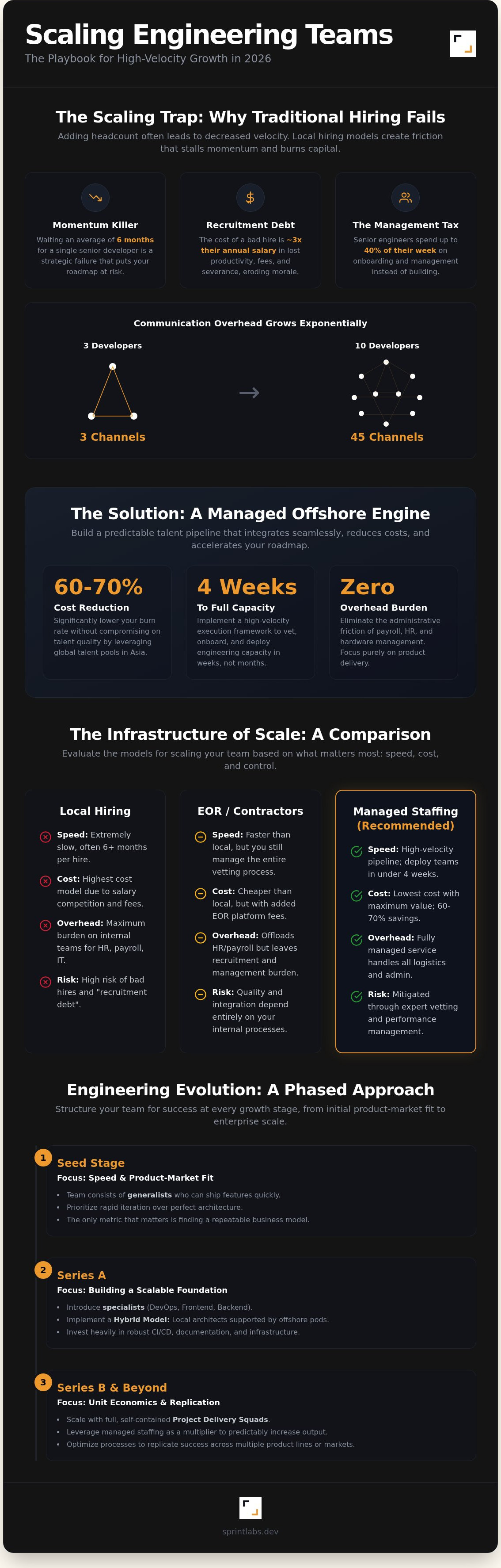
Communication channels expand exponentially with every hire. While three developers share three channels, ten developers share forty-five. Every new engineer requires syncs, stand-ups, and documentation. This creates a management tax that drains your existing senior capacity. Your top architects, the people who should be building the future, often spend 40% of their week onboarding new hires. You hire more to ship faster, but you ship less because your engine room is clogged with administrative friction. This is the hidden cost of local, unmanaged growth.
Identifying Recruitment Debt Before It Breaks Your Team
Recruitment debt isn't always visible on a balance sheet, but its symptoms are unmistakable. Look for long PR review times and consistent roadmap slippage. When you prioritize speed over structural alignment, you overlook technical nuance and cultural fit. According to industry data, the cost of a bad hire is approximately 3x their annual salary when accounting for severance, recruitment fees, and lost productivity. Beyond the budget, it erodes team morale and trust. Recruitment Debt is the long-term cost of rushed, unmanaged hiring.
To avoid this, you need a predictable pipeline that bypasses the friction of local talent wars. Moving toward Dedicated Developers or Project Delivery Squads in Asia allows you to bypass these bottlenecks. By utilizing a managed "engine room" that handles the logistics of hardware, payroll, and initial vetting, you can focus on output rather than overhead. This approach ensures that scaling engineering teams quickly doesn't result in the velocity crash that kills most startups during their transition from Seed to Series B.
Engineering Evolution: Navigating Growth Stages from Seed to Series B
Engineering growth isn't a straight line. It's a series of structural shifts. Seed stage demands generalists. Speed is the only metric. You're hunting for product-market fit. Series A changes the game. Specialists take over. Infrastructure becomes the priority. Build robust CI/CD now or drown in technical debt later. The 2026 market is unforgiving. With 87% of tech leaders reporting challenges in finding skilled workers, the local talent pool is no longer sufficient. Waiting until Series B to integrate offshore talent is a strategic error. High-velocity firms integrate global resources early. They preserve capital. They maintain momentum.
Seed to Series A: Building the Foundation
Focus on a hybrid model. Hire 1-2 local architects. These are your cultural and technical anchors. Support them with offshore pods. This structure allows for lessons in scaling engineering teams to be applied without the local overhead. Establish technical standards early. Documentation isn't optional. It's the API for your organization. A strong DevOps culture enables a global footprint. It ensures that an engineer in Asia can push code as easily as one in your home office. This is how you begin scaling engineering teams quickly while keeping your core team focused on high-level strategy.
Series B and Beyond: The Managed Staffing Multiplier
Series B is about unit economics. You've proven the model. Now you must replicate it at scale. Transition from individual hires to full Project Delivery Squads. These are self-contained units with a dedicated management layer. They don't just add capacity. They add capability. Maintain culture through radical transparency. Use documented standards to remove ambiguity across time zones. Asia-based talent provides a distinct advantage: the 24/7 development cycle. Your local team finishes their day. Your offshore squad picks up the baton. This continuous delivery model is essential for meeting aggressive roadmaps. Scaling engineering teams quickly at this stage requires moving beyond simple staff augmentation toward these integrated models. If you're ready to optimize your delivery architecture, consider how Dedicated Developers can bridge the gap between your current capacity and your growth targets.
The Infrastructure of Scale: Managed Staffing vs. EOR vs. Local Hiring
Local hiring is a legacy model. In 2026, a 6-month lead time for a senior developer is a roadmap killer. High salaries and extreme retention risk in local markets drain your runway and stall momentum. If your growth strategy depends on winning local talent wars, you've already lost. High-velocity firms recognize that scaling engineering teams quickly requires moving beyond geographical constraints and embracing models designed for speed.
Employer of Record (EOR) services are often mistaken for a scaling solution. They are not. An EOR is a legal shield. It handles payroll and compliance but leaves the recruitment, vetting, and daily operational management in your lap. You are still responsible for finding the top 1% of talent and ensuring they have the tools to succeed. This creates a hidden management tax that slows your ascent from Seed to Series B.
Managed staffing is the structural remedy. At Sprint Labs, we operate as your offshore engine room. We don't just find developers; we integrate them. This end-to-end approach covers recruitment, technical vetting, and ongoing HR support. It is the only model built for the speed of a modern rollout, offering a predictable 2-4 week hiring timeline that bypasses the friction of traditional methods.
Comparing Operational Overhead
Who handles the hardware and office space in Vietnam or the Philippines? In an EOR model, that logistics burden falls on your internal team. You become a procurement officer instead of a product leader. Managed staffing flips the script. We provide the infrastructure, from high-end hardware to secure office environments. There is a fundamental difference between renting a developer through a marketplace and embedding a managed employee into your culture. EOR models often fail during rapid engineering scale because they lack a technical vetting layer. They'll hire anyone you find. We only hire those who meet our rigorous standards.
The Economics of Global Engineering
The math is undeniable. Shifting your development focus to Asia yields a 60-70% cost saving without sacrificing code quality. This isn't about cutting corners. It's about arbitrage. Reinvest those savings into aggressive R&D or high-level local leadership. You can hire three senior offshore engineers for the price of one local mid-level developer. This capital efficiency extends your runway and accelerates your time-to-market. Sprint Labs removes the operational friction of Asian market entry by managing the structural complexities of local employment and infrastructure. This approach ensures your team remains focused on building product while we handle the engine room.
The 4-Week Execution Framework: Vetting and Onboarding at Speed
Speed is a competitive advantage. Most firms fail at scaling engineering teams quickly because their recruitment process is reactive. They wait for candidates to apply and then spend weeks in a sluggish interview loop. A high-velocity framework flips this. It treats recruitment as a precision engineering problem with a defined 4-week timeline. To hit your roadmap milestones, you must move from a "post and pray" mentality to a structured execution engine.
The first step is defining the profile. Move beyond generic keyword lists. Focus on functional requirements. What specific problems will this engineer solve in their first 90 days? Once the profile is set, the technical vetting must be rapid. Identifying the top 1% of talent should take 72 hours, not three weeks. We look for cultural alignment next. Testing for communication, proactivity, and ownership is as vital as checking their syntax. Finally, integration begins. Your "First 30 Days" playbook must be ready before the contract is signed.
Technical Vetting for Offshore Developers
Stop relying on take-home tests. They are slow and easily gamed. Use live coding and system design interviews instead. This provides immediate clarity on an engineer's problem-solving logic and technical depth. Vetting must be stack-specific. Whether you need iOS, Android, or DevOps expertise, the interviewer must be a subject matter expert. Sprint Labs accelerates this by maintaining a pre-vetted talent pool in Asia. We handle the initial technical screening, allowing you to choose from a curated shortlist. This internal vetting engine is what enables our 2-4 week hiring timeline.
Seamless Onboarding for Remote Pods
Onboarding is where most scaling efforts stall. You must standardize documentation to remove "Tribal Knowledge" bottlenecks. If a process isn't written down, it doesn't exist. Implement a "Buddy System" by pairing your local leads with offshore seniors. This creates a direct line for cultural and technical knowledge transfer. Leverage AI tools to bridge communication gaps across time zones. Automated meeting summaries and asynchronous video updates ensure clarity without requiring 2 AM syncs. A managed approach ensures your remote pods are shipping code on day one, not waiting for access tokens on day ten. If you want to bypass the friction of recruitment, you can hire Dedicated Developers who are ready to integrate with your workflow immediately.
This 4-week framework ensures that scaling engineering teams quickly doesn't result in a drop in code quality. By prioritizing functional requirements and rigorous live vetting, you build a foundation for long-term velocity. You aren't just adding headcount; you are installing a high-performance component into your business engine.
Sprint Labs: Building Your Offshore Engineering Engine in Asia
Scaling engineering teams quickly requires more than just a recruitment agency. It requires an operational partner. Sprint Labs functions as your engine room in Asia. We eliminate the systemic friction that traditionally comes with offshore expansion. While others provide a list of names, we provide a managed infrastructure. We handle the recruitment, technical vetting, payroll, and HR. We even manage the hardware and physical office space. This ensures your new engineers are ready to contribute from day one.
Our model is built on transparency and logic. We believe in structural superiority over marketing hype. By centering our management in Singapore, we provide a gold standard for global engineering scale. You get the cost advantages of Asian talent with the operational standards of a global financial hub. This isn't a distant service provider relationship. It is a strategic integration that yields 60-70% cost savings compared to local hiring.
Dedicated Developers vs. Project Delivery Squads
Flexibility is central to our architecture. For teams with established workflows, our Dedicated Developers offer the perfect fit. These are individual contributors who embed directly into your existing squads. They follow your lead and adopt your culture. If you need to offload entire technical surfaces, Project Delivery Squads are the solution. These are autonomous units that take full ownership of a product or feature set. This allows your local team to focus on core innovation while we handle the heavy lifting. To ensure maximum business flexibility, we offer a 60-day notice period for scaling down. You maintain control over your headcount without long-term legal entanglements.
Your High-Velocity Roadmap Starts Here
The shift from local-only to a global-first engineering strategy is a competitive necessity in 2026. Waiting months for local talent is no longer viable for high-growth startups. You can launch a pilot pod with us in under 4 weeks. This rapid deployment allows you to test the model and see immediate results. We handle the vetting and the logistics. You focus on the roadmap. This is the most efficient path for scaling engineering teams quickly while maintaining high standards. Your journey toward a streamlined, managed engineering engine begins with a single step. It is time to remove the friction from your growth process. Scale your engineering team with Sprint Labs today.
Secure Your Strategic Advantage
Scaling is an operational challenge. You've seen how the Scaling Trap stalls momentum and why traditional hiring models fail in the 2026 market. Success requires more than just adding headcount; it requires a managed engine room that removes friction. By shifting to a global-first strategy, you bypass local talent wars and focus on product output. This approach is the only way to maintain velocity as you move from Seed to Series B.
Sprint Labs provides the structural remedy for scaling engineering teams quickly. Our managed model delivers a 60-70% cost reduction and a predictable 2-4 week hiring timeline. We handle the complex logistics of HR, payroll, and hardware so your internal leads can focus on the roadmap. It's a sophisticated alternative to unmanaged EOR services or slow local recruitment. You get the capacity you need without the administrative debt that kills growth.
Ready to scale? Build your high-velocity engineering team with Sprint Labs today. Your milestones are waiting. Let's build the engine to reach them.
Frequently Asked Questions
How quickly can I actually hire an engineer through Sprint Labs?
You can hire a dedicated developer in as little as 2 to 4 weeks. This speed is possible because we maintain a pre-vetted talent pool and a structured technical screening process. Unlike traditional local recruitment that often takes 6 months, our framework is designed for scaling engineering teams quickly. We handle the initial sourcing and vetting, presenting you with a curated shortlist. This allows you to focus on strategy instead of administrative bottlenecks.
What is the difference between Managed Staffing and an Employer of Record (EOR)?
An EOR is a legal layer that handles payroll and compliance but leaves recruitment and daily operations to you. Managed staffing with Sprint Labs is an end-to-end solution. We act as your offshore engine room, handling recruitment, technical vetting, HR, and even physical infrastructure like hardware and office space. You direct the work while we remove the operational friction of managing a distributed team in Asian markets.
How does Sprint Labs ensure the quality of offshore engineering talent?
We utilize a rigorous technical vetting process that prioritizes functional requirements over generic keywords. Every candidate undergoes live coding and system design interviews conducted by subject matter experts. We identify the top 1% of talent in Asia within 72 hours. This methodology ensures that every engineer we present meets the high standards required for rapid growth stages, protecting your team from technical debt and culture friction.
Do I need to set up a local legal entity in Asia to hire through Sprint Labs?
No, you don't need to establish a local legal entity. Sprint Labs employs the developers directly through our established infrastructure in Asia. We handle all local employment laws, tax compliance, and payroll requirements. This allows you to scale your engineering presence internationally without the administrative burden or legal complexity of setting up a foreign subsidiary. It's a faster, cleaner way to expand your global engineering footprint.
How do you handle hardware and security for offshore employees?
We provide and manage all necessary high-end hardware for your offshore team members. Beyond equipment, we facilitate secure office environments in Asian markets to ensure a professional and stable workspace. This managed approach includes overseeing local security protocols and technical support. By handling the physical "engine room" of your business, we ensure your developers have the tools and environment needed for high-velocity output from day one.
What happens if a hire isn’t the right fit for our engineering culture?
We prioritize cultural alignment during vetting, but we also provide flexibility if a hire isn't the right fit. Our managed HR layer handles performance management and transitions to minimize disruption to your local team. We offer a 60-day notice period for scaling down or replacing individual contributors. This structural flexibility ensures that scaling engineering teams quickly doesn't leave you locked into long-term contracts with misaligned talent or poor performers.
Can Sprint Labs provide full squads, or just individual developers?
We provide both individual Dedicated Developers and full Project Delivery Squads. If you need to augment an existing team, individual developers embed directly into your current structure. If you need to offload an entire technical surface, our Project Delivery Squads take end-to-end ownership. This flexibility allows you to choose the level of integration that matches your current growth stage, whether you're at Seed or moving toward a Series B.
How do you manage time zone differences between Asia and Western markets?
We use time zone differences as a strategic advantage for 24/7 development cycles. While your local team sleeps, your offshore squad in Asia continues the roadmap. We emphasize standardized documentation and asynchronous communication tools to bridge the gap. By removing "Tribal Knowledge" bottlenecks, we ensure seamless handovers. This structure allows for continuous delivery and helps high-growth startups hit aggressive roadmap milestones earlier than traditional local-only teams.
Frequently asked questions
How quickly can I actually hire an engineer through Sprint Labs?
You can hire a dedicated developer in as little as 2 to 4 weeks. This speed is possible because we maintain a pre-vetted talent pool and a structured technical screening process. Unlike traditional local recruitment that often takes 6 months, our framework is designed for scaling engineering teams quickly. We handle the initial sourcing and vetting, presenting you with a curated shortlist. This allows you to focus on strategy instead of administrative bottlenecks.
What is the difference between Managed Staffing and an Employer of Record (EOR)?
An EOR is a legal layer that handles payroll and compliance but leaves recruitment and daily operations to you. Managed staffing with Sprint Labs is an end-to-end solution. We act as your offshore engine room, handling recruitment, technical vetting, HR, and even physical infrastructure like hardware and office space. You direct the work while we remove the operational friction of managing a distributed team in Asian markets.
How does Sprint Labs ensure the quality of offshore engineering talent?
We utilize a rigorous technical vetting process that prioritizes functional requirements over generic keywords. Every candidate undergoes live coding and system design interviews conducted by subject matter experts. We identify the top 1% of talent in Asia within 72 hours. This methodology ensures that every engineer we present meets the high standards required for rapid growth stages, protecting your team from technical debt and culture friction.
Do I need to set up a local legal entity in Asia to hire through Sprint Labs?
No, you don't need to establish a local legal entity. Sprint Labs employs the developers directly through our established infrastructure in Asia. We handle all local employment laws, tax compliance, and payroll requirements. This allows you to scale your engineering presence internationally without the administrative burden or legal complexity of setting up a foreign subsidiary. It's a faster, cleaner way to expand your global engineering footprint.
How do you handle hardware and security for offshore employees?
We provide and manage all necessary high-end hardware for your offshore team members. Beyond equipment, we facilitate secure office environments in Asian markets to ensure a professional and stable workspace. This managed approach includes overseeing local security protocols and technical support. By handling the physical "engine room" of your business, we ensure your developers have the tools and environment needed for high-velocity output from day one.
What happens if a hire isn’t the right fit for our engineering culture?
We prioritize cultural alignment during vetting, but we also provide flexibility if a hire isn't the right fit. Our managed HR layer handles performance management and transitions to minimize disruption to your local team. We offer a 60-day notice period for scaling down or replacing individual contributors. This structural flexibility ensures that scaling engineering teams quickly doesn't leave you locked into long-term contracts with misaligned talent or poor performers.
Can Sprint Labs provide full squads, or just individual developers?
We provide both individual Dedicated Developers and full Project Delivery Squads. If you need to augment an existing team, individual developers embed directly into your current structure. If you need to offload an entire technical surface, our Project Delivery Squads take end-to-end ownership. This flexibility allows you to choose the level of integration that matches your current growth stage, whether you're at Seed or moving toward a Series B.
How do you manage time zone differences between Asia and Western markets?
We use time zone differences as a strategic advantage for 24/7 development cycles. While your local team sleeps, your offshore squad in Asia continues the roadmap. We emphasize standardized documentation and asynchronous communication tools to bridge the gap. By removing "Tribal Knowledge" bottlenecks, we ensure seamless handovers. This structure allows for continuous delivery and helps high-growth startups hit aggressive roadmap milestones earlier than traditional local-only teams.
Hiring in Asia? We'll do it for you.
Sprint Labs is a managed staffing firm. We recruit, vet, employ and retain senior talent across the Philippines, Vietnam, Malaysia, Indonesia and India — you direct the work, we handle everything else.
Create a request →