
Technical Vetting for Offshore Developers: How to Identify the Top 1%
Master technical vetting for offshore developers. Our framework helps you spot elite talent, bypass resume padding, and hire the top 1% in just 2-4 weeks.
A senior title in an offshore market often masks a junior reality. Most hiring managers waste dozens of hours on interviews only to find resume padding or AI-generated portfolio pieces. Effective technical vetting for offshore developers isn't about checking boxes on a syntax test. It's about verifying architectural intuition and operational integration before the first interview even starts. Traditional vetting is broken. It prioritizes volume over velocity.
You need a team that builds. Not just one that codes. We know the frustration of remote hires who lack the communication skills to navigate complex sprints. This guide delivers the precise 2026 framework for identifying, testing, and verifying elite engineering talent. We provide a clear checklist for technical assessments and a strategy to reduce your time-to-hire to 2-4 weeks. You'll gain total confidence in the technical depth of your hires while bypassing the systemic flaws of traditional outsourcing models. It's time to stop gambling on talent and start engineering your team.
Key Takeaways
- Stop relying on generic syntax tests. Learn to identify architectural intuition and eliminate resume padding before the first interview even begins.
- Deploy a rigorous 4-layer framework for technical vetting for offshore developers to ensure every candidate meets high-velocity operational standards.
- Navigate the nuances of Asian talent pools by matching project needs with the specific engineering strengths found in Vietnam, the Philippines, and India.
- Reduce your time-to-hire to 2-4 weeks by automating baseline proficiency screenings and focusing internal engineering hours only on the final 1% of candidates.
- Shift from simple recruitment to managed integration, ensuring long-term performance through continuous monitoring and streamlined HR operations in Asian markets.
Table of Contents
- The Flaws in Traditional Technical Vetting for Offshore Developers
- A 4-Layer Framework for Rigorous Technical Vetting
- Vetting Across Asian Talent Pools: Regional Nuances
- Building vs. Buying Your Vetting Pipeline
- Managed Staffing: The Logical Conclusion of Elite Vetting
The Flaws in Traditional Technical Vetting for Offshore Developers
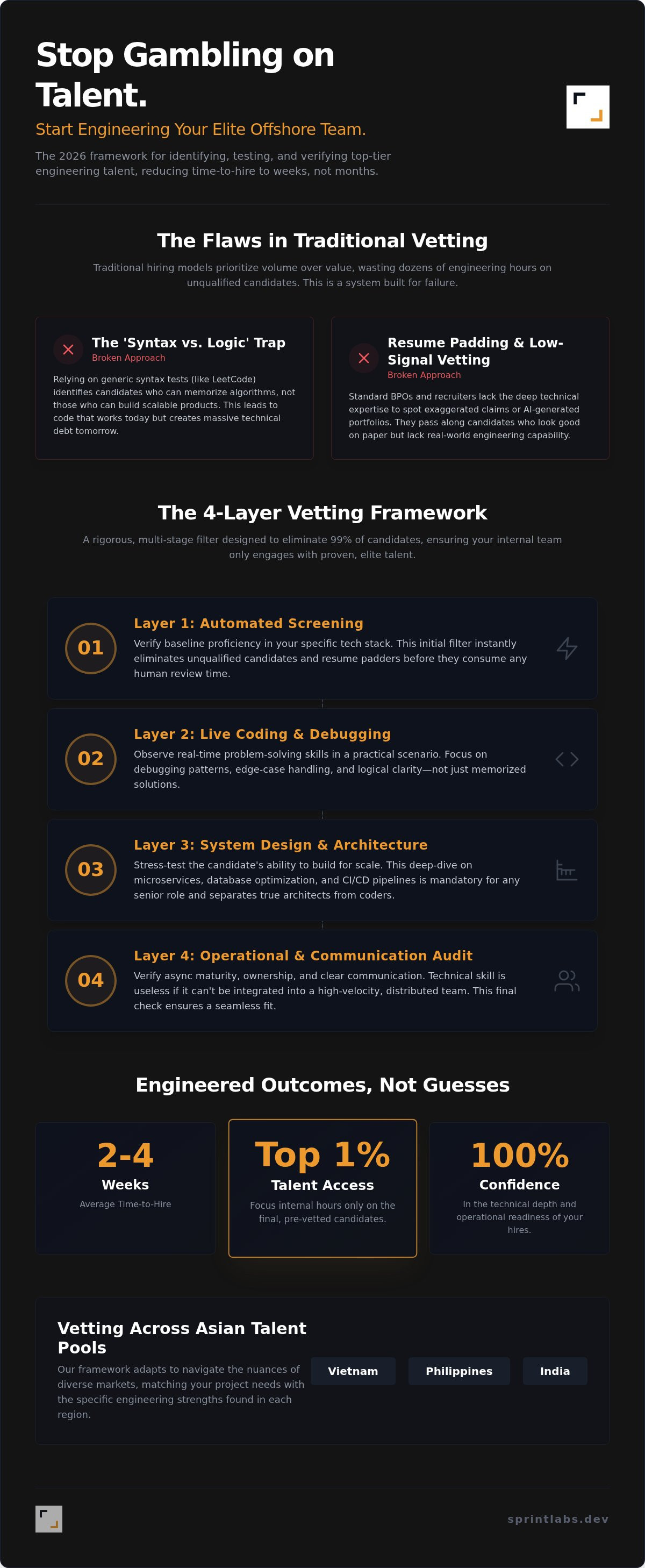
Traditional hiring is broken. It's built on volume, not precision. Offshore custom software development has historically suffered from low-signal vetting processes that prioritize seat-filling over technical depth. Most companies rely on standardized tests that any candidate can game with a weekend of memorization. This creates a culture of "resume padding" where expertise is exaggerated and actual engineering capability is ignored. You don't just lose time. You inherit technical debt and high turnover.
Effective technical vetting for offshore developers requires a shift in perspective. You aren't looking for someone who can follow instructions. You're looking for someone who can solve problems. When vetting is shallow, the true cost remains hidden until a project stalls or a critical system fails. Speed over substance. Volume over value. These are the hallmarks of a failing recruitment strategy.
The 'Syntax vs. Logic' Trap
LeetCode tests don't build products. They test memory, not architectural judgment. A developer might solve a complex algorithm problem in minutes but fail to build a scalable microservice. The industry is flooded with "coders" who can mirror syntax but lack the "product engineer" mindset. They write code that works today but breaks tomorrow. Technical Intuition is the instinctive ability to predict system failures and architectural bottlenecks before they manifest in production. Without this intuition, your offshore team becomes a liability rather than an asset.
Why Traditional BPOs Fail the Technical Bar
Standard recruitment agencies are sales engines. They aren't engineering firms. Their primary goal is to close seats and collect commissions. This creates a fundamental conflict of interest. They lack the senior engineering leadership required for rigorous technical vetting for offshore developers. They can't tell the difference between a senior architect and a junior developer with a polished CV. Sprint Labs operates differently. We replace guesswork with CTO-led vetting protocols. We don't just scan resumes. We stress-test logic, architectural depth, and operational integration to ensure only the top 1% reach your desk.
Technical skill is useless in a vacuum. If a developer can't explain their logic during a high-velocity sprint, they become a bottleneck. This "communication debt" is just as dangerous as bad code. It slows down every deployment and creates friction in your engineering engine. Elite vetting must account for soft skills and English fluency as core technical requirements, not optional extras. If they can't communicate the solution, they haven't truly solved the problem.
A 4-Layer Framework for Rigorous Technical Vetting
Elite hiring isn't a single event. It's a filter. Most companies fail because their technical vetting for offshore developers stops at a basic syntax check. This is Layer 1 logic in a Layer 4 world. A robust framework moves beyond code completion to verify operational readiness and architectural depth. You need to see how they think, not just what they type.
- Layer 1: Automated Screening. Verify baseline proficiency in your specific stack. This eliminates unqualified candidates instantly.
- Layer 2: Live Coding. Observe real-time problem-solving. Focus on debugging patterns and edge-case handling rather than memorized algorithms.
- Layer 3: System Design. Stress-test their ability to build for scale. This is mandatory for senior roles.
- Layer 4: Operational Alignment. Ensure they can thrive in high-velocity, distributed environments. Test for ownership and async maturity.
This tiered approach ensures you only spend internal engineering hours on the final 1%. If you want to skip the heavy lifting of building this pipeline from scratch, you can leverage CTO-led vetting protocols to ensure your team is built on logic, not luck.
Evaluating Architectural Intuition
Seniority is measured in trade-offs. In a 60-minute deep-dive, we probe how a developer handles microservices and database optimization. We don't just ask for a solution; we ask for the "why" behind it. We look for proficiency in CI/CD pipelines and a deep understanding of security protocols. A top-tier engineer understands that every architectural choice has a technical cost. They prioritize maintainability under pressure. They don't just build features. They build systems that survive growth.
Soft Skills: The Technical Communication Audit
Code is only half the job. In a remote setting, communication is the primary bottleneck. We audit their ability to explain complex technical concepts in clear English. Can they explain a race condition to a non-technical stakeholder? We also test for proactive communication. We look for candidates who flag potential blockers before they break the sprint. They must be fluent in Agile rhythms. They don't just take tickets; they own outcomes. This reduces the "communication debt" that typically plagues offshore engagements.
Vetting Across Asian Talent Pools: Regional Nuances
Asia isn't a single market. It's a collection of distinct engineering cultures. Effective technical vetting for offshore developers requires understanding these regional nuances. India offers massive scale with 21.9 million developers on GitHub. Vietnam provides a superior cost-to-skill ratio for AI and mobile development. The Philippines delivers elite English proficiency, scoring 569 on the EF Index. You can't use a one-size-fits-all filter. Precision matters.
Education standards vary wildly across Southeast Asia. A degree from a top university in Hanoi doesn't always translate to clean code in a production environment. Prioritize real-world project contributions over academic credentials. We verify local employment history through rigorous reference checks and social proofing. We also conduct "Availability Vetting." This ensures developers can overlap at least 4 hours with your core time zone without compromising output quality. Reliability is non-negotiable.
The Rise of High-Velocity Tech Hubs in Asia
Vietnam and the Philippines are the new standard. They offer a blend of technical grit and communication clarity that older hubs often lack. Vietnam's focus on complex backend architecture makes it a powerhouse for product squads. The Philippines excels in collaborative engineering environments. Sprint Labs bridges the gap between these markets and Western expectations. We apply Singapore-headquartered operational standards to local talent pools. You get Asian cost structures with Western management discipline. It's the only way to ensure 60-70% cost savings don't result in 100% project failure.
Cultural Intelligence in Technical Interviews
"Yes-culture" is a project killer. It's the tendency to agree to impossible deadlines or flawed requirements to avoid conflict. We vet for critical thinking. During interviews, we intentionally present a flawed architectural requirement. A junior developer says "yes." A top 1% engineer challenges the logic. We look for ownership. We want developers who flag risks early. Accountability isn't just a soft skill. It's a technical requirement for distributed teams. If they don't challenge the requirements, they aren't ready for your engine room.
- Vietnam: High technical proficiency, rising AI/ML hub.
- Philippines: Superior communication, strong Agile alignment.
- India: Massive talent volume, highly competitive senior market.
Vetting for ownership means testing how a developer handles failure. We ask for specific examples of project roadblocks and the logic used to bypass them. We don't want a "coder" who waits for instructions. We want a strategic partner who understands your business goals.
Building vs. Buying Your Vetting Pipeline
Every hour your senior engineers spend interviewing is an hour they aren't shipping code. Building an internal pipeline for technical vetting for offshore developers seems logical until you calculate the loaded cost of engineering time. Industry data suggests it takes between 15 to 25 interviews to secure a single high-quality hire in competitive remote markets. If your lead architect spends three hours per candidate on prep, live coding, and evaluation, you're losing nearly 60 hours of high-level output per successful hire. This is the hidden tax on growth.
Automated platforms like Coderpad and HackerRank provide a baseline. They handle the syntax checks. However, they can't verify the architectural intuition or operational alignment required for senior roles. Tools are a component, not a strategy. Relying on them exclusively leads to the "Vetting Gap." This occurs when your internal team, trained for local hiring, fails to account for the regional nuances and "resume padding" prevalent in offshore markets. They miss the red flags because they don't know where to look. You end up with a "post-and-pray" model that sacrifices velocity for the illusion of control.
The Internal Vetting Audit
Audit your current process. How many engineering hours are burned per hire? Slow vetting doesn't just cost money. It stalls your product roadmap. When the hiring cycle stretches beyond six weeks, top-tier talent in hubs like Vietnam or the Philippines accepts other offers. You're left with the leftovers. Effective technical vetting for offshore developers requires a dedicated infrastructure that most mid-sized firms can't justify building in-house. Without a rigorous playbook, your team settles for "good enough," which inevitably leads to technical debt and high turnover.
The Sprint Labs Advantage: Managed Vetting
We eliminate the operational overhead. Sprint Labs functions as your external engineering filter. We handle the heavy lifting of Layer 1 through Layer 3 vetting, presenting you only with the final 1% of candidates. This reduces your internal interview load by 90%. Instead of 20 interviews, you conduct two. Our 2-4 week timeline moves from requirement definition to an onboarded engineer, maintaining your team's velocity without burning out your senior staff. Managed staffing isn't just about finding talent. It's about protecting your core team's productivity. Stop wasting engineering hours on unqualified resumes and build your dedicated team with a partner that owns the vetting process.
Managed Staffing: The Logical Conclusion of Elite Vetting
Vetting is not a destination. It's a continuous process. Most firms treat technical vetting for offshore developers as a hurdle to clear once. This is a strategic error. Elite engineering requires ongoing performance monitoring and operational stability. If your vetting process ends on the start date, you're flying blind. You need a model that integrates talent into your engine room while owning the friction of management. High-velocity teams don't just happen. They are maintained.
Managed staffing solves the operational overhead trap. You shouldn't be managing payroll, local HR compliance, or hardware logistics in Asian markets. Those are distractions from your core product. We handle the mechanics of employment while you focus on the mechanics of code. By leveraging 60-70% cost savings compared to local hires, you can reinvest capital directly into R&D. You aren't just saving money. You're buying velocity. This reinvestment is what separates market leaders from those just trying to keep the lights on.
From Individual Contributors to Delivery Pods
Technical vetting changes when you scale from a single dev to a full squad. You aren't just vetting for syntax; you're vetting for team dynamics and collective output. Our Pod Model focuses on the Lead Engineer as the anchor. We verify their ability to manage Project Delivery Squads and maintain Singapore-headquartered standards across the entire unit. Sprint Labs provides the delivery oversight so your internal team doesn't have to. We ensure the pod functions as a cohesive unit, reducing the management burden on your internal CTO. You manage the roadmap. We manage the engine.
Next Steps: Building Your High-Velocity Team
The 2026 market demands speed. Defining your technical requirements is the first step. Whether you need AI-focused engineers in Vietnam or Agile-ready teams in the Philippines, the framework remains the same. Rigorous testing. Clear communication. Operational ownership. We provide a 60-day notice period for maximum flexibility. This allows you to scale up or down based on your roadmap without the risk of long-term lock-ins. It's time to stop managing resumes and start managing outcomes. You can Scale your engineering team with Sprint Labs and secure your 2-4 week hiring timeline today. Don't settle for the average. Identify the top 1% and build for the future.
Engineering Your Competitive Advantage in 2026
Elite engineering isn't found by accident. It's built through a rigorous 4-layer filter that prioritizes architectural intuition over memorized syntax. Traditional models fail because they ignore the operational nuances of Asian tech hubs. By implementing a sophisticated framework for technical vetting for offshore developers, you move from a state of complication to one of streamlined simplicity. You stop gambling on talent and start investing in logic.
Sprint Labs removes the friction of building this pipeline from scratch. We handle the heavy lifting, delivering the final 1% of talent with a 2-4 week hiring velocity. You capture 60-70% cost savings without inheriting the operational overhead of managed payroll and HR. This isn't just about reducing costs. It's about reclaiming your team's velocity and refocusing on your core product roadmap. The infrastructure for scale is ready. It's time to build.
Hire Vetted Offshore Developers with Sprint Labs and secure your high-performance team today.
Frequently Asked Questions
What are the best platforms for technical vetting of offshore developers?
Coderpad and HackerRank are the industry standard for Layer 1 screening. They handle syntax and basic logic filters with high efficiency. However, these tools don't replace human-led architectural deep-dives. We use them to eliminate high-volume noise. Elite technical vetting for offshore developers requires senior engineers to observe problem-solving patterns in real-time. Tools provide the data. Our CTO-led protocols provide the judgment. You need a strategy that moves beyond simple code completion.
How long does a typical technical vetting process take for a senior developer?
A rigorous process typically takes 7 to 10 days from the initial screen to the final offer. Most companies fail because they'll drag hiring out to 6 weeks and lose top-tier talent. We maintain a 2-4 week hiring velocity by front-loading the technical vetting for offshore developers. We handle the screening, live coding, and system design reviews. You only interview the final 1%. This compression saves your roadmap while ensuring technical depth.
Is it better to use automated coding tests or live technical interviews?
You need a hybrid approach. Automated tests serve as effective filters for syntax and baseline proficiency. They save your team dozens of hours of manual review. Live interviews are mandatory for verifying architectural intuition and trade-off logic. You can't test a developer's ability to navigate a complex microservices failure through a bot. Use automation for volume. Use senior-led live sessions for quality. This ensures you only hire engineers who build systems, not just code.
How do you verify the identity and work history of an offshore developer?
We verify identity through government-issued ID checks and rigorous reference calls with past employers. We don't just trust LinkedIn profiles or resumes. We analyze GitHub contributions and social proofing within regional tech communities to identify "resume padding." Our Singapore-headquartered standards ensure full compliance and transparency. This meticulous process eliminates the risk of identity fraud and ensures every developer has the real-world experience they claim. We prioritize logic over marketing fluff.
What technical skills are most in demand for offshore developers in 2026?
AI integration and Machine Learning proficiency are the top requirements in 2026. Developers must be able to fine-tune LLMs and integrate AI tools into existing workflows. Senior-level DevOps and microservices architecture also remain critical for scalable systems. We look for "product engineers" who understand CI/CD pipelines and cloud security. It isn't just about writing syntax anymore. It's about building resilient, AI-ready infrastructure that can handle high-velocity growth and complex operational demands.
How does Sprint Labs ensure the technical quality of its developers?
We use a CTO-led, 4-layer framework that stress-tests logic and architectural depth. We don't just scan CVs; we observe how candidates handle technical pressure. Every developer passes automated screening, live coding, and system design reviews before they reach your desk. We only present the final 1%. Our managed model includes continuous performance monitoring. We own the operational quality, ensuring your offshore team meets high-velocity standards from day one. We value systems over mere transactions.
Can I use my own technical tests during the Sprint Labs hiring process?
Yes. We encourage you to conduct a final technical interview using your specific stack and internal testing protocols. You own the final decision. Our vetting pipeline reduces your interview load by 90% by filtering out unqualified candidates before they reach your calendar. We handle the baseline logic and proficiency testing. You focus on the last mile of architectural fit. This ensures the candidate aligns perfectly with your engineering culture and specific technical standards.
What is the typical cost saving when using a vetted offshore developer vs a local hire?
Clients typically see 60-70% cost savings compared to local hires in markets like Australia, the US, or the UK. These savings are verified and include the fully loaded cost of employment. We handle payroll, HR, hardware, and office space in Asian hubs. You get senior-level talent without the local recruitment fees or operational overhead. This capital can be reinvested directly into your R&D and product roadmap to accelerate your market velocity and competitive advantage.
Frequently asked questions
What are the best platforms for technical vetting of offshore developers?
Coderpad and HackerRank are the industry standard for Layer 1 screening. They handle syntax and basic logic filters with high efficiency. However, these tools don't replace human-led architectural deep-dives. We use them to eliminate high-volume noise. Elite technical vetting for offshore developers requires senior engineers to observe problem-solving patterns in real-time. Tools provide the data. Our CTO-led protocols provide the judgment. You need a strategy that moves beyond simple code completion.
How long does a typical technical vetting process take for a senior developer?
A rigorous process typically takes 7 to 10 days from the initial screen to the final offer. Most companies fail because they'll drag hiring out to 6 weeks and lose top-tier talent. We maintain a 2-4 week hiring velocity by front-loading the technical vetting for offshore developers. We handle the screening, live coding, and system design reviews. You only interview the final 1%. This compression saves your roadmap while ensuring technical depth.
Is it better to use automated coding tests or live technical interviews?
You need a hybrid approach. Automated tests serve as effective filters for syntax and baseline proficiency. They save your team dozens of hours of manual review. Live interviews are mandatory for verifying architectural intuition and trade-off logic. You can't test a developer's ability to navigate a complex microservices failure through a bot. Use automation for volume. Use senior-led live sessions for quality. This ensures you only hire engineers who build systems, not just code.
How do you verify the identity and work history of an offshore developer?
We verify identity through government-issued ID checks and rigorous reference calls with past employers. We don't just trust LinkedIn profiles or resumes. We analyze GitHub contributions and social proofing within regional tech communities to identify "resume padding." Our Singapore-headquartered standards ensure full compliance and transparency. This meticulous process eliminates the risk of identity fraud and ensures every developer has the real-world experience they claim. We prioritize logic over marketing fluff.
What technical skills are most in demand for offshore developers in 2026?
AI integration and Machine Learning proficiency are the top requirements in 2026. Developers must be able to fine-tune LLMs and integrate AI tools into existing workflows. Senior-level DevOps and microservices architecture also remain critical for scalable systems. We look for "product engineers" who understand CI/CD pipelines and cloud security. It isn't just about writing syntax anymore. It's about building resilient, AI-ready infrastructure that can handle high-velocity growth and complex operational demands.
How does Sprint Labs ensure the technical quality of its developers?
We use a CTO-led, 4-layer framework that stress-tests logic and architectural depth. We don't just scan CVs; we observe how candidates handle technical pressure. Every developer passes automated screening, live coding, and system design reviews before they reach your desk. We only present the final 1%. Our managed model includes continuous performance monitoring. We own the operational quality, ensuring your offshore team meets high-velocity standards from day one. We value systems over mere transactions.
Can I use my own technical tests during the Sprint Labs hiring process?
Yes. We encourage you to conduct a final technical interview using your specific stack and internal testing protocols. You own the final decision. Our vetting pipeline reduces your interview load by 90% by filtering out unqualified candidates before they reach your calendar. We handle the baseline logic and proficiency testing. You focus on the last mile of architectural fit. This ensures the candidate aligns perfectly with your engineering culture and specific technical standards.
What is the typical cost saving when using a vetted offshore developer vs a local hire?
Clients typically see 60-70% cost savings compared to local hires in markets like Australia, the US, or the UK. These savings are verified and include the fully loaded cost of employment. We handle payroll, HR, hardware, and office space in Asian hubs. You get senior-level talent without the local recruitment fees or operational overhead. This capital can be reinvested directly into your R&D and product roadmap to accelerate your market velocity and competitive advantage.
Hiring in Asia? We'll do it for you.
Sprint Labs is a managed staffing firm. We recruit, vet, employ and retain senior talent across the Philippines, Vietnam, Malaysia, Indonesia and India — you direct the work, we handle everything else.
Create a request →