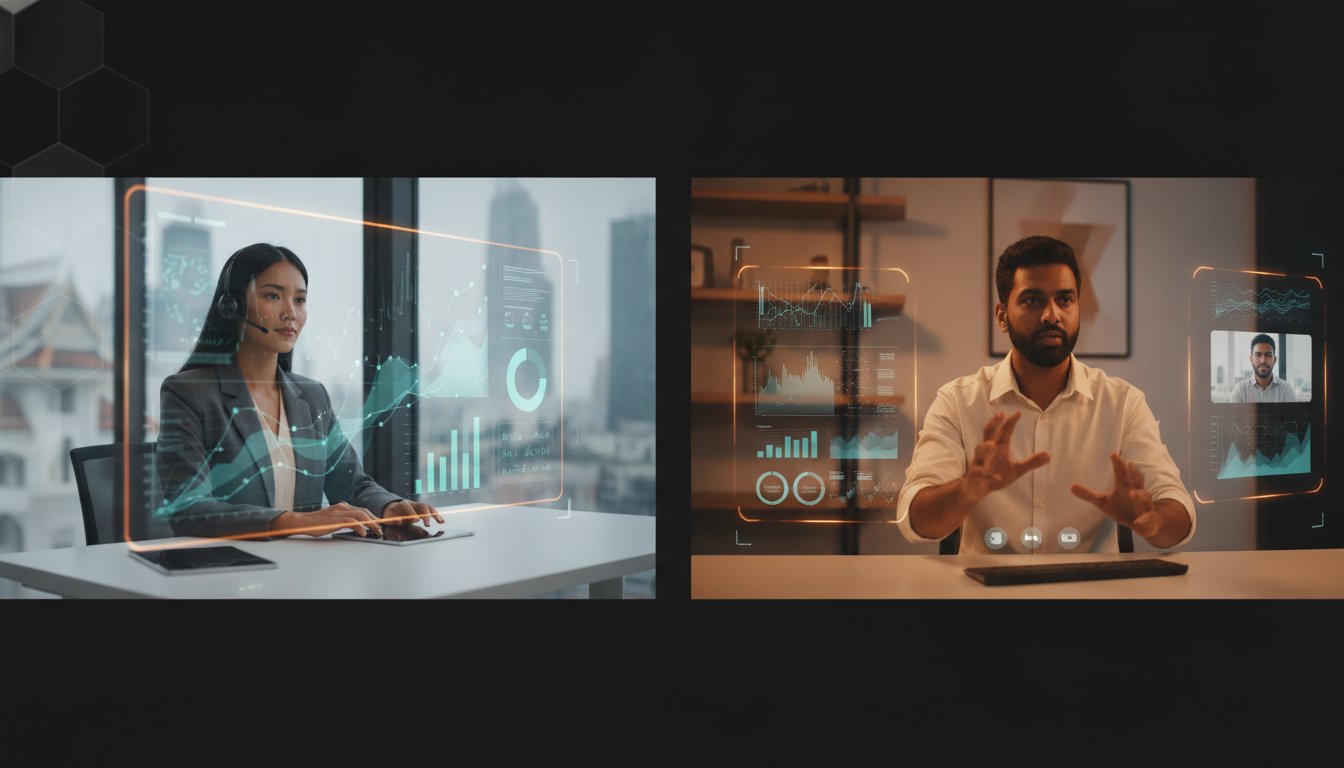
AI Accent Conversion Support: The Operational Bridge for Global Teams
Scale offshore teams using ai accent conversion support. Eliminate linguistic friction, improve CSAT scores, and unlock Tier 1 customer service quality.
The most talented support agents in the world are often sidelined by a linguistic barrier that has nothing to do with their technical skill. Traditional accent neutralisation training is a failed legacy model that wastes months of ramp-up time. Today, ai accent conversion support provides the operational bridge that allows global teams to communicate with 100% clarity. It's a strategic tool designed to eliminate the cognitive friction that kills customer satisfaction and stalls sales growth.
You've likely seen high-potential offshore pods struggle with CSAT scores simply because of regional dialects or phoneme mishearings. It's a systemic inefficiency that drains your revenue and burns out your staff. This article shows you how to unlock Tier 1 support quality at offshore costs while significantly increasing sales conversion rates. We'll explore the technical shift from classroom training to real-time AI and how to scale your global engine without the usual friction.
Key Takeaways
- Understand how Speech-to-Speech technology preserves vocal emotion while digitally adjusting phonemes for absolute phonetic clarity.
- Learn how removing comprehension friction directly improves CSAT scores and reduces Average Handle Time across global support pods.
- Discover why standalone software fails and how managed ai accent conversion support integrates hardware and talent for a seamless rollout.
- Follow a phased roadmap for assessing linguistic gaps and optimising network infrastructure to ensure low-latency communication.
- Explore how combining offshore staffing with managed AI tech delivers Tier 1 quality at 60-70% lower costs than local hires.
Table of Contents
- What is AI Accent Conversion Support?
- The Strategic Advantage of Accent Neutralisation
- Software vs. Managed Staffing: The Deployment Debate
- Step-by-Step: Implementing AI Accent Conversion
- Scale Your Global Engine with Sprint Labs
What is AI Accent Conversion Support?
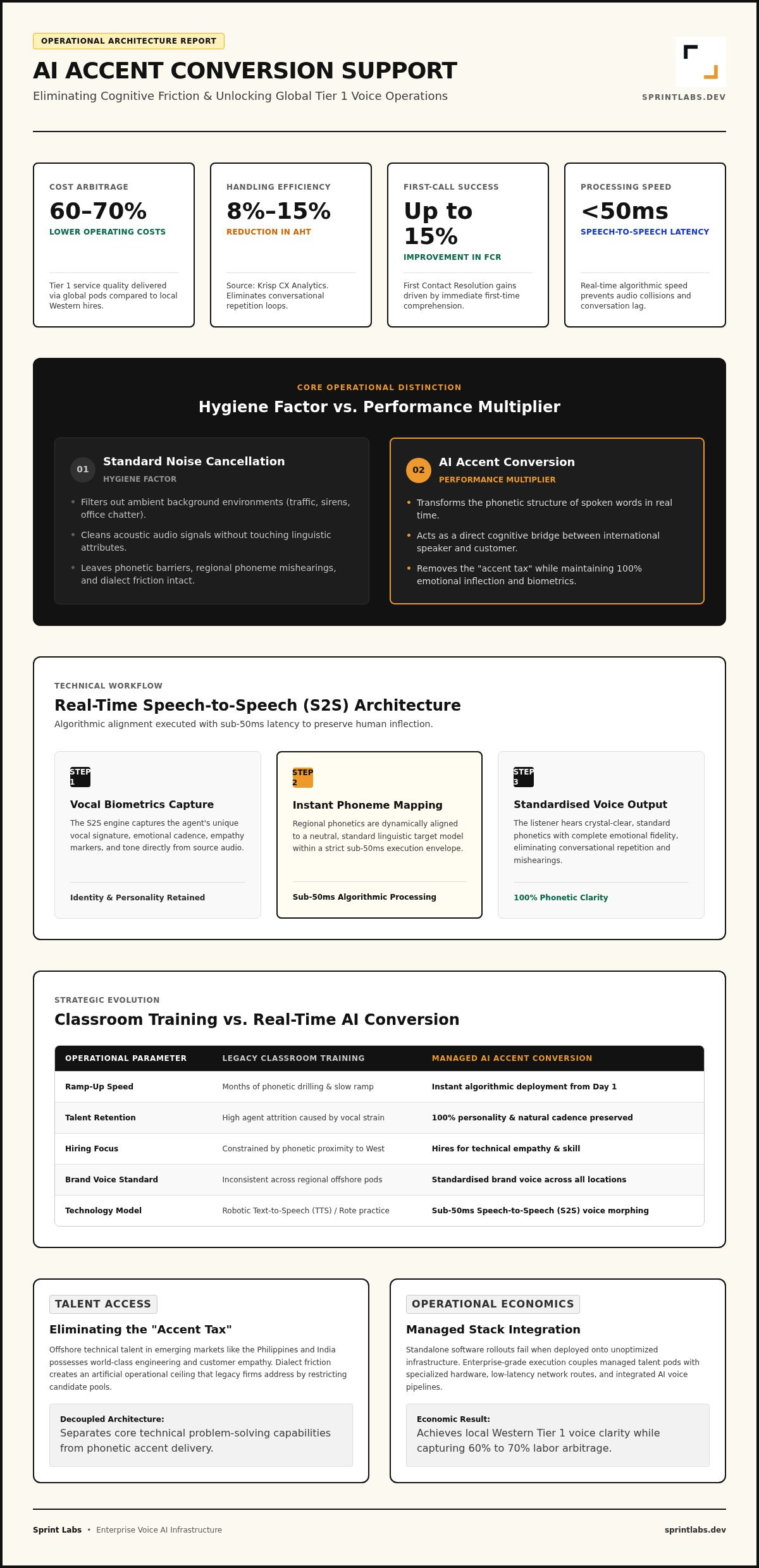
AI accent conversion support is the real-time digital transformation of regional speech patterns into neutral, standard phonetic models. It is an operational necessity for the modern enterprise. While standard noise cancellation filters out environmental sounds like traffic or sirens, accent conversion modifies the actual structure of the spoken word. It removes the final friction point in global communication. In 2026, the industry has moved past simple outsourcing. We are now in the era of global team integration. This technology ensures that a specialist in the Philippines or India sounds as clear as a local hire in London.
Standard noise cancellation is a hygiene factor. It cleans the audio. Accent conversion is a performance multiplier. It transforms the delivery. One deals with the background; the other deals with the bridge between two humans. Without this bridge, even the most skilled offshore teams face a ceiling on their effectiveness. AI accent conversion support breaks that ceiling by providing instant, algorithmic alignment between speaker and listener.
How Speech-to-Speech (S2S) Technology Works
Speech-to-Speech (S2S) technology is the engine room of this transformation. It doesn't just replace a voice with a generic bot. The system captures the speaker's unique vocal biometrics and emotional inflection. It then maps regional phonetics to a target linguistic model instantly. This process happens with sub-50ms latency. Speed is critical here. Anything slower causes audio collisions and conversational lag that frustrates the caller. The result is a voice that retains the agent's personality while delivering 100% clarity. It is seamless. It is invisible. It is the new standard for international voice operations.
The Evolution of Voice AI in Customer Support
Voice AI has undergone a radical shift. We have moved from robotic text-to-speech (TTS) to sophisticated, human-centric voice morphing. Historically, businesses relied on traditional accent modification and neutralization programs. These classroom sessions were slow. They were expensive. They often failed to produce lasting results. Modern 2026 models maintain the speaker's original timbre and cadence. They don't erase identity; they enhance intelligibility. This evolution allows businesses to hire for technical skill and empathy rather than phonetic proximity to the West. You get the best talent, regardless of their original dialect.
- Old Model: Months of classroom drilling and high attrition.
- New Model: Instant algorithmic clarity with 100% personality retention.
- Operational Result: Rapid scaling of global pods without linguistic friction.
The Strategic Advantage of Accent Neutralisation
Accent neutralisation is not a cosmetic upgrade. It is a strategic operational lever that attacks systemic friction in customer interactions. Deploying ai accent conversion support directly addresses the linguistic barriers that lead to phoneme mishearings and alphanumeric errors. By removing these hurdles, businesses can standardise their brand voice across global support centres. This ensures a uniform experience regardless of where the agent is located. It transforms a potential communication liability into a high-velocity asset.
The impact on key performance indicators is immediate. Data from Krisp CX Analytics shows an 8% to 15% reduction in Average Handling Time (AHT) when real-time voice tools are active. This efficiency gain is driven by eliminating conversational repetition loops. When a customer understands the response the first time, First Contact Resolution (FCR) improves by up to 15%. This isn't just about comfort; it's about the bottom line. As reported in the discussion regarding real-time voice-altering technology, the drive to mitigate customer friction is a primary motivator for enterprise adoption.
Hiring for linguistic proximity is a legacy constraint. It forces you to ignore the world's most capable specialists because of their regional dialect. Integrating ai accent conversion support into your tech stack removes the 'accent tax' that typically hampers offshore operations. By decoupling technical expertise from phonetic delivery, you expand your talent pool to include the highest-calibre professionals in emerging markets. This allows you to prioritise empathy and problem-solving skills over accent profiles.
Unlocking Global Talent Markets
Technical expertise in Asia is often world-class but remains masked by linguistic friction. AI bridges the gap between elite Asian tech talent and Western markets, allowing for seamless integration into existing workflows. Moving to Managed offshore staffing in Asia ensures your pods are equipped with these tools from day one. You can hire for the engine room without worrying about the interface.
Boosting Sales and SDR Performance
In high-velocity outbound sales, the first five seconds are critical. Immediate phonetic familiarity increases cold call 'stay-on-the-line' rates. Statistics from the Contact Center Performance Index indicate a 17% to 26% lift in outbound sales conversion rates when linguistic friction is removed. Trust is built faster. Hang-ups decrease. Revenue grows because your SDRs can focus on the pitch rather than repeating their name. If you want to scale your revenue engine without the usual friction, consider how Sprint Labs can embed these capabilities into your dedicated pods.
Software vs. Managed Staffing: The Deployment Debate
Buying a software license is not an operational strategy. It is a starting point for a logistical headache. Many enterprises treat ai accent conversion support as a simple plug-and-play add-on. This is a mistake. Standalone tools require significant "hidden work" including local hardware configuration, agent training, and network optimisation. Without managed oversight, these tools often sit idle or perform poorly, failing to deliver the promised ROI.
The DIY approach forces your internal IT team to become voice AI specialists. They must manage software updates, troubleshoot latency issues, and ensure compatibility across various softphone platforms. Managed staffing eliminates this friction. By choosing a managed model, you shift the burden of technical implementation to a partner who handles the entire stack. This allows your team to get online in a 2-4 week hiring timeline rather than waiting months for a custom internal rollout.
Operational Challenges of Standalone Voice AI
Hardware is the first bottleneck. Real-time speech-to-speech conversion requires high-performance GPUs to maintain sub-150ms round-trip latency. Standard office laptops often lack the processing power to handle these neural models without causing audio lag. If the processing frames exceed 80ms, the conversation becomes disjointed. You risk the "robotic" sound that damages brand reputation and frustrates customers. Compliance is another hurdle. Managing real-time voice streams involves strict data privacy standards. Operational decisions must also align with regulatory frameworks, such as EEOC guidance on accent-related workplace policies, to ensure equitable treatment and compliance in global workflows.
The Managed Staffing Advantage
Managed staffing provides a turnkey solution by integrating ai accent conversion support directly into the offshore employee's hardware stack. The technology is pre-configured before the agent even takes their first call. This integration extends to HR and retention. In an industry where contact centre turnover averages 40% to 45% annually, losing an agent often means losing the training investment in the AI tool. A managed partner handles the recruitment, cultural onboarding, and local compliance, ensuring your AI investment remains productive. If you intend to Hire dedicated developers in Asia or build a support pod, a managed model provides the structural superiority needed to scale at velocity.
- Standalone: High IT overhead, hardware compatibility risks, and unmanaged agent churn.
- Managed: Pre-configured tech stack, 2-4 week deployment, and full HR oversight.
- Result: Operational clarity and immediate performance gains.
Step-by-Step: Implementing AI Accent Conversion
Implementation is a technical deployment, not a software installation. You cannot simply toggle a switch and expect 100% clarity. A successful rollout requires a rigorous four-phase roadmap to ensure your ai accent conversion support delivers maximum ROI. Phase one involves assessing the 'Accent Gap'. Don't guess. Analyse existing call recordings to identify specific phonetic friction points. Define your target linguistic model based on your primary customer base. This ensures the output matches market expectations exactly.
Phase two focuses on infrastructure. Hardware provisioning is non-negotiable. You need local workstations capable of running neural models in real-time without causing audio lag. Network optimisation follows. You must ensure sub-100ms round-trip latency to prevent conversational overlap and echo. Phase three is the pilot. Deploy to a single support pod or sales squad to measure the immediate impact on CSAT and AHT. Finally, phase four requires continuous monitoring. Establish 'Vocal Clarity Scores' to maintain a high-velocity standard across your entire global engine.
Provisioning for Performance
Neural voice conversion is resource-intensive. Selecting the right CPU and GPU configurations for offshore workstations is critical. Standard office gear won't cut it. Without dedicated processing power, you get audio collision and lag. We optimise local ISP routes to guarantee low latency and implement fail-safe 'bypass' modes. If the AI layer encounters a technical outage, the agent reverts to their natural voice instantly. No dropped calls. No lost revenue. Technical reliability is the foundation of global integration.
Training and Quality Assurance
The technology is only half the battle. Agents must learn to speak 'with' the AI. This involves maintaining a steady cadence and clear enunciation that allows the neural model to map phonetics accurately. It's a partnership between human and machine. We review call recordings weekly to fine-tune these phonetic mappings. It's a meticulous process of adjustment. Setting benchmarks for Vocal Clarity Scores ensures your team stays sharp and your brand voice remains consistent. If you want to skip the technical setup and deploy a pre-configured pod in 2-4 weeks, build your global team with Sprint Labs.
- Phase 1: Define the linguistic target and assess phonetic friction.
- Phase 2: Provision GPU-enabled hardware and optimise network routes.
- Phase 3: Pilot the tech with specific sales or support pods.
- Phase 4: Monitor CSAT and Vocal Clarity Scores for continuous improvement.
Scale Your Global Engine with Sprint Labs
Software is a tool; Sprint Labs is the engine. We don't just sell licenses for ai accent conversion support. We build high-performance, managed offshore pods that integrate this technology as a foundational standard. This approach moves your operations beyond simple offshore staffing into the territory of high-velocity project delivery. By handling the recruitment, local compliance, and the entire AI hardware stack, we remove the operational overhead that typically stalls global expansion. You get the clarity of a local hire with the structural advantage of a global team.
The economic logic is decisive. You achieve 60-70% cost savings compared to local hires while maintaining Tier 1 support quality. We eliminate the 'accent tax' by equipping our agents with the best technology available in 2026. While competitors offer standalone software that creates IT bottlenecks, we provide a turnkey solution. We employ the people. You direct the work. This model ensures that your investment in AI tech isn't lost to high attrition or poor local implementation. It is a strategic partnership designed for speed and precision.
Managed Support Pods with AI Precision
We recruit the top 1% of support talent across Asia. These specialists are vetted for technical skill and empathy, then equipped with pre-configured AI accent conversion hardware. This hybrid model addresses the 'Human + AI' gap that software-only providers ignore. We don't just mask accents; we empower elite talent to communicate without friction. You receive detailed reporting on team performance and vocal clarity metrics. It is total operational transparency. We manage the HR, payroll, and hardware in Asia so your internal teams can focus on core revenue drivers.
Ready to Scale? Your 2-Week Roadmap
Scaling shouldn't take months. Our high-velocity roadmap gets your team online in a 2-4 week hiring timeline. It begins with a deep-dive consultation on your team structure and specific linguistic requirements. We then move to rapid vetting, selecting dedicated offshore employees who fit your culture and technical needs. Integration is seamless. We ensure the AI stack is fully compatible with your existing communication workflow before the first call is ever taken. Stop managing contractors and start building a global engine. Scale your team with Sprint Labs to remove the final barrier to international growth.
- Phase 1: Consultation on team structure and AI phonetic targets.
- Phase 2: Rapid vetting and hiring of top 1% Asian talent.
- Phase 3: Seamless technical integration and hardware provisioning.
- Phase 4: High-velocity delivery with 100% communication clarity.
Eliminate the Linguistic Barrier to Global Growth
Global team integration is no longer limited by regional phonetics. Real-time ai accent conversion support has transformed from a niche tool into a critical operational bridge. It allows businesses to access the world's best specialists without sacrificing customer comprehension or brand consistency. You've seen how this technology reduces handle times and boosts sales conversions by removing the friction of miscommunication.
Choosing a managed model over a standalone software rollout is the only way to avoid the hidden work of technical configuration and hardware bottlenecks. Sprint Labs delivers this structural advantage by handling the recruitment, hardware, and local compliance for you. You gain 60-70% cost savings compared to local hires while securing a 2-4 week hiring timeline. We provide the engine room and fully managed HR operations so you can focus on strategy.
Stop letting linguistic friction stall your revenue growth. It is time to deploy a team that communicates with 100% clarity from day one. Build your high-velocity global team with Sprint Labs and start scaling your business with absolute precision. Your global engine is ready for ignition.
Frequently Asked Questions
Does AI accent conversion make my team sound like robots?
No, modern Speech-to-Speech (S2S) technology preserves the agent's original pitch, emotion, and vocal timbre. Unlike older text-to-speech models, these neural systems only alter specific phonemes to improve intelligibility. The result is a natural, human voice that retains the speaker's personality while removing regional friction. Sprint Labs integrates these tools into managed pods to ensure high-quality delivery without the robotic artifacts common in legacy software.
What is the latency for real-time AI accent conversion on support calls?
Production-grade ai accent conversion support operates with sub-150ms round-trip latency. Advanced neural models achieve processing frames between 5ms and 80ms to avoid audio collisions or conversational lag. This speed is essential for maintaining a natural flow on VoIP networks. Sprint Labs provisions high-performance hardware for offshore teams to ensure this latency threshold is met, preventing the echo or delay that often plagues unmanaged software deployments.
Is AI accent conversion legal and compliant with data privacy laws?
Yes, but transparency is mandatory under current regulations like the EU AI Act’s Article 50, which took effect in August 2026. Deployers must disclose that audio has been artificially altered. Compliance also involves adhering to EEOC guidance regarding national origin and accent-related policies. Sprint Labs handles the operational compliance and data privacy protocols, ensuring that your global team operates within international legal frameworks without creating liability for your business.
Do I need to buy expensive hardware for my offshore team to use this?
High-performance GPUs are required to run neural voice models with low latency, but you don't need to manage this procurement yourself. Standard office laptops typically lack the processing power for real-time conversion. Sprint Labs includes hardware provisioning as part of our managed staffing service. We equip your dedicated offshore pods with pre-configured workstations designed specifically for AI-enabled voice operations, removing the capital expenditure and logistical burden from your team.
Can AI accent conversion handle multiple different regional accents?
Yes, neural models are trained to map diverse regional phonetics to a standard neutral model. Whether your team is based in the Philippines, India, or Vietnam, the technology dynamically adjusts specific speech patterns to ensure clarity for Western customers. This flexibility allows businesses to recruit the best talent across multiple Asian hubs. Sprint Labs manages these multi-region teams, ensuring the ai accent conversion support is fine-tuned for each specific linguistic profile.
How does this technology impact customer satisfaction (CSAT) scores?
Data indicates a significant positive impact, with CSAT scores increasing by up to 20% when linguistic friction is removed. By eliminating phoneme mishearings and the need for repetition, first contact resolution (FCR) typically improves by 15% according to industry benchmarks. Customers experience faster, clearer resolutions, which directly correlates to higher Net Promoter Scores. Sprint Labs tracks these metrics for your support pods, providing transparent reporting on how AI integration drives operational success.
Is it better to use AI or just provide accent neutralisation training?
AI is the superior operational choice because it provides instant results without the high attrition risks of traditional training. Legacy accent neutralisation programs take 4 to 8 weeks and often lose ROI when agents leave. In contrast, software-level harmonisation is immediate and consistent across the entire team. Sprint Labs combines this technical precision with cultural onboarding, creating a hybrid model that outperforms classroom-based drilling in both speed and retention.
What happens if the AI software fails during a live customer call?
Fail-safe protocols ensure that calls are never dropped due to a software glitch. Enterprise-grade systems include a bypass mode that reverts the agent to their natural voice instantly if the AI layer encounters an error. This prevents conversational breaks or technical lag during critical interactions. Sprint Labs implements these fail-safes at the hardware level, ensuring your support operations remain resilient. Your agents continue the call without interruption, maintaining service continuity regardless of technical fluctuations.
Frequently asked questions
Does AI accent conversion make my team sound like robots?
No, modern Speech-to-Speech (S2S) technology preserves the agent's original pitch, emotion, and vocal timbre. Unlike older text-to-speech models, these neural systems only alter specific phonemes to improve intelligibility. The result is a natural, human voice that retains the speaker's personality while removing regional friction. Sprint Labs integrates these tools into managed pods to ensure high-quality delivery without the robotic artifacts common in legacy software.
What is the latency for real-time AI accent conversion on support calls?
Production-grade ai accent conversion support operates with sub-150ms round-trip latency. Advanced neural models achieve processing frames between 5ms and 80ms to avoid audio collisions or conversational lag. This speed is essential for maintaining a natural flow on VoIP networks. Sprint Labs provisions high-performance hardware for offshore teams to ensure this latency threshold is met, preventing the echo or delay that often plagues unmanaged software deployments.
Is AI accent conversion legal and compliant with data privacy laws?
Yes, but transparency is mandatory under current regulations like the EU AI Act’s Article 50, which took effect in August 2026. Deployers must disclose that audio has been artificially altered. Compliance also involves adhering to EEOC guidance regarding national origin and accent-related policies. Sprint Labs handles the operational compliance and data privacy protocols, ensuring that your global team operates within international legal frameworks without creating liability for your business.
Do I need to buy expensive hardware for my offshore team to use this?
High-performance GPUs are required to run neural voice models with low latency, but you don't need to manage this procurement yourself. Standard office laptops typically lack the processing power for real-time conversion. Sprint Labs includes hardware provisioning as part of our managed staffing service. We equip your dedicated offshore pods with pre-configured workstations designed specifically for AI-enabled voice operations, removing the capital expenditure and logistical burden from your team.
Can AI accent conversion handle multiple different regional accents?
Yes, neural models are trained to map diverse regional phonetics to a standard neutral model. Whether your team is based in the Philippines, India, or Vietnam, the technology dynamically adjusts specific speech patterns to ensure clarity for Western customers. This flexibility allows businesses to recruit the best talent across multiple Asian hubs. Sprint Labs manages these multi-region teams, ensuring the ai accent conversion support is fine-tuned for each specific linguistic profile.
How does this technology impact customer satisfaction (CSAT) scores?
Data indicates a significant positive impact, with CSAT scores increasing by up to 20% when linguistic friction is removed. By eliminating phoneme mishearings and the need for repetition, first contact resolution (FCR) typically improves by 15% according to industry benchmarks. Customers experience faster, clearer resolutions, which directly correlates to higher Net Promoter Scores. Sprint Labs tracks these metrics for your support pods, providing transparent reporting on how AI integration drives operational success.
Is it better to use AI or just provide accent neutralisation training?
AI is the superior operational choice because it provides instant results without the high attrition risks of traditional training. Legacy accent neutralisation programs take 4 to 8 weeks and often lose ROI when agents leave. In contrast, software-level harmonisation is immediate and consistent across the entire team. Sprint Labs combines this technical precision with cultural onboarding, creating a hybrid model that outperforms classroom-based drilling in both speed and retention.
What happens if the AI software fails during a live customer call?
Fail-safe protocols ensure that calls are never dropped due to a software glitch. Enterprise-grade systems include a bypass mode that reverts the agent to their natural voice instantly if the AI layer encounters an error. This prevents conversational breaks or technical lag during critical interactions. Sprint Labs implements these fail-safes at the hardware level, ensuring your support operations remain resilient. Your agents continue the call without interruption, maintaining service continuity regardless of technical fluctuations.
Hiring in Asia? We'll do it for you.
Sprint Labs is a managed staffing firm. We recruit, vet, employ and retain senior talent across the Philippines, Vietnam, Malaysia, Indonesia and India — you direct the work, we handle everything else.
Create a request →