
Customer Support Outsourcing Companies: The 2026 Buyer’s Guide
Compare top customer support outsourcing companies with our 2026 buyer's guide. Cut support costs by up to 70% while boosting CSAT and managerial control.
Legacy call centers are quietly breaking your customer experience. Most customer support outsourcing companies promise effortless scale, yet they deliver disengaged, revolving-door agents who tank your CSAT scores. You already know the exhaustion of watching domestic support staff burn out under relentless 24/7 queues, only to test disconnected offshore call centers that create more operational fires than they resolve. Wrestling with overseas legal compliance, hardware logistics, and fragmented management only deepens the internal headache.
You shouldn't have to choose between unsustainable domestic payroll and compromised brand equity. This 2026 buyer's guide shows you how to critically evaluate customer support outsourcing companies, compare delivery models, and build high-performing offshore support teams that cut operational staffing costs by 60 to 70 percent. From auditing hidden vendor fees to retaining direct managerial control over dedicated support pods, here is your definitive roadmap to establishing seamless omnichannel coverage that scales.
Key Takeaways
- Why traditional shared BPOs and volatile gig models dilute customer retention, and how managed staffing bridges the operational gap.
- The non-negotiable technical and communication benchmarks required when vetting customer support outsourcing companies.
- How to audit hidden vendor markups, software licensing fees, and turnover expenses to determine true operational ROI.
- A structured four-week deployment framework to launch dedicated offshore support pods without risking baseline CSAT.
- How to cut support staffing overhead by 60 to 70 percent while maintaining direct day-to-day managerial direction.
Table of Contents
- Evaluating Customer Support Outsourcing Models: BPO vs. Gig vs. Managed Staffing For a closer look, read our managed staffing vs bpo comparison.
- Core Criteria for Selecting Customer Support Outsourcing Companies
- The True Economics of Outsourcing Support: Hidden Costs vs. Managed Value
- How to Launch an Offshore Support Team in 2–4 Weeks Without CSAT Drops
- Why Fast-Growing Tech Companies Partner with Sprint Labs for Customer Support
Evaluating Customer Support Outsourcing Models: BPO vs. Gig vs. Managed Staffing
Choosing the right operational framework dictates whether your support engine scales or stalls. Most buyers default to legacy vendors without understanding how underlying delivery mechanics impact service quality. While modern Business Process Outsourcing firms claim universal capability, their operational incentives rarely align with customer retention. Scaling tech companies need dedicated brand advocates who understand complex technical edge cases, not detached contract workers triaging tickets across multiple disconnected clients.
The Shared BPO Model: High Attrition and Diluted Brand Experience
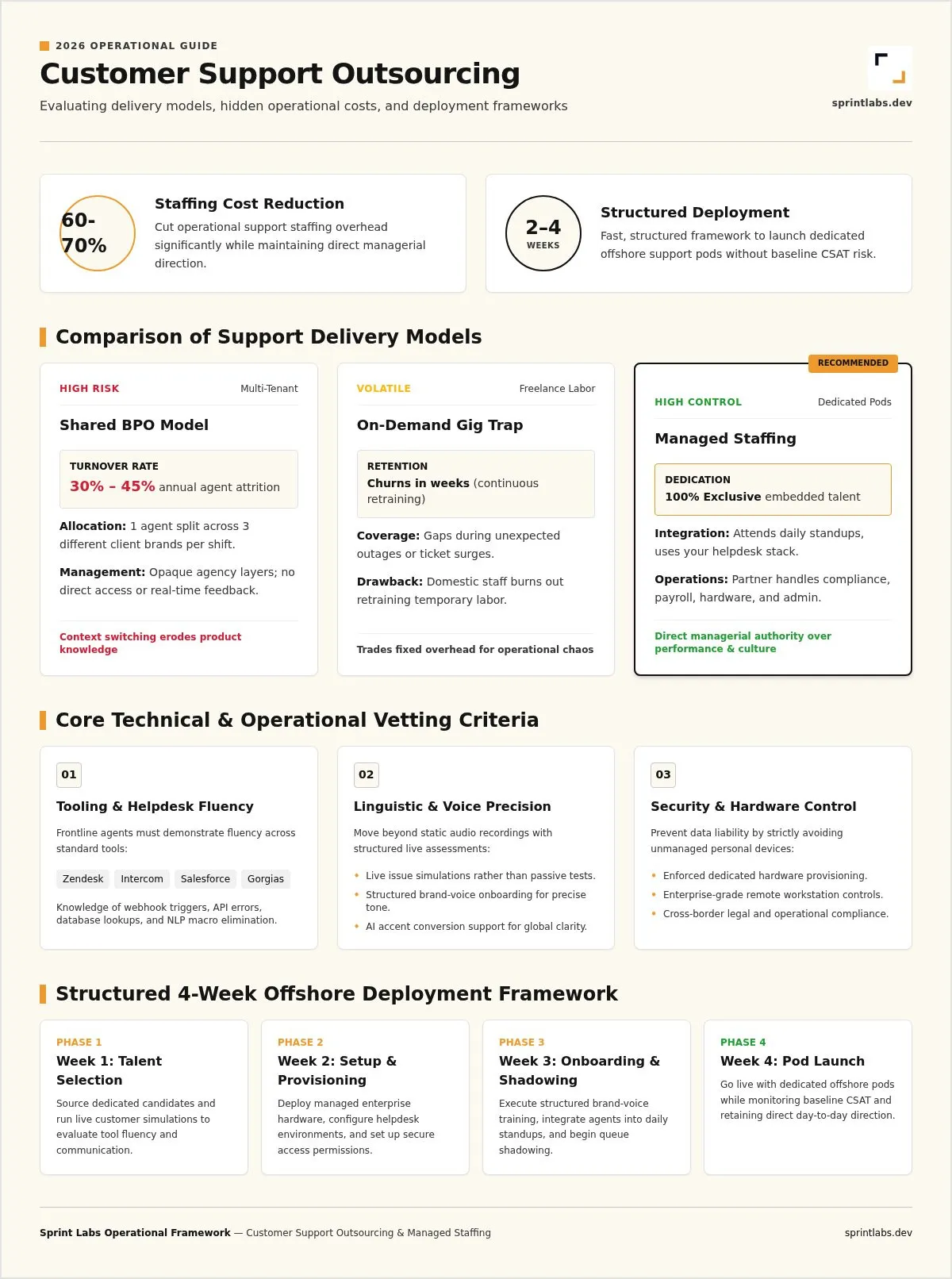
Shared call centers run on multi-tenancy. A single tier-one agent often handles tickets for three different brands during one shift. Constant context switching erodes focus and dilutes product knowledge. Standard contact centers also suffer from 30% to 45% annual agent turnover, steadily draining institutional memory. Heavy, opaque layers of account managers sit between you and the frontline staff. You cannot mentor agents directly, verify quality workflows, or inject real-time feedback when resolution times slip.
The On-Demand Gig Workforce Trap: Inconsistent Quality at Scale
Gig platforms pitch on-demand elasticity using distributed freelance labor. In reality, this model trades fixed overhead for operational chaos. Fractional contractors lack long-term incentives to master complex SaaS products or internal workflows. Variable scheduling creates critical coverage gaps during unexpected product outages or ticket surges. The burden then falls back on your core domestic staff, who burn out running continuous retraining cycles for temporary workers who churn in weeks.
The Managed Staffing Alternative: Dedicated Full-Time Talent
Managed staffing fixes these systemic flaws by decoupling talent acquisition from bureaucratic agency overhead. Instead of buying pooled ticket bandwidth, you build an embedded offshore team. Your dedicated specialists work exclusively for your company, attending your daily standups and using your preferred helpdesk environments. You retain direct managerial authority over performance and culture. Meanwhile, your managed staffing partner handles the contractor engagement: contracts, fees and payments, time off coordination, performance concerns, replacement, offboarding, and managed devices where needed.
For an in-depth breakdown of scaling international operations, explore our guide to managed offshore staffing in Asia. When vetting customer support outsourcing companies, prioritize dedicated ownership over shared vendor queues. It is the only way to safeguard your customer lifetime value.
Core Criteria for Selecting Customer Support Outsourcing Companies
Evaluating vendor capability requires looking past polished sales decks. Traditional business process outsourcing (BPO) providers frequently highlight headcount capacity rather than operational rigor. Selecting the right partner means auditing their underlying infrastructure, security posture, and frontline fluency. Modern customer support outsourcing companies must function as an organic extension of your engineering and product organizations, not an isolated call pool.
Technical Tooling Fluency and Helpdesk Integration
Frontline agents need instant command of your tech stack. Require proven experience across modern ecosystems like Zendesk, Intercom, Salesforce Service Cloud, and Gorgias. Beyond simple ticket tagging, agents should understand webhook triggers, API error responses, and database lookups. They must also know how to deploy modern natural language processing tools for customer support to automate triage and eliminate routine macro drafting.
Linguistic Precision, Cultural Alignment, and Voice Clarity
Scripted responses damage brand equity. Test candidate capabilities through live customer issue simulations rather than passive audio recordings. Top partners implement structured brand-voice onboarding to mirror your exact internal tone. For voice operations, forward-thinking teams leverage AI accent conversion for support clarity, removing comprehension barriers while keeping human empathy front and center.
Endpoint Security, Hardware Provisioning, and Data Protection
Unmanaged personal devices represent an unacceptable corporate liability. Demand enterprise-grade controls across every remote workstation:
- Hardware Provisioning: Enforce dedicated, company-owned machines locked via Mobile Device Management (MDM) platforms.
- Security Protocols: Mandate multi-factor authentication, hard-drive encryption, and strict zero-trust network access.
- Regulatory Adherence: Verify compliance with ISO/IEC 27001:2022 and SOC 2 Type II operational standards.
Review our comprehensive offshore team hardware checklist to audit prospective vendors against enterprise device baselines. If you need a partner that handles this technical vetting end-to-end, explore how Sprint Labs deploys fully managed teams with managed device options where needed.
The True Economics of Outsourcing Support: Hidden Costs vs. Managed Value
A low hourly rate looks compelling on a spreadsheet. In reality, it masks the true total cost of ownership. Fragmented vendor accountability and complex rate cards quickly erode initial savings. Evaluating customer support outsourcing companies requires looking beyond basic billing rates to understand the downstream financial impact of quality, retention, and operational overhead.
Deconstructing Hidden Fees in Legacy Outsourcing Contracts
Traditional vendor invoices arrive packed with unbundled markups. You expect to pay for agent time, but end up funding basic infrastructure: workstation provisioning, software connectivity, and training hours. Many legacy providers also tack on hefty administrative margins for team leads and internal quality auditors. Add rigid multi-year contracts with minimum seat commitments, and your operational flexibility vanishes. When customer support outsourcing companies bury overhead in opaque invoices, your actual spend balloons.
The Financial Upside of the Dedicated Managed Staffing Model
Dedicated managed staffing eliminates invoice volatility. You operate on transparent, flat monthly billing without per-ticket spikes or surprise technical surcharges:
- Direct Cost Reductions: Realize 60 to 70 percent cost savings compared to hiring domestic support personnel.
- Zero Administrative Friction: Offload contractor engagement administration, contracts, fees and payments, FX, time off coordination, performance concerns, replacement, and offboarding.
- Predictable Budgeting: Lock in stable operating expenditures while deploying dedicated personnel exclusively aligned with your product.
Measuring Business Impact: CSAT, Resolution Velocity, and Retention
The costliest support ticket is the one handled twice. Low-cost transactional models trigger chronic escalations, frustrated users, and elevated churn. In contrast, dedicated support professionals build deep contextual intuition over time. First Contact Resolution (FCR) rates rise, handling times normalize, and customer satisfaction scores climb. Retaining customers through reliable, rapid resolutions drives real lifetime value, proving far more profitable than cutting corners on disposable call center talent.
How to Launch an Offshore Support Team in 2–4 Weeks Without CSAT Drops
Transitioning support operations offshore shouldn't trigger an operational crisis. Many companies delay hiring because legacy customer support outsourcing companies enforce lengthy three-month ramp cycles. A structured, phased sprint lets you build capacity rapidly while protecting response times and CSAT baselines from day one.
Phase 1: Role Scoping, Playbook Audit, and Rapid Recruitment
Execution begins with granular operational scoping. Isolate your top twenty recurring inquiry types, catalog macro libraries, and formalize escalation paths. In week one, define your technical profiles and service-level agreements. Screening occurs in week two. Evaluate pre-vetted talent through live ticket simulations that assess written precision, logical troubleshooting, and brand alignment under time constraints.
Phase 2: Secure Infrastructure Setup and Technical Systems Onboarding
Operational readiness demands zero-trust endpoint control before agents log into queues:
- Hardware Deployment: Where a managed device is required, arrange a laptop configured with Mobile Device Management (MDM) software directly for the professional during week three.
- Credential Access: Authenticate users via centralized single sign-on (SSO) tools, eliminating the risk of unmanaged local credential storage.
- Team Integration: Embed agents immediately into daily standups and operational Slack channels alongside internal team leads.
Phase 3: Supervised Handover, Calibration, and Autonomous Scaling
Avoid dumping raw ticket queues onto new hires overnight. Week four focuses on structured shadowing and gradual volume ramp. Pair incoming agents with domestic leads to co-pilot tickets. Begin with simple macro responses and refund verifications, then transition toward edge-case technical workflows.
Audit initial resolutions against strict QA rubrics. Score tickets on tone, technical accuracy, and policy adherence. Once the team hits target quality thresholds across initial cohorts, increase ticket allocation. Leading customer support outsourcing companies build clear operational guardrails so agents resolve issues autonomously without degrading performance.
Ready to deploy dedicated support pods in two to four weeks? Build your custom support team with Sprint Labs and secure reliable, seamless coverage without administrative headaches.
Why Fast-Growing Tech Companies Partner with Sprint Labs for Customer Support
High-growth operators cannot tolerate the rigid friction of legacy vendor contracts. Where conventional customer support outsourcing companies lock clients into opaque ticket queues and bureaucratic account layers, Sprint Labs provides an agile alternative. You get dedicated, vetted support professionals embedded directly into your systems, tools, and daily standups within a rapid two- to four-week deployment window.
Elite Talent Sourcing with Full Management Autonomy
True brand alignment requires direct control over your frontline personnel. Instead of accepting pre-assigned seat fillers, you interview and select the specific professionals who represent your brand. Your support specialists report directly to your internal leadership and master your product roadmap. We remove the middleman BPO managers who traditionally restrict operational visibility, giving you complete oversight of daily ticket quality and performance metrics.
Turnkey Global Infrastructure with Zero Administrative Friction
Building an overseas support pod shouldn't mean wrestling with cross-border logistics. Sprint Labs handles the operational engine room end-to-end:
- Contractor Engagement Administration: We manage contractor agreements, monthly invoicing and payments, FX, time off coordination, performance concerns, replacement, and offboarding.
- Enterprise Endpoint Security: Every team member receives secure, enterprise-grade laptops equipped with MDM software and strict data protocols.
- High Talent Retention: Competitive contractor fees and proactive retention programs protect your institutional knowledge and combat contact center fatigue.
- Advanced Voice Tooling: Support voice operations seamlessly with optional AI accent conversion capabilities that ensure clear customer communication.
Flexible Scaling for High-Velocity Customer Operations
Rapid growth requires elastic capacity without long-term traps. Sprint Labs allows you to scale dedicated headcount up or down smoothly with a transparent 60-day operational notice. When ticket escalations reveal underlying product bugs or software bottlenecks, deploy technical staff in parallel using our playbook on hiring dedicated developers. It's time to move beyond the limitations of legacy customer support outsourcing companies. Partner with Sprint Labs to build your dedicated, high-retention support engine today.
Build a High-Retention Support Operation for 2026 and Beyond
Customer support shouldn't feel like an ongoing compromise between ballooning domestic payroll and declining service quality. Evaluating conventional customer support outsourcing companies often presents a false choice: settle for high-churn shared ticket pools or absorb the chaos of managing unvetted overseas contractors. Dedicated managed staffing eliminates that friction entirely.
Building dedicated support pods lets you retain full managerial authority while cutting operational staffing costs by 60 to 70 percent. Managed contractor infrastructure covers contracts, fees and payments, FX, management support, replacement, and MDM-secured devices where required so your internal team can stay focused on core product velocity. With pre-vetted specialists deployed in just two to four weeks, scaling your support engine no longer requires months of administrative drag.
Protect your brand equity, eliminate response bottlenecks, and elevate your customer experience with an agile, high-performing offshore team. Scale your support team with dedicated offshore talent from Sprint Labs and turn daily customer operations into a predictable growth driver.
Frequently Asked Questions
What is the primary difference between a traditional BPO and managed customer support staffing?
Traditional BPOs utilize shared agent pools and opaque management layers, whereas managed staffing delivers dedicated contractors who integrate directly into your internal workflows. In a BPO, multi-tenant reps juggle multiple accounts under vendor-enforced processes. With managed staffing, you interview, select, and direct your support professionals directly. The staffing partner manages contractor agreements, fees and payments, time off coordination, performance concerns, replacement, offboarding, and managed device logistics where needed.
How quickly can an outsourced customer support team become fully operational?
A dedicated offshore support team can become fully operational within two to four weeks. Week one focuses on defining role specifications and auditing internal ticket documentation. Candidate screening and operational simulations occur during week two. Week three covers any required managed device provisioning and single sign-on onboarding. By week four, agents shadow your senior domestic reps on live queues, moving into supervised autonomous ticket resolution with zero CSAT disruption.
How do customer support outsourcing companies ensure data privacy and compliance?
Top customer support outsourcing companies enforce zero-trust security frameworks, Mobile Device Management (MDM), and strict role-based access controls. Where required, agents work on locked, company-provisioned laptops with encrypted drives, disabled USB storage, and multi-factor authentication. Reps never store customer credentials locally. Vetted partners also adhere to global compliance benchmarks like SOC 2 Type II and ISO/IEC 27001, ensuring customer data handling meets stringent international privacy standards.
Will our internal team lose control over customer support quality when outsourcing?
You will not lose quality control if you partner with a dedicated managed staffing provider rather than a shared call center. Dedicated agents attend your internal team rituals, use your native ticketing setups, and report directly to your support leads. You set ticket-handling guidelines, calibrate QA rubrics, and run weekly performance reviews directly. The outsourcing partner manages local administrative overhead, leaving operational direction in your hands.
Can outsourced customer support agents handle complex technical SaaS inquiries?
Yes, vetted offshore support specialists routinely manage tier-two technical workflows, API troubleshooting, and bug reproduction. Dedicated models source experienced talent proficient with modern developer and helpdesk stacks, including Postman, GitHub, Zendesk, and Intercom. Because these professionals work exclusively on your product, they build deep contextual intuition over time. They understand software dependencies, parse server errors, and escalate validated edge cases directly to your engineering squads.
How do managed support staffing models handle agent attrition and replacement?
Managed staffing providers mitigate attrition through competitive contractor fees and proactive retention programs. While legacy call centers battle 30% to 45% turnover, dedicated offshore environments prioritize long-term career progression. If a professional departs or underperforms, your staffing partner rapidly sources, vets, and presents qualified replacements from their existing talent pipelines. Seamless offboarding protocols and MDM remote wiping, where applicable, safeguard corporate data instantly.
What software tools and infrastructure must our company provide for outsourced agents?
Your company only provides cloud software seats and single sign-on credentials for your operational tools. You grant agent access to platforms like Zendesk, Slack, Jira, or your internal knowledge base. Modern customer support outsourcing companies handle physical infrastructure entirely. They procure, configure, and ship enterprise-grade laptops, install security software, manage endpoint encryption, and maintain reliable secondary internet connections to ensure uninterrupted daily uptime.
Frequently asked questions
What is the primary difference between a traditional BPO and managed customer support staffing?
Traditional BPOs utilize shared agent pools and opaque management layers, whereas managed staffing delivers dedicated contractors who integrate directly into your internal workflows. In a BPO, multi-tenant reps juggle multiple accounts under vendor-enforced processes. With managed staffing, you interview, select, and direct your support professionals directly. The staffing partner manages contractor agreements, fees and payments, time off coordination, performance concerns, replacement, offboarding, and managed device logistics where needed.
How quickly can an outsourced customer support team become fully operational?
A dedicated offshore support team can become fully operational within two to four weeks. Week one focuses on defining role specifications and auditing internal ticket documentation. Candidate screening and operational simulations occur during week two. Week three covers any required managed device provisioning and single sign-on onboarding. By week four, agents shadow your senior domestic reps on live queues, moving into supervised autonomous ticket resolution with zero CSAT disruption.
How do customer support outsourcing companies ensure data privacy and compliance?
Top customer support outsourcing companies enforce zero-trust security frameworks, Mobile Device Management (MDM), and strict role-based access controls. Where required, agents work on locked, company-provisioned laptops with encrypted drives, disabled USB storage, and multi-factor authentication. Reps never store customer credentials locally. Vetted partners also adhere to global compliance benchmarks like SOC 2 Type II and ISO/IEC 27001, ensuring customer data handling meets stringent international privacy standards.
Will our internal team lose control over customer support quality when outsourcing?
You will not lose quality control if you partner with a dedicated managed staffing provider rather than a shared call center. Dedicated agents attend your internal team rituals, use your native ticketing setups, and report directly to your support leads. You set ticket-handling guidelines, calibrate QA rubrics, and run weekly performance reviews directly. The outsourcing partner manages local administrative overhead, leaving operational direction in your hands.
Can outsourced customer support agents handle complex technical SaaS inquiries?
Yes, vetted offshore support specialists routinely manage tier-two technical workflows, API troubleshooting, and bug reproduction. Dedicated models source experienced talent proficient with modern developer and helpdesk stacks, including Postman, GitHub, Zendesk, and Intercom. Because these professionals work exclusively on your product, they build deep contextual intuition over time. They understand software dependencies, parse server errors, and escalate validated edge cases directly to your engineering squads.
How do managed support staffing models handle agent attrition and replacement?
Managed staffing providers mitigate attrition through competitive contractor fees and proactive retention programs. While legacy call centers battle 30% to 45% turnover, dedicated offshore environments prioritize long-term career progression. If a professional departs or underperforms, your staffing partner rapidly sources, vets, and presents qualified replacements from their existing talent pipelines. Seamless offboarding protocols and MDM remote wiping, where applicable, safeguard corporate data instantly.
What software tools and infrastructure must our company provide for outsourced agents?
Your company only provides cloud software seats and single sign-on credentials for your operational tools. You grant agent access to platforms like Zendesk, Slack, Jira, or your internal knowledge base. Modern customer support outsourcing companies handle physical infrastructure entirely. They procure, configure, and ship enterprise-grade laptops, install security software, manage endpoint encryption, and maintain reliable secondary internet connections to ensure uninterrupted daily uptime.
Hiring in Asia? We'll do it for you.
Sprint Labs is a managed staffing firm. We recruit, vet, place and manage senior professionals across the Philippines, Vietnam, Malaysia, Indonesia and India. You direct the work, we handle the engagement.
Create a request →