
How to Hire an Offshore SDR: A Practical Guide for 2026
Ready to hire offshore SDR talent? Learn how to evaluate real skills, streamline onboarding, and drive qualified sales pipeline with our practical 2026 guide.
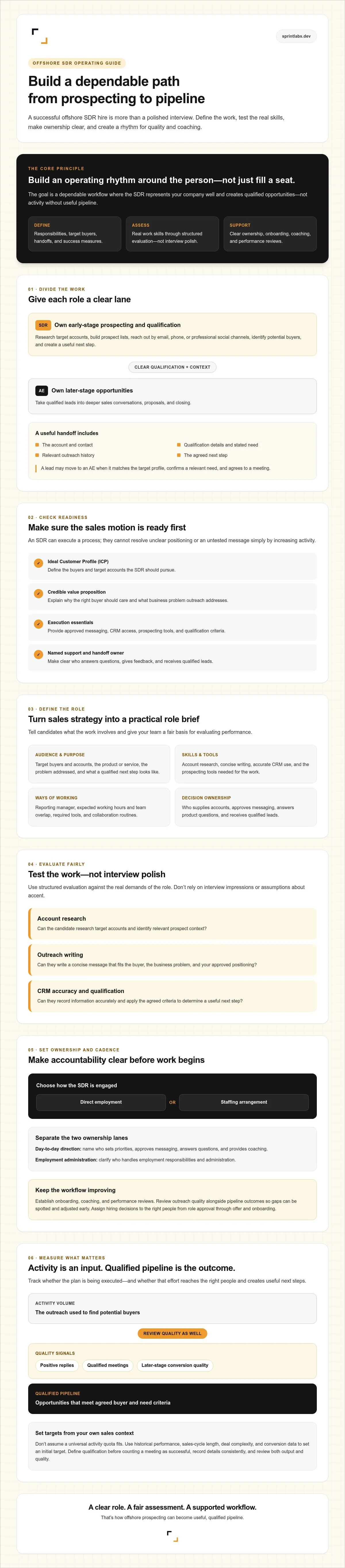
A polished interview won’t tell you whether an offshore SDR can represent your brand or turn prospecting into qualified pipeline. To hire offshore SDR talent effectively, build an operating rhythm around the person, not just fill a seat.
The appeal is clear: an SDR can take prospecting and lead qualification off your plate. But without a defined role, clear handoffs, and quality standards, even a capable hire can generate activity without creating useful pipeline. Decide who owns communication, coaching, and employment responsibilities before recruiting.
This guide shows you how to define a measurable SDR role, assess candidates through realistic work samples, and establish onboarding, coaching, and performance reviews. You’ll also learn how to choose a hiring model and clarify who directs day-to-day work and who handles employment administration. The goal is a dependable workflow that helps your SDR represent your company well and create qualified opportunities.
Key Takeaways
- Before you hire offshore SDR talent, turn your sales strategy into a role brief with clear responsibilities and success measures.
- Assess candidates against the role’s real demands with structured evaluation, not interview polish or assumptions about accent.
- Assign hiring decisions to the right people, from role approval through offer and onboarding.
- Build a coaching cadence that reviews outreach quality as well as pipeline outcomes, so you can spot gaps and adjust early.
Table of Contents
- Why hire an offshore SDR, and what should the role own?
- Define the offshore SDR profile, targets, and success measures
- How to evaluate offshore SDR candidates beyond the interview
- Follow a clear process to hire an offshore SDR
- Onboard and manage your offshore SDR for consistent pipeline
Why hire an offshore SDR, and what should the role own?
Qualified pipeline depends on consistent, focused prospecting. When account executives split their time between researching prospects, sending first-touch messages, qualifying interest, and advancing active deals, prospecting can lose priority. An offshore sales development representative (SDR) can own that early-stage work remotely, giving the sales team a clearer division of responsibilities.
Offshoring describes where work is performed; outsourcing describes how work is assigned outside an organization, as explained in this overview of the business practice of outsourcing. An offshore SDR may be employed directly or through a staffing arrangement. Either way, define the role by its responsibilities and handoffs, not its location.
What work should an offshore SDR own?
The SDR’s job is to identify and qualify potential buyers, then create a useful next step. Depending on your sales motion and how buyers prefer to engage, that can include researching target accounts, building prospect lists, and conducting outreach by email, phone, or professional social channels. The account executive typically owns later-stage opportunities, including deeper sales conversations, proposals, and closing.
Make the handoff explicit. For example, a qualified lead might move to an account executive when the prospect matches your target profile, confirms a relevant need, and agrees to a meeting. The handoff should include the account and contact, qualification details, stated need, relevant outreach history, and agreed next step. That gives the receiving rep context instead of another name to investigate.
Set boundaries, too. Decide who approves messaging, who handles replies that fall outside the qualification criteria, and how the SDR records disqualified prospects. Clear ownership prevents duplicate outreach and keeps the buyer experience coherent.
Is your sales motion ready for an offshore SDR?
Before you hire offshore SDR talent, check that the work can be directed and evaluated. The SDR needs a defined Ideal Customer Profile (ICP), a credible value proposition, and target accounts that match both. Your team should also provide approved messaging, CRM access, qualification criteria, and a named owner for questions and feedback.
Test the sales motion before assigning it to a new hire. If your team can’t explain why the right buyer should care or which signals make a prospect qualified, the SDR won’t fix that uncertainty by increasing activity. Unclear positioning and untested outreach can waste effort and weaken brand representation. Tighten the message and agree on what a successful handoff looks like first. Then the SDR can execute against a process the sales team is ready to support.
Define the offshore SDR profile, targets, and success measures
A clear role brief turns your sales strategy into hiring criteria. Before you recruit, specify who the SDR will contact, what business problem the outreach addresses, and what a qualified next step looks like. This gives candidates a concrete picture of the work and gives your team a fair basis for evaluating performance.
For a broader view of the strategy behind building a distributed sales function, read this offshore sales development guide. Use that strategic context to shape a brief for the specific role you need to fill.
What belongs in an offshore SDR job description?
Describe the target buyers and accounts, the products or services they’ll hear about, and the problems your outreach should address. Be specific about the skills the work requires, such as researching accounts, writing concise messages, using your CRM accurately, and working with your prospecting tools.
Set operating expectations before you hire offshore SDR talent. Name the reporting manager, expected working hours and overlap with the sales team, required tools, and collaboration routines. Clarify who supplies target accounts, approves messaging, answers product questions, and receives qualified leads. These details make the job easier to understand and reduce guesswork once work begins.
Which SDR metrics show quality as well as activity?
Activity shows whether the SDR is executing the plan. Quality shows whether that effort is reaching the right people and creating useful next steps. Qualified pipeline measures opportunities that meet agreed buyer and need criteria, while activity volume counts the outreach used to find them.
Track activity volume alongside positive replies, qualified meetings, and conversion quality in later sales stages. Define qualification before counting a meeting as successful. For example, agree whether a lead must match your target account profile, have a relevant business need, and include a suitable contact. Then record those details consistently so the sales team can assess the handoff.
Don’t lift a universal activity quota and assume it fits. Use your own historical performance, sales-cycle length, deal complexity, and conversion data to set an initial target. Review both output and quality, then adjust when the evidence shows the target is unrealistic or the process needs refinement. If you’re considering external support for the role, explore Sales & Marketing Staffing as one option.
How to evaluate offshore SDR candidates beyond the interview
A confident interview is only one data point. To hire offshore SDR talent with more confidence, use the same evidence-based process for every candidate: screen against the role brief, ask structured interview questions, assign a practical work sample, check references, then compare scores before deciding. This makes the choice less dependent on instinct and more closely tied to the work the person will actually do.
Use exercises that reflect your sales motion, not generic sales tests. Share a sample target account and ask the candidate to explain whether it fits your Ideal Customer Profile, what research supports that view, and who they would contact. Then provide accurate information and ask for a short outreach draft. Assess relevance, clarity, tone, and whether the message gives the recipient a credible reason to respond.
Test communication in realistic situations
A role-play can reveal how a candidate listens and responds under light pressure. Present a prospect’s concern and observe whether the candidate asks a useful follow-up question, acknowledges the concern, and responds respectfully rather than pushing a canned pitch. Give specific feedback and ask them to try again. Their ability to understand and apply coaching matters as much as their first attempt.
Assess communication by comprehension, clarity, responsiveness, and accuracy. Don’t use accent as a proxy for sales ability. Focus on whether the candidate can understand the buyer, communicate the intended message, and represent your brand appropriately.
Score candidates consistently
Before interviews begin, create a shared rubric tied to the role brief. Rate each candidate on the same dimensions, such as account research, writing, listening, objection handling, CRM experience, and coachability. Use consistent questions and record specific evidence for each score. A polished answer should not outweigh weak work-sample results, and one interviewer’s instinct shouldn’t silently reset the criteria.
After the work sample, check references with focused questions about reliability, communication, response to feedback, and relevant sales responsibilities. Compare evidence across screening, interviews, exercises, and references. If candidates are close, identify which capability matters most for your role and review that evidence again.
Recruitment and engagement support can vary by hiring model. A company recruiting and managing a dedicated contractor may handle functions that a direct-hire process leaves to your organization. For a closer look at how these arrangements differ, read the guide to managed offshore staffing. Sprint Labs also provides Sales & Marketing Staffing for businesses considering managed staffing.
Follow a clear process to hire an offshore SDR
A hiring process moves more smoothly when each decision has an owner and a deadline. Before you hire offshore SDR talent, agree on who approves the role, who assesses sales capability, who coordinates recruitment, and who reviews employment arrangements. Keep candidates and interviewers informed with a set update cadence, such as a brief weekly status check, and decide in advance when the team will make its final choice.
What are the steps for hiring an offshore SDR?
- Approve the role. The sales leader confirms the need and target outcomes. The hiring manager finalizes responsibilities, scorecard, compensation parameters, reporting line, and working-hour expectations.
- Source and screen candidates. The recruiter checks candidates against the agreed role brief and shares relevant profiles with the hiring manager. Use consistent screening criteria rather than changing the bar mid-process.
- Assess practical skills. The hiring manager runs a structured interview and job-relevant work sample. The sales leader reviews the evidence against the scorecard, including research, writing, listening, and coachability.
- Compare and decide. Interviewers document scores and evidence, then meet by the agreed decision deadline. The hiring manager owns the selection recommendation; the sales leader confirms business fit.
- Complete checks and prepare onboarding. The recruiter coordinates references and appropriate employment checks. The relevant operations contact reviews the employment process, while the hiring manager prepares tools, training, and the first work priorities. Confirm the offer in writing before onboarding begins.
What should you clarify before choosing a hiring model?
Direct hiring and managed staffing differ in who handles employment administration and ongoing operations. In a direct arrangement, clarify which responsibilities your company will own. With managed staffing, confirm in writing who handles recruitment, contracts, payments, equipment and day-to-day support, and who sets daily SDR priorities. In Sprint Labs’ model, clients direct the contractor’s work while Sprint Labs handles recruitment, vetting, contracts, fees and payments, management support, replacement, and any managed device the client needs.
Ask the relevant operations contact to identify any employment requirements that need review in the relevant jurisdiction. Treat this as a prompt to seek qualified professional advice, not a substitute for it. Make the decision only when ownership, costs, responsibilities, and the onboarding handoff are clear.
Avoid delays by setting a communication rhythm at the start: share candidate updates on a regular schedule, give interviewers a short deadline to submit feedback, and reserve time for the final decision. If you want support with recruitment and contractor engagement administration, explore Sprint Labs Sales & Marketing Staffing.
Onboard and manage your offshore SDR for consistent pipeline
Hiring selects a person. Onboarding connects that person to your sales process. Give your SDR the context and practice needed to represent your company accurately before expecting independent execution. Start with product knowledge, buyer priorities, approved messaging, qualification criteria, and the tools they’ll use each day.
What should an offshore SDR onboarding plan include?
Build onboarding around the work the SDR will perform. Provide target-account criteria, examples of strong-fit buyers, approved positioning, common objections and response guidance, and clear escalation paths for questions they shouldn’t answer alone. Document how to use the CRM, which stages to update, what information belongs in a lead handoff, how meetings are recorded, and what data-handling procedures to follow.
Then practice before handing over live prospects. Have the SDR research sample accounts, draft outreach, role-play qualification conversations, and enter example records in the CRM. Review the work together. Correct inaccurate claims, unclear writing, or missing qualification details, then repeat the exercise until the process is understood. Supervised practice helps protect the buyer experience while the SDR builds confidence.
How can you keep an offshore SDR aligned with the sales team?
Set a regular management rhythm and keep each meeting focused. In one-to-ones, review a small sample of calls or messages, give specific coaching, and agree on one or two follow-up actions. In pipeline reviews, look beyond outreach volume: check lead fit, reply quality, meeting outcomes, conversion, and where prospects stall. Assign an owner to each action so feedback leads to a change in execution.
Use a shared dashboard to make the same information visible to the SDR, sales manager, and account executives. Track activity alongside quality and outcomes. If replies are strong but meetings don’t progress, review qualification and handoff context. If outreach volume is high but relevant responses are limited, revisit account selection or messaging. Treat performance gaps as signals to investigate, not automatic proof that the hire was wrong.
Managing an offshore SDR still requires clear direction from your team. In Sprint Labs’ managed contractor model, the client directs the contractor’s day-to-day work, while Sprint Labs handles the engagement, including contracts, fees and payments, time off, performance concerns, replacement, offboarding, and any managed device the client needs. That separates work priorities from engagement administration without outsourcing accountability for sales execution.
Start by assigning the SDR a manager, approving the onboarding materials, and scheduling the first coaching and pipeline reviews. To explore recruitment and operational support, learn about Sprint Labs’ managed staffing approach. A defined process gives you a practical foundation to hire offshore SDR talent and improve the workflow based on real pipeline evidence, without assuming any hire guarantees meetings or revenue.
Build your offshore SDR role around a clear system
A successful offshore SDR hire starts with a defined role, not a job title. Set clear responsibilities, qualification criteria, and measures that balance outreach activity with lead quality. Then assess candidates using realistic work samples and a consistent scorecard, so your decision reflects how they’ll perform the work, not just how they interview.
Once hired, provide product and buyer context, supervised practice, and regular coaching. Clear handoffs and shared pipeline reviews help the SDR stay connected to the sales team and improve execution over time. To hire offshore SDR talent through a managed model, understand who directs daily work and who handles engagement operations before choosing a partner.
With Sprint Labs, clients direct the work of dedicated contractors while Sprint Labs handles recruitment, vetting, contracts, fees and payments, management support, replacement, and any managed device the client needs. Explore Sprint Labs’ managed offshore staffing approach to see whether this model fits your team’s needs. Define the process, set clear expectations, and take the next step toward a more consistent pipeline.
Frequently Asked Questions
What does an offshore SDR do?
An offshore SDR is a remote sales development representative focused on early-stage sales work. Depending on your sales motion, they may research target accounts, find prospects, conduct outreach, qualify interest, and book or hand off suitable meetings. An SDR usually doesn’t own later-stage opportunities or closing; those responsibilities typically belong to an account executive. Before recruiting, document the SDR’s responsibilities, qualification criteria, handoff requirements, and boundaries for handling prospect questions.
How do I hire an offshore SDR?
To hire offshore SDR talent, start by defining your Ideal Customer Profile and the outcomes the role should support. Write a scorecard, choose a hiring model, source candidates, and assess them with structured interviews and practical exercises tied to the actual work. Compare candidates using consistent criteria, complete appropriate reference and employment checks, then prepare onboarding before the start date. Set decision owners and deadlines. Review employment responsibilities with qualified advisers where needed, since one hiring arrangement won’t suit every company.
How can I assess an offshore SDR’s communication skills?
Assess communication through realistic work, not accent or interview polish. Ask candidates to research a sample account, draft a concise outreach message, and respond to specific feedback. A discovery role-play can reveal whether they listen, ask relevant questions, and handle an objection respectfully. Use the same rubric for each candidate. Score clarity, comprehension, relevance, accuracy, and coachability against your buyers, outreach channels, and brand standards. This shows how they may communicate in the role.
Should I hire an offshore SDR directly or through a staffing partner?
The right model depends on your team’s capacity and the responsibilities you want to retain. With direct hiring, your company may need to coordinate recruitment and employment administration. A managed staffing partner such as Sprint Labs takes on defined tasks such as recruitment, vetting, contracts, contractor payments and engagement support. Confirm the exact scope and employment arrangement before deciding. For example, Sprint Labs says clients direct contractors’ work while Sprint Labs handles contractor engagement operations. Review relevant requirements with qualified advisers.
How long does it take to hire an offshore SDR?
Hiring time depends on role clarity, candidate availability, interview pace, assessment steps, and employment requirements. Sprint Labs states a 2-4-week hiring timeline, but confirm what starts the clock, which stages it includes, and whether it applies to your specific role. Treat that timeframe as a company-reported estimate, not a guarantee. Before recruitment begins, agree on milestones, interview availability, feedback deadlines, and who makes each decision to reduce avoidable delays.
What should I measure when managing an offshore SDR?
Measure activity alongside quality and outcomes. Depending on the role, track researched accounts, relevant outreach, positive responses, qualified meetings, complete handoffs, and progression through your sales process. Define qualification consistently before counting a meeting as successful, then compare results with your own historical performance. Activity counts alone don’t show whether outreach creates useful pipeline. Pair a shared dashboard with regular coaching so you can review real examples, identify bottlenecks, and agree on specific follow-up actions.
How do I onboard an offshore SDR successfully?
Onboard an offshore SDR with structured training on your product, buyers, Ideal Customer Profile, approved messaging, CRM workflow, qualification rules, and escalation paths. Use practice tasks and supervised outreach before assigning independent ownership of live prospects. Document the handoff fields and data-handling procedures the SDR must follow. Then schedule regular one-to-ones, review real calls or messages, and record coaching actions. Clear management ownership and accessible feedback help the SDR integrate into the sales team and follow its process.
Frequently asked questions
What work should an offshore SDR own?
The SDR’s job is to identify and qualify potential buyers, then create a useful next step. Depending on your sales motion and how buyers prefer to engage, that can include researching target accounts, building prospect lists, and conducting outreach by email, phone, or professional social channels. The account executive typically owns later-stage opportunities, including deeper sales conversations, proposals, and closing. Make the handoff explicit. For example, a qualified lead might move to an account executive when the prospect matches your target profile, confirms a relevant need, and agrees to a meeting. The handoff should include the account and contact, qualification details, stated need, relevant outreach history, and agreed next step. That gives the receiving rep context instead of another name to investigate. Set boundaries, too. Decide who approves messaging, who handles replies that fall outside the qualification criteria, and how the SDR records disqualified prospects. Clear ownership prevents duplicate outreach and keeps the buyer experience coherent.
Is your sales motion ready for an offshore SDR?
Before you hire offshore SDR talent, check that the work can be directed and evaluated. The SDR needs a defined Ideal Customer Profile (ICP), a credible value proposition, and target accounts that match both. Your team should also provide approved messaging, CRM access, qualification criteria, and a named owner for questions and feedback. Test the sales motion before assigning it to a new hire. If your team can’t explain why the right buyer should care or which signals make a prospect qualified, the SDR won’t fix that uncertainty by increasing activity. Unclear positioning and untested outreach can waste effort and weaken brand representation. Tighten the message and agree on what a successful handoff looks like first. Then the SDR can execute against a process the sales team is ready to support. A clear role brief turns your sales strategy into hiring criteria. Before you recruit, specify who the SDR will contact, what business problem the outreach addresses, and what a qualified next step looks like. This gives candidates a concrete picture of the work and gives your team a fair basis for evaluating performance. For a broader view of the strategy behind building a distributed sales function, read this offshore sales development guide. Use that strategic context to shape a brief for the specific role you need to fill.
What belongs in an offshore SDR job description?
Describe the target buyers and accounts, the products or services they’ll hear about, and the problems your outreach should address. Be specific about the skills the work requires, such as researching accounts, writing concise messages, using your CRM accurately, and working with your prospecting tools. Set operating expectations before you hire offshore SDR talent. Name the reporting manager, expected working hours and overlap with the sales team, required tools, and collaboration routines. Clarify who supplies target accounts, approves messaging, answers product questions, and receives qualified leads. These details make the job easier to understand and reduce guesswork once work begins.
Which SDR metrics show quality as well as activity?
Activity shows whether the SDR is executing the plan. Quality shows whether that effort is reaching the right people and creating useful next steps. Qualified pipeline measures opportunities that meet agreed buyer and need criteria, while activity volume counts the outreach used to find them. Track activity volume alongside positive replies, qualified meetings, and conversion quality in later sales stages. Define qualification before counting a meeting as successful. For example, agree whether a lead must match your target account profile, have a relevant business need, and include a suitable contact. Then record those details consistently so the sales team can assess the handoff. Don’t lift a universal activity quota and assume it fits. Use your own historical performance, sales-cycle length, deal complexity, and conversion data to set an initial target. Review both output and quality, then adjust when the evidence shows the target is unrealistic or the process needs refinement. If you’re considering external support for the role, explore Sales & Marketing Staffing as one option. A confident interview is only one data point. To hire offshore SDR talent with more confidence, use the same evidence-based process for every candidate: screen against the role brief, ask structured interview questions, assign a practical work sample, check references, then compare scores before deciding. This makes the choice less dependent on instinct and more closely tied to the work the person will actually do. Use exercises that reflect your sales motion, not generic sales tests. Share a sample target account and ask the candidate to explain whether it fits your Ideal Customer Profile, what research supports that view, and who they would contact. Then provide accurate information and ask for a short outreach draft. Assess relevance, clarity, tone, and whether the message gives the recipient a credible reason to respond.
What are the steps for hiring an offshore SDR?
Approve the role. The sales leader confirms the need and target outcomes. The hiring manager finalizes responsibilities, scorecard, compensation parameters, reporting line, and working-hour expectations. Source and screen candidates. The recruiter checks candidates against the agreed role brief and shares relevant profiles with the hiring manager. Use consistent screening criteria rather than changing the bar mid-process. Assess practical skills. The hiring manager runs a structured interview and job-relevant work sample. The sales leader reviews the evidence against the scorecard, including research, writing, listening, and coachability. Compare and decide. Interviewers document scores and evidence, then meet by the agreed decision deadline. The hiring manager owns the selection recommendation; the sales leader confirms business fit. Complete checks and prepare onboarding. The recruiter coordinates references and appropriate employment checks. The relevant operations contact reviews the employment process, while the hiring manager prepares tools, training, and the first work priorities. Confirm the offer in writing before onboarding begins.
What should you clarify before choosing a hiring model?
Direct hiring and managed staffing differ in who handles employment administration and ongoing operations. In a direct arrangement, clarify which responsibilities your company will own. With managed staffing, confirm in writing who handles recruitment, contracts, payments, equipment and day-to-day support, and who sets daily SDR priorities. In Sprint Labs’ model, clients direct the contractor’s work while Sprint Labs handles recruitment, vetting, contracts, fees and payments, management support, replacement, and any managed device the client needs. Ask the relevant operations contact to identify any employment requirements that need review in the relevant jurisdiction. Treat this as a prompt to seek qualified professional advice, not a substitute for it. Make the decision only when ownership, costs, responsibilities, and the onboarding handoff are clear. Avoid delays by setting a communication rhythm at the start: share candidate updates on a regular schedule, give interviewers a short deadline to submit feedback, and reserve time for the final decision. If you want support with recruitment and contractor engagement administration, explore Sprint Labs Sales & Marketing Staffing. Hiring selects a person. Onboarding connects that person to your sales process. Give your SDR the context and practice needed to represent your company accurately before expecting independent execution. Start with product knowledge, buyer priorities, approved messaging, qualification criteria, and the tools they’ll use each day.
What should an offshore SDR onboarding plan include?
Build onboarding around the work the SDR will perform. Provide target-account criteria, examples of strong-fit buyers, approved positioning, common objections and response guidance, and clear escalation paths for questions they shouldn’t answer alone. Document how to use the CRM, which stages to update, what information belongs in a lead handoff, how meetings are recorded, and what data-handling procedures to follow. Then practice before handing over live prospects. Have the SDR research sample accounts, draft outreach, role-play qualification conversations, and enter example records in the CRM. Review the work together. Correct inaccurate claims, unclear writing, or missing qualification details, then repeat the exercise until the process is understood. Supervised practice helps protect the buyer experience while the SDR builds confidence.
How can you keep an offshore SDR aligned with the sales team?
Set a regular management rhythm and keep each meeting focused. In one-to-ones, review a small sample of calls or messages, give specific coaching, and agree on one or two follow-up actions. In pipeline reviews, look beyond outreach volume: check lead fit, reply quality, meeting outcomes, conversion, and where prospects stall. Assign an owner to each action so feedback leads to a change in execution. Use a shared dashboard to make the same information visible to the SDR, sales manager, and account executives. Track activity alongside quality and outcomes. If replies are strong but meetings don’t progress, review qualification and handoff context. If outreach volume is high but relevant responses are limited, revisit account selection or messaging. Treat performance gaps as signals to investigate, not automatic proof that the hire was wrong. Managing an offshore SDR still requires clear direction from your team. In Sprint Labs’ managed contractor model, the client directs the contractor’s day-to-day work, while Sprint Labs handles the engagement, including contracts, fees and payments, time off, performance concerns, replacement, offboarding, and any managed device the client needs. That separates work priorities from engagement administration without outsourcing accountability for sales execution. Start by assigning the SDR a manager, approving the onboarding materials, and scheduling the first coaching and pipeline reviews. To explore recruitment and operational support, learn about Sprint Labs’ managed staffing approach. A defined process gives you a practical foundation to hire offshore SDR talent and improve the workflow based on real pipeline evidence, without assuming any hire guarantees meetings or revenue. A successful offshore SDR hire starts with a defined role, not a job title. Set clear responsibilities, qualification criteria, and measures that balance outreach activity with lead quality. Then assess candidates using realistic work samples and a consistent scorecard, so your decision reflects how they’ll perform the work, not just how they interview. Once hired, provide product and buyer context, supervised practice, and regular coaching. Clear handoffs and shared pipeline reviews help the SDR stay connected to the sales team and improve execution over time. To hire offshore SDR talent through a managed model, understand who directs daily work and who handles engagement operations before choosing a partner. With Sprint Labs, clients direct the work of dedicated contractors while Sprint Labs handles recruitment, vetting, contracts, fees and payments, management support, replacement, and any managed device the client needs. Explore Sprint Labs’ managed offshore staffing approach to see whether this model fits your team’s needs. Define the process, set clear expectations, and take the next step toward a more consistent pipeline.
What does an offshore SDR do?
An offshore SDR is a remote sales development representative focused on early-stage sales work. Depending on your sales motion, they may research target accounts, find prospects, conduct outreach, qualify interest, and book or hand off suitable meetings. An SDR usually doesn’t own later-stage opportunities or closing; those responsibilities typically belong to an account executive. Before recruiting, document the SDR’s responsibilities, qualification criteria, handoff requirements, and boundaries for handling prospect questions.
How do I hire an offshore SDR?
To hire offshore SDR talent, start by defining your Ideal Customer Profile and the outcomes the role should support. Write a scorecard, choose a hiring model, source candidates, and assess them with structured interviews and practical exercises tied to the actual work. Compare candidates using consistent criteria, complete appropriate reference and employment checks, then prepare onboarding before the start date. Set decision owners and deadlines. Review employment responsibilities with qualified advisers where needed, since one hiring arrangement won’t suit every company.
How can I assess an offshore SDR’s communication skills?
Assess communication through realistic work, not accent or interview polish. Ask candidates to research a sample account, draft a concise outreach message, and respond to specific feedback. A discovery role-play can reveal whether they listen, ask relevant questions, and handle an objection respectfully. Use the same rubric for each candidate. Score clarity, comprehension, relevance, accuracy, and coachability against your buyers, outreach channels, and brand standards. This shows how they may communicate in the role.
Should I hire an offshore SDR directly or through a staffing partner?
The right model depends on your team’s capacity and the responsibilities you want to retain. With direct hiring, your company may need to coordinate recruitment and employment administration. A managed staffing partner such as Sprint Labs takes on defined tasks such as recruitment, vetting, contracts, contractor payments and engagement support. Confirm the exact scope and employment arrangement before deciding. For example, Sprint Labs says clients direct contractors’ work while Sprint Labs handles contractor engagement operations. Review relevant requirements with qualified advisers.
How long does it take to hire an offshore SDR?
Hiring time depends on role clarity, candidate availability, interview pace, assessment steps, and employment requirements. Sprint Labs states a 2–4-week hiring timeline, but confirm what starts the clock, which stages it includes, and whether it applies to your specific role. Treat that timeframe as a company-reported estimate, not a guarantee. Before recruitment begins, agree on milestones, interview availability, feedback deadlines, and who makes each decision to reduce avoidable delays.
What should I measure when managing an offshore SDR?
Measure activity alongside quality and outcomes. Depending on the role, track researched accounts, relevant outreach, positive responses, qualified meetings, complete handoffs, and progression through your sales process. Define qualification consistently before counting a meeting as successful, then compare results with your own historical performance. Activity counts alone don’t show whether outreach creates useful pipeline. Pair a shared dashboard with regular coaching so you can review real examples, identify bottlenecks, and agree on specific follow-up actions.
How do I onboard an offshore SDR successfully?
Onboard an offshore SDR with structured training on your product, buyers, Ideal Customer Profile, approved messaging, CRM workflow, qualification rules, and escalation paths. Use practice tasks and supervised outreach before assigning independent ownership of live prospects. Document the handoff fields and data-handling procedures the SDR must follow. Then schedule regular one-to-ones, review real calls or messages, and record coaching actions. Clear management ownership and accessible feedback help the SDR integrate into the sales team and follow its process.
Hiring in Asia? We'll do it for you.
Sprint Labs is a managed staffing firm. We recruit, vet, place and manage senior professionals across the Philippines, Vietnam, Malaysia, Indonesia and India. You direct the work, we handle the engagement.
Create a request →