
Offshore Finance and Accounting: Roles, Workflows, and Operating Models
Master offshore finance and accounting. Discover how to delegate key workflows, maintain internal control, and choose the right operating model for growth.
Offshore finance doesn’t have to mean handing over the books. Offshore finance and accounting can add capacity for reconciliations, accounts payable, reporting preparation, and other repeatable workflows while your internal team retains financial decisions and required review. Distance isn’t the only risk. Unclear ownership, broad system access, and missing checkpoints can make work difficult to control.
To decide what to delegate, consider the task, the access it requires, and who will review the output. Clear instructions and checkpoints help remote colleagues work within your processes. Vague handoffs make errors harder to spot and resolve.
This guide explains what offshore finance teams can handle, which responsibilities should remain internally owned, and how workflows, access controls, and review processes support quality. It also compares dedicated team members, whose day-to-day work your business directs, with outsourced accounting services managed by a provider. Use these distinctions to choose an operating model that adds capacity without giving up oversight.
Key Takeaways
- Define offshore finance and accounting by the work, access, and review structure, not by where the team is based.
- Make transaction handoffs repeatable with documented deadlines, formats, and routes for exceptions.
- Compare hiring, embedded staff, and outsourced delivery by who directs the work and owns each review.
- Protect accuracy and accountability by mapping sensitive tasks, limiting permissions, and documenting checks.
- Use a role scorecard to connect daily responsibilities with close timelines and reporting needs.
Table of Contents
- What Does Offshore Finance and Accounting Actually Cover?
- How Offshore Finance Teams Handle Workflows from Transaction to Report
- Offshore Finance and Accounting Models: Embedded Staff or Outsourced Service?
- How to Protect Accuracy, Access, and Accountability in Offshore Finance
- Building an Offshore Finance Team with Clear Ownership and Support
What Does Offshore Finance and Accounting Actually Cover?
Offshore finance and accounting is finance work performed remotely by dedicated professionals, with responsibilities, access, and review defined by the business. The work may happen in another country, but geography alone doesn’t determine what the team handles. Role design, system permissions, documented procedures, and internal checks do.
The broader concept of Offshoring includes relocating supporting processes such as accounting. In practice, a distributed finance role can take on specific steps in your existing workflow. That’s different from transferring financial decision-making or buying advisory services. Your business retains ownership of its financial policies, approvals, and required professional review.
Which finance tasks are commonly handled by distributed teams?
Distributed professionals can support repeatable operational work, including invoice processing, transaction categorization, account reconciliations, and finance data maintenance. Depending on the role’s scope and review process, they may also prepare reporting inputs or organize supporting documents.
Separate execution from authority. A team member might prepare a payment batch while an authorized internal approver releases it. They can flag unusual transactions without deciding how the company should treat them. Keep policies, approvals, and final financial decisions with the people your business assigns to those responsibilities.
How does offshore staffing differ from outsourced accounting?
With embedded staffing, a dedicated contributor works within client-defined priorities, systems, and team routines. Your managers assign daily work and coordinate handoffs. Sprint Labs recruits, vets, places and manages vetted independent finance and accounting professionals under a managed contractor model, including contracts, fees and payments, time off, performance concerns, replacement and offboarding, and managed devices where needed. The client directs the work.
Outsourced accounting is structured around a provider delivering a defined service or set of outputs. The provider generally manages how its team performs that work. A defined, self-contained service may suit an outsourced arrangement; ongoing tasks that need close alignment with internal workflows may call for embedded staff.
Choose based on how much day-to-day direction and process ownership your team needs. In either model, be explicit about who prepares, checks, approves, and acts on the work. That division creates a clear operating model rather than an ambiguous transfer of responsibility.
How Offshore Finance Teams Handle Workflows from Transaction to Report
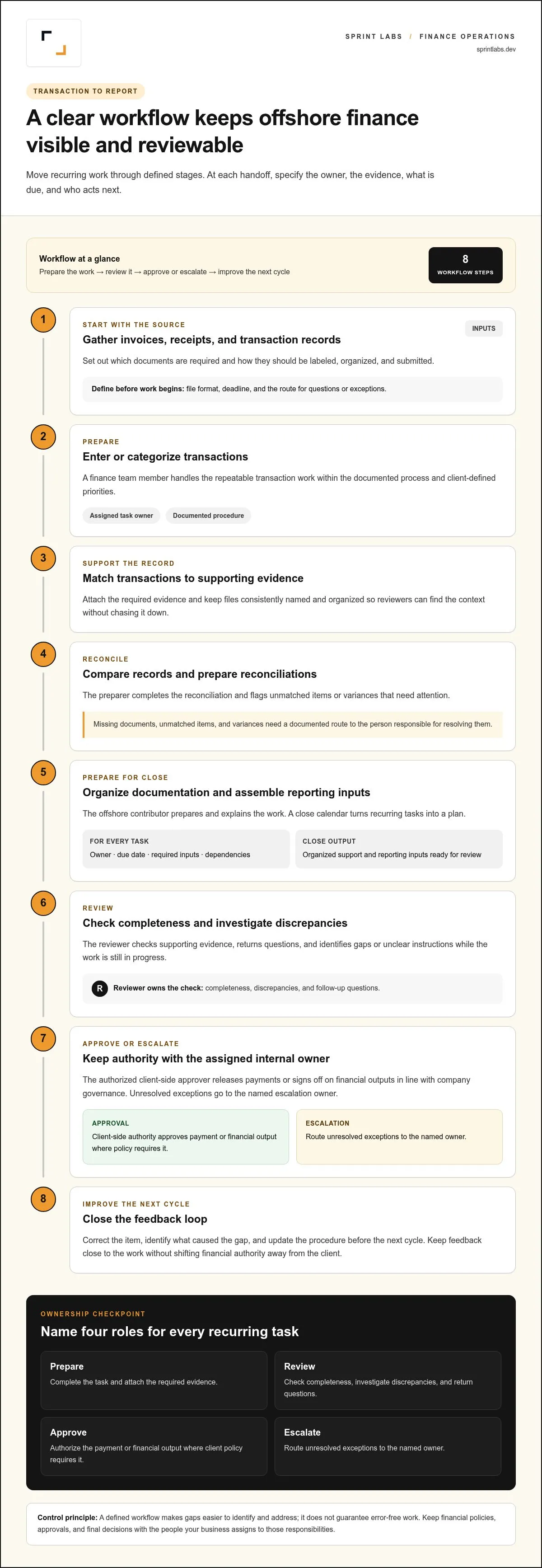
A reliable finance workflow moves work through defined stages, with a clear owner at each handoff. For offshore finance and accounting teams, that structure makes remote collaboration visible and reviewable. Specify what’s due, what evidence accompanies it, and who acts next. This won’t guarantee error-free work, but it makes gaps easier to identify and address.
Where can offshore finance staff contribute across the monthly close?
Work often starts with source documents such as invoices, receipts, or transaction records. A finance team member can enter or categorize transactions, match records to supporting evidence, and prepare reconciliations. During close, they can flag variances, organize documentation, and assemble reporting inputs for review.
Use a close calendar to turn this sequence into an operating plan. For each task, identify an owner, due date, required inputs, and dependencies. Include a route for missing documents, unmatched items, or variances that need attention. The offshore contributor can prepare and explain the work; the client-side reviewer retains authority to approve payments and sign off on financial outputs in line with company governance.
How should teams divide responsibilities and handoffs?
Use a responsibility matrix to make accountability explicit. Name the preparer, reviewer, approver, and escalation owner for each recurring task. These roles may belong to different people. For example, one person may reconcile an account, another may review the supporting evidence, and an authorized client-side approver may sign off on the result.
Before recurring work begins, document the required evidence and how files should be labeled, organized, and submitted. Specify the format, deadline, and route for questions or exceptions. Consistent file names and organization help reviewers find supporting documents without chasing down context.
- Prepare: Complete the task and attach the required evidence.
- Review: Check completeness, investigate discrepancies, and return questions.
- Approve: Authorize the payment or financial output where client policy requires it.
- Escalate: Route unresolved exceptions to the named owner.
Keep feedback close to the work. If a reviewer finds missing support or unclear instructions, correct the item, identify what caused the gap, and update the procedure before the next cycle. This creates a practical improvement loop without shifting financial authority away from the client. For broader context on how businesses use offshoring as an operating choice, see the Corporate Finance Institute’s strategic approach to offshoring.
Dedicated finance professionals can work within client-defined routines. Learn more about dedicated finance and accounting staff and how they can add capacity while your team directs daily work.
Offshore Finance and Accounting Models: Embedded Staff or Outsourced Service?
The right model depends on who directs daily work, who owns the process, and how much execution capacity you need. In-house hiring, embedded offshore staffing, and outsourced service delivery can all support finance operations. They differ in control and scope, not in whether one is automatically better. This is the practical distinction behind managed offshore staffing. For a closer look, read our offshore staffing vs in-house hiring comparison.
| Model | Work direction | Process ownership | Staffing continuity | Client review |
|---|---|---|---|---|
| In-house hire | Client managers direct daily work | Typically remains internal | Contractor is part of the client-directed team | Client assigns review and approval |
| Embedded offshore staff | Client sets priorities and routines | Client retains the process | Dedicated contributor joins ongoing workflows | Client retains review and decision authority |
| Outsourced service | Provider typically manages delivery | Defined service scope is delivered by provider | Continuity depends on the service arrangement | Client reviews agreed outputs and retains required approvals |
When does a dedicated finance contributor make sense?
A dedicated contributor can suit recurring work that needs stable capacity and frequent coordination with internal finance leads. Examples include ongoing transaction processing, reconciliations, and preparing close materials within established procedures. The business still owns the process and financial leadership. The role works best with clear priorities, written instructions, and reviewers who can resolve questions and check outputs.
This model adds execution capacity without transferring financial authority. Sprint Labs places and manages dedicated independent finance and accounting professionals under a managed contractor model, while clients direct their day-to-day work. Engagement and operational support do not replace the client’s responsibility for financial decisions or required professional review.
When is a project-based or service-led model a better fit?
A bounded outcome may suit a project-based arrangement. For example, a team could be assigned a defined process improvement or a specific body of work, with agreed deliverables and ownership. That differs from an individual contributor who handles ongoing responsibilities within the client’s existing finance routine.
A squad can coordinate several contributors around a shared delivery surface, while an individual role is designed around continuing tasks and internal collaboration. The key question is whether you need a person integrated into your process or a team organized around a defined outcome. For more on the squad model, see project delivery squads.
Match the structure to the work. Keep priorities, process ownership, and approval authority explicit, then choose the model that gives your finance leads the right balance of capacity and control.
How to Protect Accuracy, Access, and Accountability in Offshore Finance
Strong controls depend on who can do what, how work is checked, and what happens when something falls outside the process, not on where a finance professional works. For offshore finance and accounting, build safeguards into the workflow before assigning access or delegating tasks.
What controls help maintain quality and financial oversight?
Start by mapping sensitive tasks, then set permissions, document review steps, monitor exceptions, and refine the process based on what the team finds. For each workflow, identify the information involved, the actions allowed, and the client-side owner responsible for oversight.
Checklists help staff complete recurring work consistently. Reconciliations surface differences between records. Approval thresholds clarify which transactions require additional review, while documented exception handling shows how to route missing evidence, unusual entries, or unresolved variances.
Set review frequency according to transaction risk, workflow volume, and your company’s policies. Track corrections and recurring exceptions, not just completed tasks. If the same information is repeatedly missing, improve the instructions or handoff instead of relying on reviewers to catch the same gap each cycle.
How should teams manage access to financial information?
Apply least-privilege access: give each person only the information and actions needed for assigned responsibilities. Role-based permissions make this easier to manage. A preparer, for example, may need to enter or organize information, while payment approval remains restricted to an authorized client-side approver. Where client controls require it, separate preparation, approval, and payment authority.
Keep access aligned with current responsibilities. Review permissions when duties change, and remove access that is no longer needed. The client should define and own the control framework, including which systems and files are approved for work. Document file-handling procedures and a clear route for reporting access issues or uncertain instructions.
- Map: Identify sensitive information and task owners.
- Limit: Assign permissions according to each person’s role.
- Review: Record checks, approvals, and supporting evidence.
- Refine: Use exceptions and corrections to improve the workflow.
Accounting standards, privacy duties, and tax obligations vary by jurisdiction and business circumstances. Set controls with the relevant internal owners and qualified advisers; don’t assume a process suitable for one location applies everywhere. Staffing support can add execution capacity, but it doesn’t replace the client’s ownership of policies, financial decisions, or required professional review.
See how to build a dedicated finance team around clear responsibilities, controlled access, and client-led oversight.
Building an Offshore Finance Team with Clear Ownership and Support
A successful launch starts before a new team member takes on recurring work. Define the outcomes, map workflows, assign controls, onboard the contributor, and review how the arrangement is working. This turns offshore finance and accounting from a staffing decision into an operating plan with clear ownership.
Put expectations in a written role scorecard. Connect daily responsibilities to the finance calendar and reporting needs so both the contributor and internal reviewers know what completion means. A practical scorecard can specify:
- Responsibilities: tasks the role prepares, maintains, or monitors.
- Outputs and timing: required records or reports and when they’re due in the close cycle.
- Handoffs: who supplies inputs, reviews work, approves outputs, and handles exceptions.
- Success measures: how the team will assess completeness, timeliness, and recurring process issues.
Keep the scope grounded in work the role can perform. The scorecard should make the contribution visible without assigning financial authority that belongs to internal leaders.
What should the first weeks of onboarding establish?
Document the systems and approved workspaces, recurring deadlines, process owners, communication norms, and escalation contacts. Pair each task with the instructions and supporting materials needed to complete it. Start with supervised workflows, then expand responsibility as review shows the work is ready to move forward.
Schedule regular check-ins to surface bottlenecks, clarify priorities, and resolve questions before they become recurring delays. Update procedures when the workflow changes or feedback reveals an unclear step. Onboarding isn’t a one-time handoff; it’s how the team aligns its working habits with the finance process.
How does managed staffing support an embedded finance team?
With managed staffing, the client directs the dedicated contractor’s day-to-day work and retains ownership of finance processes. Sprint Labs recruits, vets, places and manages vetted independent finance and accounting professionals under a managed contractor model, including contracts, fees and payments, time off, performance concerns, replacement and offboarding, and managed devices where needed. That support establishes the engagement and operating structure; it doesn’t transfer the client’s responsibility for payment approvals, financial decisions, or required professional judgments.
Keep the division clear: staffing support enables the role, while client leaders set priorities, maintain financial governance, and review the work. If you need dedicated capacity within an internally directed team, managed offshore staffing is one operating model to consider.
Build Finance Capacity Without Losing Oversight
Offshore finance and accounting works best when responsibilities are designed around clear workflows, controlled access, and client-led review. Routine preparation can be delegated, but internal leaders retain ownership of financial policies, approvals, and decisions. Match the operating model to the work: dedicated staff can support ongoing responsibilities that need close integration, while a service-led arrangement can suit defined outputs.
A strong start requires clear role expectations, documented handoffs, and review routines. These structures help distributed contributors work within your finance processes while making ownership visible at each step.
Sprint Labs provides dedicated finance and accounting professionals who work within client-directed teams. Sprint Labs handles recruitment, vetting, contracts, fees and payments, time off, performance concerns, replacement and offboarding, and managed devices where needed, while your team directs daily work and retains financial decision-making and required review.
Explore managed offshore staffing with Sprint Labs to see how dedicated finance capacity can fit your operating model. With clear ownership and practical controls in place, your team can add capacity while keeping oversight in place.
Frequently Asked Questions
What does offshore finance and accounting include?
Offshore finance and accounting covers finance work performed remotely by dedicated professionals, with responsibilities set by the business. Scope can include transaction processing, reconciliations, finance data maintenance, and preparing reporting materials. Location doesn’t determine who owns the process or approves results. Define the role, access permissions, handoffs, and review responsibilities so distributed staff add capacity while your internal team retains financial oversight.
Which accounting tasks can an offshore finance team handle?
An offshore finance team can handle recurring operational tasks such as processing invoices, categorizing transactions, matching records, preparing reconciliations, and organizing supporting documents. Depending on role scope and internal review, staff may also maintain finance data and prepare reporting inputs. Separate preparation from authority: staff can flag variances or missing evidence, while your designated internal approvers retain responsibility for payment approvals and final financial decisions.
Can offshore finance staff work inside our existing accounting systems?
They can work within the systems and routines your business approves for the role, provided the necessary access is set up. Define permitted tasks, data access, file-handling procedures, and escalation routes before work begins. Grant permissions according to responsibilities, then review them when duties change. This keeps the workflow aligned with your existing processes without assuming every staff member needs access to every record or function.
How do companies maintain accuracy with offshore accounting teams?
Companies support accuracy with documented procedures, clear handoffs, reconciliations, and consistent review. Specify what evidence a task requires, when it’s due, and who checks the result. Track exceptions and corrections, then update instructions when the same gaps recur. Set review frequency according to transaction risk, workflow volume, and internal policy. These controls make work easier to verify, but they don’t remove the need for appropriate client-side review.
Is offshore finance staffing different from outsourced accounting?
Yes. With dedicated offshore staffing, a finance professional works within client-defined priorities and team routines, and the client directs day-to-day work. With outsourced accounting, a provider is generally engaged to deliver a defined service or output and manages how that work is performed. Neither model is automatically the right fit. Choose according to whether you need ongoing execution capacity inside your process or delivery of a specified service.
Who approves payments and financial reports when work is offshore?
Your business should assign payment and reporting approvals according to its finance governance. An offshore contributor may prepare a payment batch, reconcile accounts, or assemble reporting materials, but preparation doesn’t automatically grant approval authority. Name the reviewer and approver for each workflow, and separate those responsibilities where your controls require it. Keep final financial decisions and required professional review with the people your organization designates.
How do you onboard an offshore finance and accounting professional?
Start by defining role outcomes and documenting recurring tasks, deadlines, process owners, communication routines, and escalation contacts. Explain which systems and files are approved for each responsibility, then begin with supervised workflows. Review early work, answer questions, and adjust instructions before expanding the role’s scope. Sprint Labs recruits, vets, places and manages dedicated independent finance and accounting professionals under a managed contractor model, including contracts, fees and payments, time off, performance concerns, replacement and offboarding, and managed devices where needed.
Frequently asked questions
Which finance tasks are commonly handled by distributed teams?
Distributed professionals can support repeatable operational work, including invoice processing, transaction categorization, account reconciliations, and finance data maintenance. Depending on the role’s scope and review process, they may also prepare reporting inputs or organize supporting documents. Separate execution from authority. A team member might prepare a payment batch while an authorized internal approver releases it. They can flag unusual transactions without deciding how the company should treat them. Keep policies, approvals, and final financial decisions with the people your business assigns to those responsibilities.
How does offshore staffing differ from outsourced accounting?
With embedded staffing, a dedicated contributor works within client-defined priorities, systems, and team routines. Your managers assign daily work and coordinate handoffs. Sprint Labs recruits, vets, places and manages vetted independent finance and accounting professionals under a managed contractor model, including contracts, fees and payments, time off, performance concerns, replacement and offboarding, and managed devices where needed. The client directs the work. Outsourced accounting is structured around a provider delivering a defined service or set of outputs. The provider generally manages how its team performs that work. A defined, self-contained service may suit an outsourced arrangement; ongoing tasks that need close alignment with internal workflows may call for embedded staff. Choose based on how much day-to-day direction and process ownership your team needs. In either model, be explicit about who prepares, checks, approves, and acts on the work. That division creates a clear operating model rather than an ambiguous transfer of responsibility. A reliable finance workflow moves work through defined stages, with a clear owner at each handoff. For offshore finance and accounting teams, that structure makes remote collaboration visible and reviewable. Specify what’s due, what evidence accompanies it, and who acts next. This won’t guarantee error-free work, but it makes gaps easier to identify and address.
Where can offshore finance staff contribute across the monthly close?
Work often starts with source documents such as invoices, receipts, or transaction records. A finance team member can enter or categorize transactions, match records to supporting evidence, and prepare reconciliations. During close, they can flag variances, organize documentation, and assemble reporting inputs for review. Use a close calendar to turn this sequence into an operating plan. For each task, identify an owner, due date, required inputs, and dependencies. Include a route for missing documents, unmatched items, or variances that need attention. The offshore contributor can prepare and explain the work; the client-side reviewer retains authority to approve payments and sign off on financial outputs in line with company governance.
How should teams divide responsibilities and handoffs?
Use a responsibility matrix to make accountability explicit. Name the preparer, reviewer, approver, and escalation owner for each recurring task. These roles may belong to different people. For example, one person may reconcile an account, another may review the supporting evidence, and an authorized client-side approver may sign off on the result. Before recurring work begins, document the required evidence and how files should be labeled, organized, and submitted. Specify the format, deadline, and route for questions or exceptions. Consistent file names and organization help reviewers find supporting documents without chasing down context. Keep feedback close to the work. If a reviewer finds missing support or unclear instructions, correct the item, identify what caused the gap, and update the procedure before the next cycle. This creates a practical improvement loop without shifting financial authority away from the client. For broader context on how businesses use offshoring as an operating choice, see the Corporate Finance Institute’s strategic approach to offshoring. Dedicated finance professionals can work within client-defined routines. Learn more about dedicated finance and accounting staff and how they can add capacity while your team directs daily work. The right model depends on who directs daily work, who owns the process, and how much execution capacity you need. In-house hiring, embedded offshore staffing, and outsourced service delivery can all support finance operations. They differ in control and scope, not in whether one is automatically better. This is the practical distinction behind managed offshore staffing.
When does a dedicated finance contributor make sense?
A dedicated contributor can suit recurring work that needs stable capacity and frequent coordination with internal finance leads. Examples include ongoing transaction processing, reconciliations, and preparing close materials within established procedures. The business still owns the process and financial leadership. The role works best with clear priorities, written instructions, and reviewers who can resolve questions and check outputs. This model adds execution capacity without transferring financial authority. Sprint Labs places and manages dedicated independent finance and accounting professionals under a managed contractor model, while clients direct their day-to-day work. Engagement and operational support do not replace the client’s responsibility for financial decisions or required professional review.
When is a project-based or service-led model a better fit?
A bounded outcome may suit a project-based arrangement. For example, a team could be assigned a defined process improvement or a specific body of work, with agreed deliverables and ownership. That differs from an individual contributor who handles ongoing responsibilities within the client’s existing finance routine. A squad can coordinate several contributors around a shared delivery surface, while an individual role is designed around continuing tasks and internal collaboration. The key question is whether you need a person integrated into your process or a team organized around a defined outcome. For more on the squad model, see project delivery squads. Match the structure to the work. Keep priorities, process ownership, and approval authority explicit, then choose the model that gives your finance leads the right balance of capacity and control. Strong controls depend on who can do what, how work is checked, and what happens when something falls outside the process, not on where a finance professional works. For offshore finance and accounting, build safeguards into the workflow before assigning access or delegating tasks.
What controls help maintain quality and financial oversight?
Start by mapping sensitive tasks, then set permissions, document review steps, monitor exceptions, and refine the process based on what the team finds. For each workflow, identify the information involved, the actions allowed, and the client-side owner responsible for oversight. Checklists help staff complete recurring work consistently. Reconciliations surface differences between records. Approval thresholds clarify which transactions require additional review, while documented exception handling shows how to route missing evidence, unusual entries, or unresolved variances. Set review frequency according to transaction risk, workflow volume, and your company’s policies. Track corrections and recurring exceptions, not just completed tasks. If the same information is repeatedly missing, improve the instructions or handoff instead of relying on reviewers to catch the same gap each cycle.
How should teams manage access to financial information?
Apply least-privilege access: give each person only the information and actions needed for assigned responsibilities. Role-based permissions make this easier to manage. A preparer, for example, may need to enter or organize information, while payment approval remains restricted to an authorized client-side approver. Where client controls require it, separate preparation, approval, and payment authority. Keep access aligned with current responsibilities. Review permissions when duties change, and remove access that is no longer needed. The client should define and own the control framework, including which systems and files are approved for work. Document file-handling procedures and a clear route for reporting access issues or uncertain instructions. Accounting standards, privacy duties, and tax obligations vary by jurisdiction and business circumstances. Set controls with the relevant internal owners and qualified advisers; don’t assume a process suitable for one location applies everywhere. Staffing support can add execution capacity, but it doesn’t replace the client’s ownership of policies, financial decisions, or required professional review. See how to build a dedicated finance team around clear responsibilities, controlled access, and client-led oversight. A successful launch starts before a new team member takes on recurring work. Define the outcomes, map workflows, assign controls, onboard the contributor, and review how the arrangement is working. This turns offshore finance and accounting from a staffing decision into an operating plan with clear ownership. Put expectations in a written role scorecard. Connect daily responsibilities to the finance calendar and reporting needs so both the contributor and internal reviewers know what completion means. A practical scorecard can specify: Keep the scope grounded in work the role can perform. The scorecard should make the contribution visible without assigning financial authority that belongs to internal leaders.
What should the first weeks of onboarding establish?
Document the systems and approved workspaces, recurring deadlines, process owners, communication norms, and escalation contacts. Pair each task with the instructions and supporting materials needed to complete it. Start with supervised workflows, then expand responsibility as review shows the work is ready to move forward. Schedule regular check-ins to surface bottlenecks, clarify priorities, and resolve questions before they become recurring delays. Update procedures when the workflow changes or feedback reveals an unclear step. Onboarding isn’t a one-time handoff; it’s how the team aligns its working habits with the finance process.
How does managed staffing support an embedded finance team?
With managed staffing, the client directs the dedicated contractor’s day-to-day work and retains ownership of finance processes. Sprint Labs recruits, vets, places and manages vetted independent finance and accounting professionals under a managed contractor model, including contracts, fees and payments, time off, performance concerns, replacement and offboarding, and managed devices where needed. That support establishes the engagement and operating structure; it doesn’t transfer the client’s responsibility for payment approvals, financial decisions, or required professional judgments. Keep the division clear: staffing support enables the role, while client leaders set priorities, maintain financial governance, and review the work. If you need dedicated capacity within an internally directed team, managed offshore staffing is one operating model to consider. Offshore finance and accounting works best when responsibilities are designed around clear workflows, controlled access, and client-led review. Routine preparation can be delegated, but internal leaders retain ownership of financial policies, approvals, and decisions. Match the operating model to the work: dedicated staff can support ongoing responsibilities that need close integration, while a service-led arrangement can suit defined outputs. A strong start requires clear role expectations, documented handoffs, and review routines. These structures help distributed contributors work within your finance processes while making ownership visible at each step. Sprint Labs provides dedicated finance and accounting professionals who work within client-directed teams. Sprint Labs handles recruitment, vetting, contracts, fees and payments, time off, performance concerns, replacement and offboarding, and managed devices where needed, while your team directs daily work and retains financial decision-making and required review. Explore managed offshore staffing with Sprint Labs to see how dedicated finance capacity can fit your operating model. With clear ownership and practical controls in place, your team can add capacity while keeping oversight in place.
What does offshore finance and accounting include?
Offshore finance and accounting covers finance work performed remotely by dedicated professionals, with responsibilities set by the business. Scope can include transaction processing, reconciliations, finance data maintenance, and preparing reporting materials. Location doesn’t determine who owns the process or approves results. Define the role, access permissions, handoffs, and review responsibilities so distributed staff add capacity while your internal team retains financial oversight.
Which accounting tasks can an offshore finance team handle?
An offshore finance team can handle recurring operational tasks such as processing invoices, categorizing transactions, matching records, preparing reconciliations, and organizing supporting documents. Depending on role scope and internal review, staff may also maintain finance data and prepare reporting inputs. Separate preparation from authority: staff can flag variances or missing evidence, while your designated internal approvers retain responsibility for payment approvals and final financial decisions.
Can offshore finance staff work inside our existing accounting systems?
They can work within the systems and routines your business approves for the role, provided the necessary access is set up. Define permitted tasks, data access, file-handling procedures, and escalation routes before work begins. Grant permissions according to responsibilities, then review them when duties change. This keeps the workflow aligned with your existing processes without assuming every staff member needs access to every record or function.
How do companies maintain accuracy with offshore accounting teams?
Companies support accuracy with documented procedures, clear handoffs, reconciliations, and consistent review. Specify what evidence a task requires, when it’s due, and who checks the result. Track exceptions and corrections, then update instructions when the same gaps recur. Set review frequency according to transaction risk, workflow volume, and internal policy. These controls make work easier to verify, but they don’t remove the need for appropriate client-side review.
Is offshore finance staffing different from outsourced accounting?
Yes. With dedicated offshore staffing, a finance professional works within client-defined priorities and team routines, and the client directs day-to-day work. With outsourced accounting, a provider is generally engaged to deliver a defined service or output and manages how that work is performed. Neither model is automatically the right fit. Choose according to whether you need ongoing execution capacity inside your process or delivery of a specified service.
Who approves payments and financial reports when work is offshore?
Your business should assign payment and reporting approvals according to its finance governance. An offshore contributor may prepare a payment batch, reconcile accounts, or assemble reporting materials, but preparation doesn’t automatically grant approval authority. Name the reviewer and approver for each workflow, and separate those responsibilities where your controls require it. Keep final financial decisions and required professional review with the people your organization designates.
How do you onboard an offshore finance and accounting professional?
Start by defining role outcomes and documenting recurring tasks, deadlines, process owners, communication routines, and escalation contacts. Explain which systems and files are approved for each responsibility, then begin with supervised workflows. Review early work, answer questions, and adjust instructions before expanding the role’s scope. Sprint Labs recruits, vets, places and manages dedicated independent finance and accounting professionals under a managed contractor model, including contracts, fees and payments, time off, performance concerns, replacement and offboarding, and managed devices where needed.
Hiring in Asia? We'll do it for you.
Sprint Labs is a managed staffing firm. We recruit, vet, place and manage senior professionals across the Philippines, Vietnam, Malaysia, Indonesia and India. You direct the work, we handle the engagement.
Create a request →