
Onboarding Offshore Team Checklist: The 2026 Operational Playbook
Stop leaking capital. Our onboarding offshore team checklist is a 2026 playbook for hitting KPIs in 30 days with secure, high-velocity integration.
Most companies treat onboarding as a "welcome" phase. In 2026, that's an operational liability. If your new hires aren't shipping code or hitting sales targets within their first two weeks, your process is leaking capital. You've likely felt the friction of communication lags and the security anxiety of granting remote access to sensitive systems. It's frustrating when cultural misalignment turns a high-potential hire into a retention statistic. Utilizing a rigorous onboarding offshore team checklist isn't just about ticking boxes. It's about architecting a frictionless bridge between your core team and your global talent.
We recognize that scaling requires more than just hiring; it requires precision. This playbook replaces marketing fluff with a high-velocity framework designed to get your offshore talent hitting KPIs within 30 days. You'll master the mechanics of seamless technical integration and zero-trust security protocols. We'll show you how to eliminate "Day Zero" friction and establish operational clarity across distributed time zones. From managed hardware deployments in Asia to outcome-based performance tracking, this is your definitive guide to building a synchronized, high-performance global engine.
Key Takeaways
- Secure "Day Zero" operations with Zero Trust architectures and managed hardware to ensure your team is productive from their first login.
- Standardize your integration process using a high-velocity onboarding offshore team checklist that prioritizes technical readiness over generic corporate orientations.
- Eliminate the "time zone tax" by adopting a documentation-first rule that balances synchronous and asynchronous communication across global regions.
- Execute a 30-60-90 day roadmap to transition offshore talent from initial tool mastery to full KPI ownership within the first month.
- Reduce operational overhead by delegating recruitment and hardware logistics to a partner, allowing you to focus on work direction and velocity.
Table of Contents
- The Velocity Gap: Why Traditional Onboarding Fails Offshore Teams
- Day Zero Infrastructure: The Technical and Security Checklist
- Operational Alignment: Building One Team Across Time Zones
- The 30-60-90 Day Offshore Integration Roadmap
- Scaling Without Friction: The Sprint Labs Managed Advantage
The Velocity Gap: Why Traditional Onboarding Fails Offshore Teams
Traditional onboarding is a relic. It assumes your team shares a physical office and absorbs culture through osmosis. For high-velocity startups, this approach is a systemic failure point. The business practice of outsourcing has shifted from simple task-filling to strategic integration. If you treat your offshore partners like a distant vendor, they will perform like one. This "Out of Sight, Out of Mind" trap leads to immediate disengagement. It's the primary cause of high turnover and mounting technical debt. You don't need a welcome party; you need a structural bridge.
The Problem of Passive Integration
Passive integration is the silent killer of productivity. Generic HR manuals fail distributed Asian teams because they lack the operational rigor required for technical roles. This creates a "velocity leak" where weeks are lost to administrative confusion. To fix this, your onboarding offshore team checklist must focus on immediate, measurable output. Don't wait for new hires to "settle in" over a month. Define specific standards from the first hour. If your team isn't shipping code or managing tickets by day three, your process is leaking capital.
Reframing the Offshore Relationship
You must reframe the relationship from the start. Move away from task-based management and toward total outcome ownership. Your offshore team belongs in your "engine room." They aren't a peripheral service; they are a core department. Sprint Labs facilitates this by managing the entire operational overhead in Asian markets, allowing you to focus strictly on work direction. This model enables 60-70% cost savings while maintaining a 2-4 week hiring timeline. Your onboarding offshore team checklist should reflect this high-velocity expectation. When you treat offshore talent as internal stakeholders, you eliminate the friction of the "vendor" mindset. Set the tone on Day One: velocity is the only metric that matters.
Day Zero Infrastructure: The Technical and Security Checklist
Operational readiness starts before the first login. If your team is waiting for system access on Day One, you've already failed. A robust onboarding offshore team checklist prioritizes "Day Zero" infrastructure to eliminate technical friction. This involves more than just sending a laptop. It requires a synchronized deployment of hardware, secure networks, and communication tools. High-velocity execution depends on a foundation that's ready from the second the power button is pressed.
Hardware and Workspace Standards
Enterprise-grade equipment is non-negotiable. Relying on "Bring Your Own Device" (BYOD) in Asian markets introduces unmanaged security risks and performance bottlenecks. Sprint Labs handles the entire hardware procurement cycle, ensuring every developer or support officer has the necessary specs to perform. Beyond the machine, the environment matters. Professional, managed office spaces outperform work-from-home setups by providing stable power, high-speed fiber, and a culture of focus. This structural support is a key driver in the 60-70% cost savings realized when scaling through a managed staffing partner.
Access Control and Compliance
Security is the baseline, not a feature. In 2026, Zero Trust architecture is the standard for distributed teams. You must implement least-privileged access through SSO and VPNs to ensure developers and SDRs only see what they need. SOC2 alignment ensures that offshore staffing partners maintain rigorous controls over data security, availability, and privacy across international borders. According to research in Global Teams That Work, reducing the "social distance" in global teams requires reliable, secure technical bridges that allow for seamless collaboration without compromising corporate integrity. Compliance isn't a hurdle; it's the framework that allows you to scale safely.
Configuration of your communication stack is the final step. Your Slack, Teams, and Jira instances should be pre-populated with the necessary permissions and channel invites. Don't let new hires wander through empty workspaces. Operational clarity is achieved when a new team member opens their laptop and finds a fully mapped digital environment ready for immediate work. This isn't just about tools; it's about creating an integrated "engine room" where every team member has the resources to hit their KPIs within 30 days.
Operational Alignment: Building One Team Across Time Zones
Time zones aren't an obstacle; they're an operational variable. If you're paying a "time zone tax," your systems are broken. Alignment requires a shift from "waiting for an answer" to "working with the answer already provided." This is a critical component of your onboarding offshore team checklist. You must establish a communication rhythm that prioritizes output over presence. Stop viewing your offshore staff as a separate entity. They're one team, operating on a different clock. High-velocity startups don't just bridge time zones; they exploit them to create a 24-hour production cycle.
The Asynchronous Workflow Framework
Asynchronous work is the engine of global velocity. Use tools like Loom for video walkthroughs and Notion for living documentation. This bridges the 8-hour gap between your headquarters and Asian markets. Every task handover must be self-explanatory. If a developer has to wait for a Slack reply from your local team, you've lost a full day of productivity. Structure your handovers so the work never stops. The Documentation-First Rule is your primary defense against friction. Documenting every process empowers independent decision-making. It transforms your team from passive executors into autonomous problem solvers who don't need real-time permission to move.
Cultural Integration and Soft Skills
Navigating cultural nuances is about more than just holidays. You need to understand "High-Context" versus "Low-Context" communication styles. In many Asian markets, communication is often high-context. Meaning is derived from the relationship and subtle cues. Build trust through radical honesty and transparent feedback loops. This clarity prevents misalignment and ensures your team stays integrated into your core "engine room." Radical transparency isn't just a value; it's an operational requirement for distributed success. It ensures that expectations are met without the need for constant micromanagement.
Integrating offshore pods into your sprint cycles shouldn't feel like an afterthought. Daily stand-ups must be timed to maximize crossover without burning out either side. This level of synchronization is essential for those looking to Hire Dedicated Developers in Asia as part of a long-term scaling strategy. By treating your offshore team as a unified extension of your domestic staff, you remove the friction that kills most distributed projects. When your local team logs off, your offshore pod picks up the baton. This creates a relentless operational momentum that competitors cannot match.
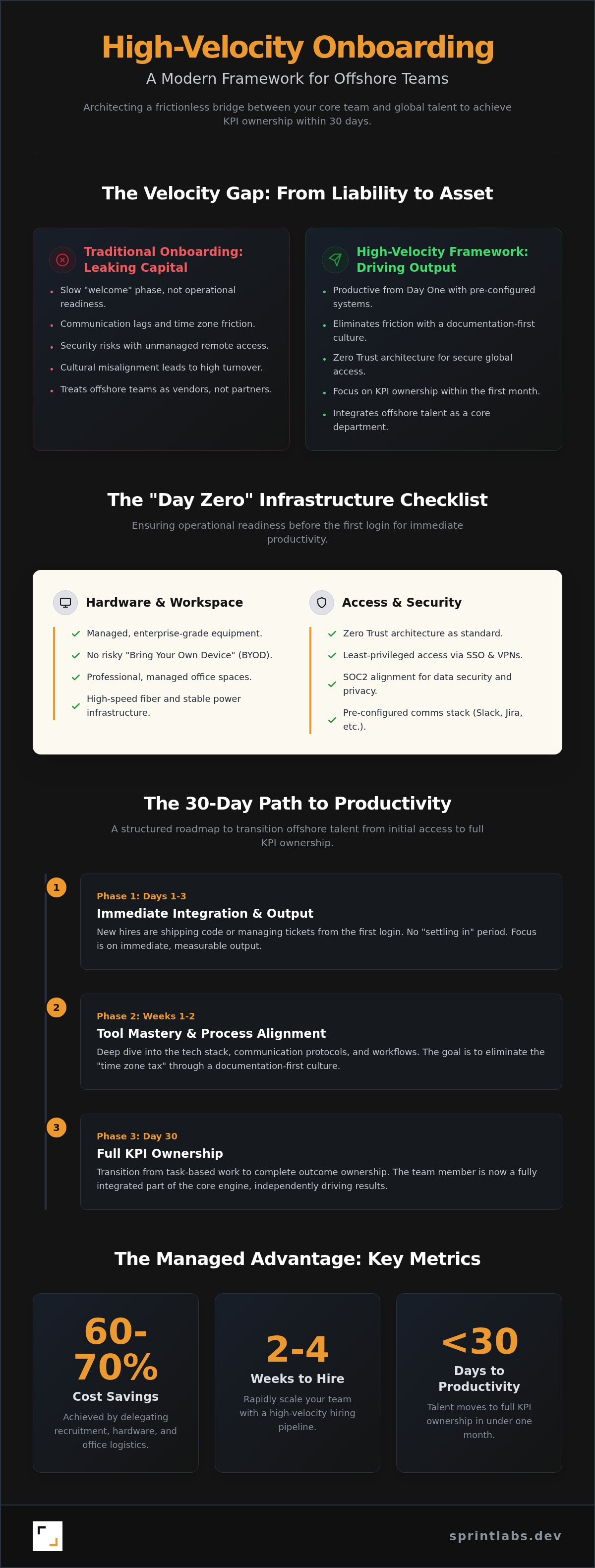
The 30-60-90 Day Offshore Integration Roadmap
Integration isn't an event. It's a trajectory. Most companies treat the first week as the finish line, but for high-velocity teams, it's just the starting block. A comprehensive onboarding offshore team checklist must account for the technical and operational transition from "new hire" to "core contributor." You need a structured roadmap that moves talent through tool mastery toward full strategic autonomy. Without this, you risk the "plateau effect," where offshore teams remain stuck in task-execution mode rather than problem-solving mode.
Month 1: The Foundation Phase
The first 30 days focus on friction removal. Assign a technical mentor or "buddy" immediately to provide real-time support for environment-specific questions. This isn't about hand-holding; it's about accelerating tool mastery and culture immersion. Set clear, measurable KPIs for the first month to track the ramp-up speed. Focus on "Quick Win" tasks that allow the new hire to push code or close tickets within their first week. Weekly 1:1s are essential during this phase. Use them to identify early friction points in your documentation or communication rhythm. If a developer is blocked, your system is failing them.
Month 2 & 3: The Scaling Phase
Transition from guided tasks to problem ownership. By Day 60, your offshore staff should no longer be asking "how" to do a task, but rather "why" a specific approach was chosen. This is the pivot point for team expansion. Review performance against technical benchmarks and KPI alignment. If the integration is seamless, consider scaling the pod. Month 3 is about strategic contribution. Your offshore talent should now be integrated into long-term product or sales roadmaps. They are no longer just "remote help." They are active stakeholders in your engine room. Regular feedback loops must move beyond the probation mindset to focus on long-term retention and contribution to strategic goals.
Scaling a global team requires more than just a hiring plan. It requires a partner that manages the operational burden so you can focus on these high-level milestones. Sprint Labs manages the entire lifecycle in Asian markets, allowing you to build high-performance offshore teams with zero administrative friction. With our 2-4 week hiring timeline and managed hardware support, your 30-60-90 day roadmap becomes a predictable engine for growth rather than a series of logistical hurdles. This structural clarity ensures your team hits their KPIs within 30 days, maintaining the velocity your business demands.
Scaling Without Friction: The Sprint Labs Managed Advantage
Scaling a global team is an architectural challenge. Most companies fail because they drown in the "boring but critical" logistics of international expansion. Your internal resources should focus on product innovation, not hardware procurement or foreign payroll compliance. Sprint Labs removes this operational burden entirely. We act as your strategic partner in Asian markets, handling everything from recruitment to physical office space. This structural support is what makes your onboarding offshore team checklist actually functional rather than just a list of aspirations.
Why Managed Staffing Wins Over EOR
Many businesses mistake an Employer of Record (EOR) for a management solution. An EOR provides legal employment; they don't provide operational excellence. They won't set up your developer's workstation or ensure they have a professional, high-velocity environment. Sprint Labs handles hardware, office logistics, and local retention strategies directly. We provide the physical "engine room" for your business. By utilizing our managed model, businesses reduce development costs by up to 70% compared to local hires while maintaining total control over work direction.
The flexibility of our model is a deliberate risk-mitigation tool. We offer 60-day notice flexibility, allowing you to scale up or pivot your Project Delivery Squads without the friction of traditional employment contracts. Whether you need individual contributors or full-scale Customer Support Teams, our infrastructure is built to move at your speed. You get the benefits of a dedicated team with the agility of a high-growth startup. This isn't just staffing; it's a managed integration that prioritizes your business's velocity.
Next Steps: Launching Your Offshore Engine
Velocity is our primary metric. We maintain a 2-4 week hiring timeline, meaning you can go from a talent gap to a fully integrated pod in less than a month. This speed doesn't compromise quality; it's a result of our established presence in Asian markets and our meticulous vetting process. We handle the paperwork, the hardware, and the HR overhead so you can focus on hitting your KPIs. Your team is ready to ship on Day One because we've already cleared the path.
Don't let operational friction stall your growth. If your current integration process feels like a series of administrative hurdles, it's time for a more sophisticated approach. Ready to scale? Book your Sprint Labs strategy session today. We'll map your onboarding needs and show you how to integrate global talent into your core operations without the performance lag typical of traditional offshoring models.
Architecting Your Global Engine Room
Integration isn't a soft skill; it's a structural requirement. Successful global scaling depends on technical readiness from Day Zero and a shift to asynchronous, documentation-first workflows. By implementing a robust onboarding offshore team checklist, you replace administrative friction with operational velocity. You don't need a distant vendor. You need a partner that integrates talent directly into your core systems while maintaining zero-trust security standards. It's the difference between a fragmented workforce and a synchronized global engine.
Sprint Labs removes the operational overhead that stalls expansion. We manage the hardware, payroll, and HR logistics in Asian markets so you can focus strictly on work direction. With a 2-4 week hiring timeline and 60-70% cost savings compared to local hires, we provide the infrastructure for immediate growth. Stop managing paperwork and start shipping product. Build your high-velocity offshore team with Sprint Labs and transform your distributed workforce into a relentless production engine. Your next phase of growth is waiting.
Frequently Asked Questions
How long does it typically take to onboard an offshore team?
Rapid hiring and onboarding takes between 2 to 4 weeks. This timeline covers recruitment, vetting, and technical setup. While traditional models drag on for months, our high-velocity framework ensures your team is ready to ship code or hit sales targets almost immediately. Technical integration happens on Day Zero, meaning your new hires are productive from their first login without the usual ramp-up lag.
Who handles the hardware and equipment for my offshore staff?
Sprint Labs manages the entire hardware procurement and logistics cycle in Asian markets. We provide enterprise-grade equipment and professional office spaces, eliminating the security risks associated with unmanaged home devices. You don't have to worry about international shipping or local technical support. We ensure every team member has the physical infrastructure required to maintain peak operational velocity from day one.
How do we manage time zone differences with a team in Asia?
Effective management requires a shift to a documentation-first, asynchronous workflow. We help you balance synchronous meetings with clear, recorded handovers and centralized knowledge bases. This approach eliminates the "time zone tax" and creates a relentless 24-hour production cycle. When your local team logs off, your offshore pod picks up the baton, ensuring that project momentum never stalls due to geographic distance.
What is the difference between managed staffing and a traditional EOR?
An Employer of Record (EOR) only handles legal compliance and payroll paperwork. Managed staffing is a more sophisticated alternative that includes hardware, physical office space, and active HR management. Sprint Labs handles the operational "engine room" of your business, not just the administrative shell. This model allows you to focus strictly on work direction while we manage the complex logistics of international employment.
Can I hire a full pod instead of individual offshore developers?
Yes, we provide Project Delivery Squads designed to own specific technical surfaces or projects end-to-end. These "pods" are pre-integrated units that include the necessary management and delivery oversight. Hiring a full squad is often more efficient than recruiting individual contributors. It allows you to scale entire departments, such as customer support or finance, with a cohesive team that already understands high-velocity standards.
What happens if an offshore hire is not the right fit during onboarding?
Our model includes 60-day notice flexibility as a primary risk-mitigation tool. If a hire doesn't align with your technical standards or culture during the initial phase, you can pivot without the friction of traditional employment contracts. This flexibility is a core component of our onboarding offshore team checklist, ensuring you can scale up or down based on real-time performance and business needs.
How do we ensure data security with remote offshore employees?
Security is maintained through Zero Trust architectures and managed hardware. Every offshore hire accesses your systems via secure VPNs and SSO with least-privileged access protocols. Sprint Labs ensures SOC2 alignment to protect your data across international borders. By providing managed devices instead of allowing "Bring Your Own Device" (BYOD), we close the primary attack vectors that typically threaten distributed or remote operations.
Frequently asked questions
How long does it typically take to onboard an offshore team?
Rapid hiring and onboarding takes between 2 to 4 weeks. This timeline covers recruitment, vetting, and technical setup. While traditional models drag on for months, our high-velocity framework ensures your team is ready to ship code or hit sales targets almost immediately. Technical integration happens on Day Zero, meaning your new hires are productive from their first login without the usual ramp-up lag.
Who handles the hardware and equipment for my offshore staff?
Sprint Labs manages the entire hardware procurement and logistics cycle in Asian markets. We provide enterprise-grade equipment and professional office spaces, eliminating the security risks associated with unmanaged home devices. You don't have to worry about international shipping or local technical support. We ensure every team member has the physical infrastructure required to maintain peak operational velocity from day one.
How do we manage time zone differences with a team in Asia?
Effective management requires a shift to a documentation-first, asynchronous workflow. We help you balance synchronous meetings with clear, recorded handovers and centralized knowledge bases. This approach eliminates the "time zone tax" and creates a relentless 24-hour production cycle. When your local team logs off, your offshore pod picks up the baton, ensuring that project momentum never stalls due to geographic distance.
What is the difference between managed staffing and a traditional EOR?
An Employer of Record (EOR) only handles legal compliance and payroll paperwork. Managed staffing is a more sophisticated alternative that includes hardware, physical office space, and active HR management. Sprint Labs handles the operational "engine room" of your business, not just the administrative shell. This model allows you to focus strictly on work direction while we manage the complex logistics of international employment.
Can I hire a full pod instead of individual offshore developers?
Yes, we provide Project Delivery Squads designed to own specific technical surfaces or projects end-to-end. These "pods" are pre-integrated units that include the necessary management and delivery oversight. Hiring a full squad is often more efficient than recruiting individual contributors. It allows you to scale entire departments, such as customer support or finance, with a cohesive team that already understands high-velocity standards.
What happens if an offshore hire is not the right fit during onboarding?
Our model includes 60-day notice flexibility as a primary risk-mitigation tool. If a hire doesn't align with your technical standards or culture during the initial phase, you can pivot without the friction of traditional employment contracts. This flexibility is a core component of our onboarding offshore team checklist, ensuring you can scale up or down based on real-time performance and business needs.
How do we ensure data security with remote offshore employees?
Security is maintained through Zero Trust architectures and managed hardware. Every offshore hire accesses your systems via secure VPNs and SSO with least-privileged access protocols. Sprint Labs ensures SOC2 alignment to protect your data across international borders. By providing managed devices instead of allowing "Bring Your Own Device" (BYOD), we close the primary attack vectors that typically threaten distributed or remote operations.
Hiring in Asia? We'll do it for you.
Sprint Labs is a managed staffing firm. We recruit, vet, employ and retain senior talent across the Philippines, Vietnam, Malaysia, Indonesia and India — you direct the work, we handle everything else.
Create a request →